
Tools to find local businesses without a website, compared
Prices and features for every tool come from its own live pages, linked in each section.
People searching for a way to find local businesses without a website usually want the same thing: a list of owners with no site, so the pitch writes itself. That list is easy to buy, and a few tools below sell it well. But the list is where most of them stop, and a list is not a client. You still have to work out which names are worth an hour, build something worth showing, and write the message that gets opened. That gap — between a row in a spreadsheet and a business that replies — is what separates the nine tools here.
This is our page, so here is the bias up front: LeadReef is one of the nine tools here, and we think it wins for people who want to show up with the work already done. We will also name what each of the others does better, because several are cheaper or freer than us and a page that concedes nothing is not worth reading. Every number below links to the source, so you can check it in a minute.
The short version. Only one tool here takes you the whole way: LeadReef finds the business, scores how badly it needs you from 0 to 100, builds the replacement page from that business’s own reviews and photos, and drafts the email and SMS you send. Every other tool on this page stops somewhere earlier — at a list, at a score, or at a report — and hands the rest back to you. Where one of them is the better buy, we say so and say why.
Every tool, at a glance
Nine tools, on the six things a buyer actually weighs. Two questions separate them more than price does: does it only find businesses with no website, or does it also judge the sites that exist, and does it stop at a list or carry you through to a page and a pitch.
| Tool | Entry price | What it finds | Builds a page? | Drafts outreach? | Free without signup? | Best for |
|---|---|---|---|---|---|---|
| LeadReef | $14/mo | Outdated or missing sites, on live businesses, scored 0–100 | Yes, a prototype | Email and SMS | No | A judged lead, a built prototype and a cold email and SMS drafted to send |
| SiteDrop AI | $25/mo | Flags no-website leads | Yes, a site | No | No | Site building and invoicing under one login |
| Ugly Site Scraper | $29/mo | Judges existing sites | No | Message and a branded report | No | The deepest site audit to prioritise prospects |
| GetSiteFinder | $20/mo | No-website and parked, verified live | Yes, a fuller site | No | No | The deepest presence verification and a publishable site |
| LeadsByLocation | $15/mo | No-website and slow sites (PageSpeed) | No | Audit report only | No | PageSpeed-scored leads and a bulk CSV to work through |
| WebLeadr | $14 / 50 leads (one-time) | No-website, graded A to F | No | One message per lead | No | A graded list and a message, pay once |
| NoSiteSearch | $19/mo | No-website only, scored 1–10 | No | No | No | Real-time alerts on fresh no-website leads |
| Outscraper | Usage, $3 / 1,000 (500 free) | Raw records, no judgement | No | No | No | Raw data at scale with an API |
| Targetron | Usage, $15 / 1,000 (50 free) | Raw records, no judgement | No | No | No | Cheap bulk records in developer formats |
LeadReef, in full
Ours, so here is the whole thing rather than one row. LeadReef finds local businesses whose website is failing them — outdated design, broken on mobile, invisible in search, slow, insecure — or missing altogether, and it checks the business itself is still trading before the lead ever reaches you. A dead site on a dead business is not an opportunity; a dead site on a restaurant with three hundred recent reviews is.
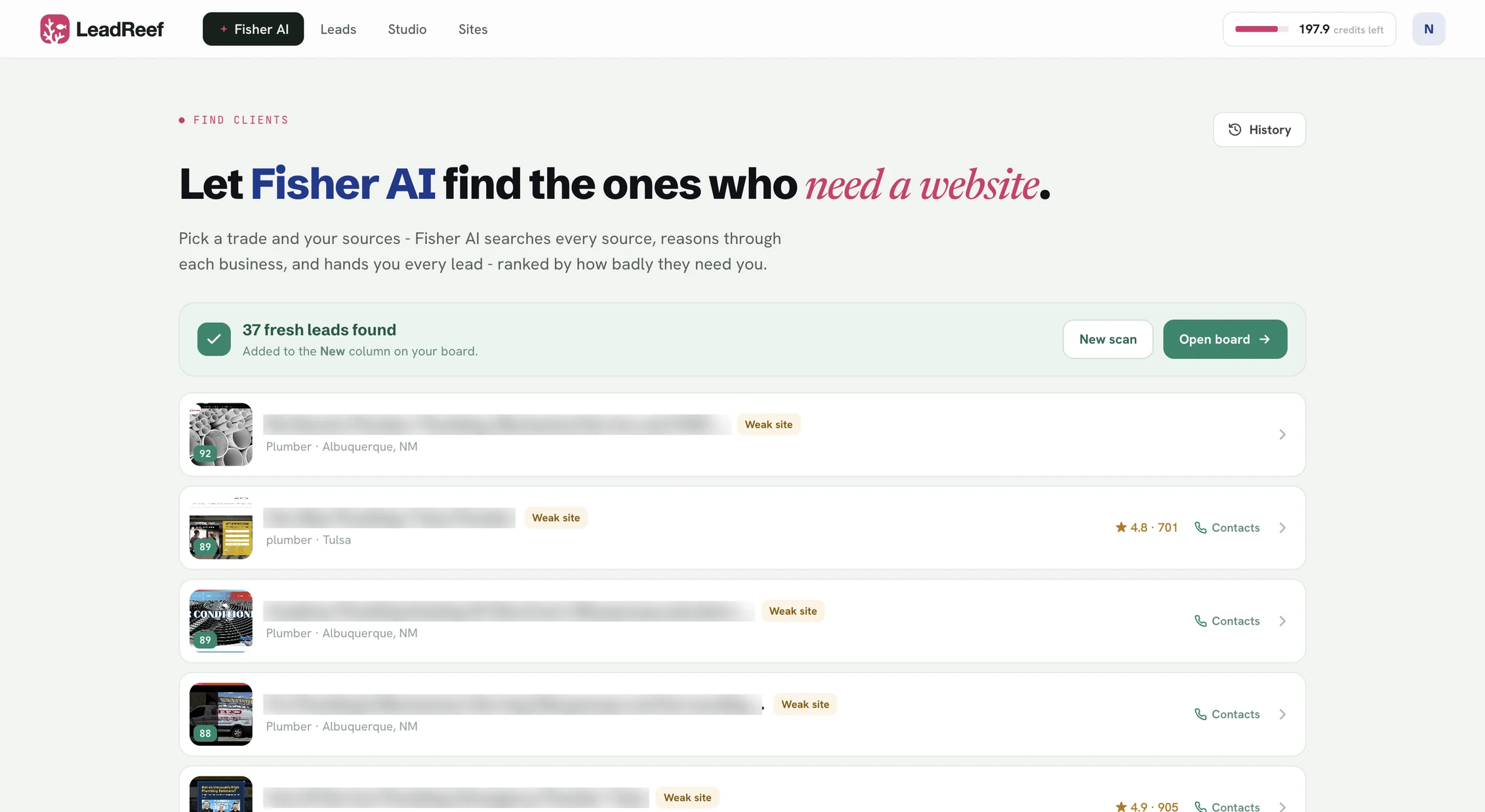
Every lead arrives with one opportunity score from 0 to 100 and plain-language problem labels across four categories — Visual, Mobile, SEO and Abandonment. Not a letter grade and not a Lighthouse number, but the sentence you can quote to an owner: Very outdated design. Broken on mobile. No SEO, invisible to search. Site won’t load, SSL error. Outdated copyright year. You see the reason, so you know what to open the conversation with.
Three places it looks. Maps on every plan, for fresh local listings. On the $39 Pro plan it adds Recent Ads — businesses already paying to get found, so they have a budget and a reason to care — and Open Web, failing sites that sit in no directory at all. Each surface answers a different prospecting question, and a tool that searches one surface can only ever return what that surface holds.
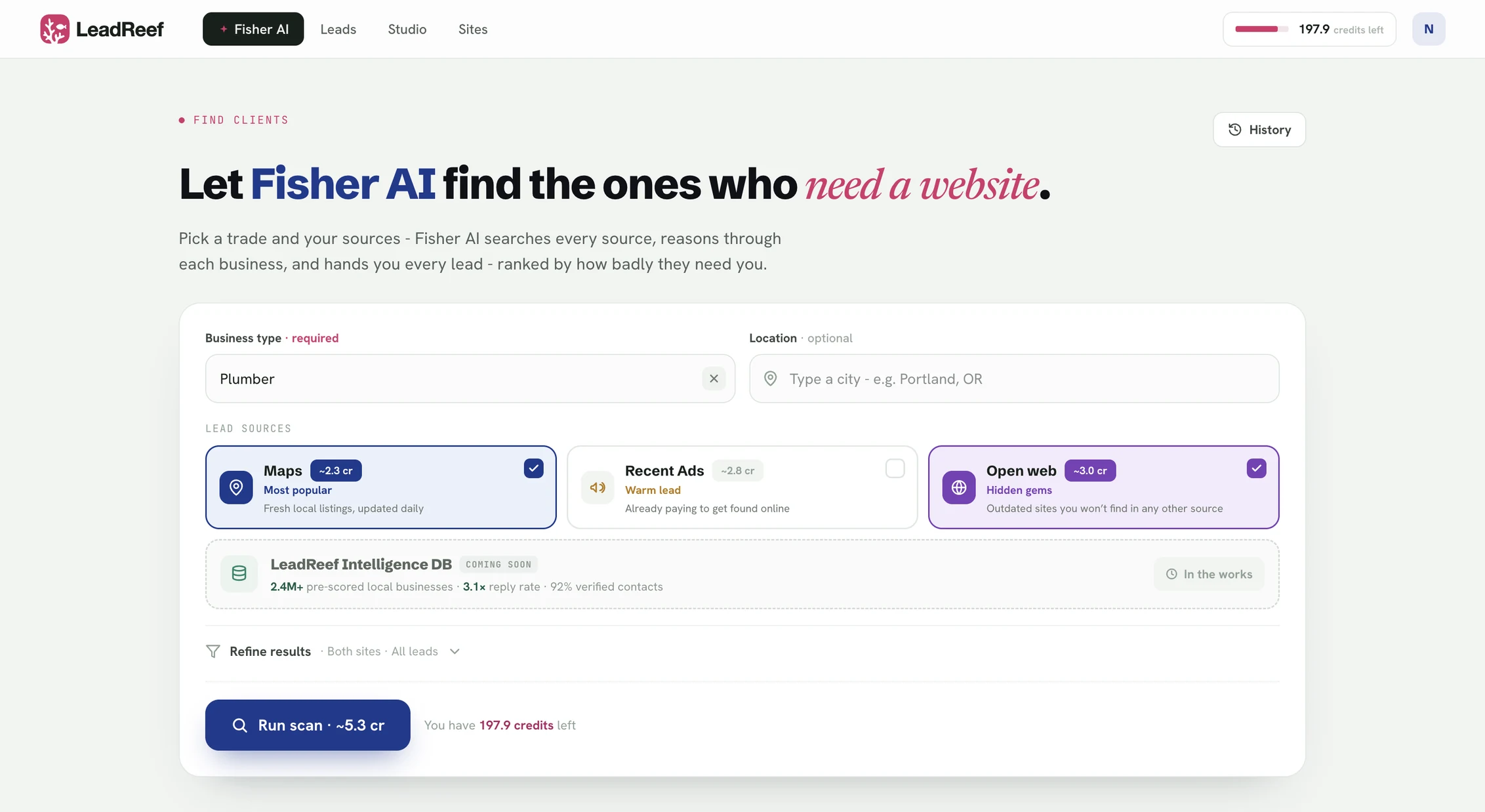
Then it builds the thing you actually pitch. One click turns a lead into a prototype landing page assembled from that business’s own material — its reviews, its photos, its hours, its phone number — not a template with the logo swapped. Alongside it come a cold email and an SMS drafted in your voice. LeadReef never sends either one. You read them, edit them, and send them yourself, so the relationship with that owner is yours from the first message.
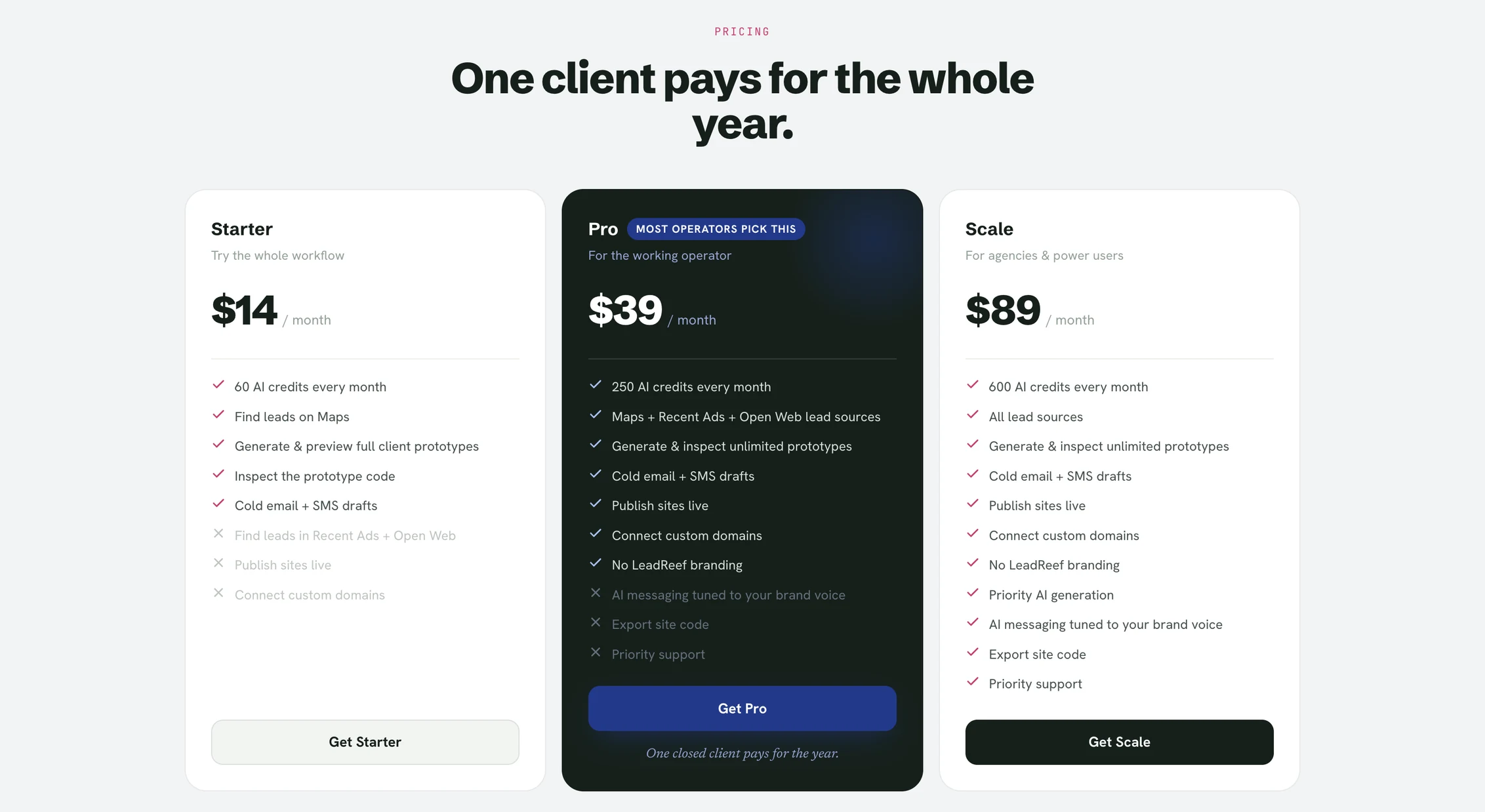
What it costs. One pool of credits funds everything — searching, building, drafting — at $14 a month for 60 credits on Starter, $39 for 250 on Pro, $89 for 600 on Scale. A credit is $0.10 of real AI cost with no markup on top. The Free plan is $0 and grants zero credits: it is a look-around, and we would rather say that than dress it up as a trial. One closed client covers the year.
One pool, not five buckets. Worth spelling out, because most tools here meter each action on its own line. Thyonix’s entry plan allows 400 leads but only 3 AI websites and 10 edits a month; LeadsByLocation’s $15 tier allows 25 searches; SiteDrop’s entry tier allows 5; WebLeadr sells leads in fixed packs of 50. Whichever quota empties first ends your month, however much of the others is left over. LeadReef has one balance and no per-action ceiling: spend it all on searching, all on building, or on editing the same prototype nine times. The month shapes itself around the work instead of the other way round.
What it looks like on one business
Take a pizzeria two towns over. Four and a half stars, three hundred reviews, open seven days — the business is working. The website was last touched in 2016: no HTTPS, the menu is a PDF, and on a phone the text is the size of an ant. Fisher AI surfaces it at an opportunity of 96 with four labels attached: very outdated design, broken on mobile, no HTTPS, not updated recently.
One click and Studio reads what the business already has — the review quotes, the food photos, the hours, the phone number — and builds a one-page site around them. A hero with a real dish on it, the menu as readable text instead of a download, a tap-to-call button, the best reviews as proof. Two minutes, start to finish.
The draft that comes with it opens on what is wrong, in the owner’s language rather than a developer’s: I noticed your site doesn’t work on phones, and that’s how most people find you. So I built you one that does — have a look. You edit it if you want, send it yourself, and the link opens a real page with their own food on it.
That is the whole difference. Every other tool on this page hands you a list, a score or a report, and the conversation still has to start with you asking an owner for something. This one starts it with you handing them something. Owners reply to that.
The ones that find and build
Two others also go past the list and generate something to show the owner. Neither judges the site the business already has, and neither writes the message that has to go with the page.
SiteDrop AI. A website builder for people who sell web work locally, with a lead finder that flags businesses with no site, from $25 a month. Its real edge is invoicing: you can bill a client without leaving the tool, which nothing else here does. What it does not do is judge the site a business already has, and it writes no outreach — so you still pick the targets and write the email yourself. Its entry tier also caps lead search at five searches a month. The full SiteDrop AI comparison goes deeper.
GetSiteFinder. Finds businesses without a real site, verified with live DNS, SSL and parked-domain checks combined into a presence score, then generates a multi-page site and publishes it to a custom domain, from $20 a month. Its live verification is the most thorough here, and the site it outputs is fuller than a prototype. It only looks for missing sites, though, so the larger failing-site pool never reaches you — and it drafts no outreach, so the page arrives with nothing to send it with. More in the GetSiteFinder comparison.
The ones that judge and report
These three judge the site a business already has, which is the right instinct — it is the larger and warmer pool. Then each one hands you a list or a branded PDF and stops. The building and the pitching are still yours, which is where the hours go.
Ugly Site Scraper. Audits existing sites with an AI quality score, screenshots and contact details, and lets you filter to the businesses that most need your offer, from $29 a month. It runs the deepest site-quality analysis of anything on this page, and it drafts a message plus a branded audit report — a genuinely strong research tool. But an audit report asks the owner to imagine the fix, and it builds no replacement page, so the most persuasive thing you could put in front of them is the one thing it does not produce. At $29 it is also the most expensive door here. The full Ugly Site Scraper comparison weighs it against a built prototype.
LeadsByLocation. Pulls from Google’s own business listings, flags the businesses with no site and the ones failing on mobile, attaches a PageSpeed score, and generates an audit PDF, from $15 a month. The PageSpeed signal and the clean, high-confidence data are real strengths, and the CSV export is tidy. Read the tiers before you judge the entry price, though: $15 buys 25 searches and nothing else, the audit PDF starts on the $79 plan and the white-label version on the $149 one. And it ends at that PDF — no page is built, no message is written, and PageSpeed alone says nothing about whether a site looks a decade old or whether the business is still trading. See the LeadsByLocation comparison.
WebLeadr. Grades each site A to F on health and 1–10 on design, flags whether a business has a real site or only a social page, and writes one outreach message per lead, on one-time packs from $14 for 50 leads with no subscription. The map-based area search and the pay-once model are genuinely good, and for a single short campaign it can cost less than a month of anything else. It builds no page, the grade is a letter rather than a reason you can quote to an owner, and when the pack runs out you buy another. More in the WebLeadr comparison.
The no-website finder
One tool here does only this, and does it cleanly. Worth knowing about if a plain list is genuinely all you want — though a no-website list is the smaller half of the opportunity, for reasons the missing-versus-failing section sets out.
NoSiteSearch. Finds local businesses that have no website today, scores each lead 1–10, and pings you with Slack and daily-digest alerts through a built-in CRM, from $19 a month. The real-time hot-lead alerts and the tight targeting loop are its strength, and the CRM means nothing gets lost. It looks only for missing sites, so every business with a bad one stays invisible to it, and it neither builds a page nor drafts a message — the alert tells you a name, and the work starts there. See the NoSiteSearch comparison.
The raw-data platforms
A different buyer entirely. These sell records, not judgement, and on breadth and price per record nothing here touches them. They are the right call if you already have a pipeline and only need data to feed it — and the wrong one if you wanted the pipeline.
Outscraper. A business-data and enrichment platform: scrapers across map listings and many other sources, with an API and prepaid credits that do not expire, priced by usage from $3 per 1,000 records and the first 500 free. Its breadth and developer pipeline are things no find-and-build tool can match, and if you are building your own stack it is the obvious choice. It makes no judgement at all, though: you get every business, not the ones worth pitching, and the qualifying, the building and the writing are all still ahead of you. See the Outscraper comparison.
Targetron. A filterable global business directory with contacts and bulk export in CSV, XLSX, JSON and Parquet, plus an API, priced by usage from $15 per 1,000 records with 50 free each cycle. Cheap bulk records in developer formats, with responsive support, is a real strength. Like Outscraper it is data only — no score, no page, no message — so it answers "who exists here", not "who needs me". More in the Targetron comparison.
Missing sites vs failing sites
Now the widening. Most of the tools above answer one question well: which businesses have no website at all. It is a clean yes or no, and it is the query most people type. But it is also the smaller pool, and the colder pitch, because the owner never wanted a site in the first place.
The larger pool is every business whose site exists and is failing them: outdated design, broken on mobile, invisible in search, slow to load, insecure. That owner already paid for a site once and believed in having one, so the conversation is warmer: you are not selling them the idea of a website, you are showing them the one they already wanted. Ugly Site Scraper, LeadsByLocation and WebLeadr judge existing sites too — the instinct is not ours alone.
What none of them does is close the loop. Judging a site tells you who to call; it does not give you anything to show when they pick up. That is the gap LeadReef is built across, and it is why the score comes with the prototype and the prototype comes with the message.
How much larger is the failing pool? Our own analysis of local businesses across 46 categories is what tells us it dwarfs the missing one — in most trades, for every business with no website at all there are several more whose site is actively costing them customers. We publish the finding, never a business paired with it.
Which one should you pick
These are not really the same product, so here is the honest routing.
If you want to turn a search into a sent pitch on the same evening, LeadReef. It is the only tool here that judges the existing site, builds the replacement page from that business’s own reviews and photos, and writes the email and SMS to send it with. Everything else stops earlier and hands the rest back to you.
The narrower cases, plainly: if all you need is a raw exportable list or an API to feed a pipeline you have already built, take Outscraper. If you want one short campaign with no subscription at all, buy a WebLeadr pack once. If a plain no-website list with Slack alerts is genuinely the whole job, NoSiteSearch does exactly that. And if what you sell is the audit itself — a branded PDF the owner pays you to read — Ugly Site Scraper runs the deepest one here.
How we compared
Every fact about another tool came from that tool’s own live pages, linked in the section where it is used. We checked each entry price, whether a free tier or a signup-free path exists, whether the tool finds missing sites or judges existing ones, whether it builds a page, and whether it drafts outreach. We did not buy any of them or screenshot their interiors. This is a selection, not the whole category: tools come and go, and there are others we have not covered here. Prices move, and usage-based and non-dollar prices move most, so if a number here ever looks off, the tool’s own live page is the one that wins. Our own figures come from LeadReef’s public pricing.
One footnote, since it is a fact about us rather than a pitch: LeadReef runs a referral program with a recurring commission and a 6-month attribution window, which matters only if you end up recommending your stack to other freelancers. The partner page has the details.
Frequently asked questions
What is the best tool to find local businesses without a website?
It depends on where you want to stop. For a plain list of businesses with no site, NoSiteSearch is built for exactly that. If you want the finding plus a built page and a drafted pitch in one place, LeadReef goes furthest: it scores each lead 0 to 100, builds a replacement prototype from the business’s own reviews and photos, and drafts the cold email and SMS you send. SiteDrop AI and GetSiteFinder also build a page, but neither writes the outreach.
How do I find businesses whose website is out of date, not just missing?
Most tools in this category filter on a yes-or-no field: does this business have a website. To find the far larger pool whose site exists and is failing them, you need a tool that judges the site itself. LeadReef, Ugly Site Scraper, LeadsByLocation and WebLeadr all do. LeadReef reports it as a single opportunity score from 0 to 100 plus plain-language problem labels across four categories — Visual, Mobile, SEO and Abandonment — and only surfaces businesses that are still trading.
Which of these builds the website for the prospect?
SiteDrop AI, GetSiteFinder and LeadReef build a page or preview for the prospect. Ugly Site Scraper, LeadsByLocation, WebLeadr, NoSiteSearch, Outscraper and Targetron stop at a list, a score or an audit report. Only LeadReef builds that page from the business’s own reviews, photos and hours and pairs it with a drafted email and SMS.
Which of these is the cheapest?
Of the tools on this page, WebLeadr is the cheapest one-off at $14 for 50 leads with no subscription. Among the monthly subscriptions here, LeadReef is $14, LeadsByLocation $15, NoSiteSearch $19, GetSiteFinder $20, SiteDrop AI $25 and Ugly Site Scraper $29. Outscraper and Targetron price per record instead. This page does not cover every tool in the category, so cheaper options exist outside it.
Do any of these have a free tier?
Some. Outscraper and Targetron both include a small block of free records before you pay. LeadReef has a Free plan at $0, but it grants 0 credits, so it is a look-around rather than a working free tier — finding and building both spend credits.
Does LeadReef send the cold emails for me?
No. LeadReef never sends anything. It drafts a cold email and an SMS in your voice; you read them, edit them and send them yourself, so the relationship with that business owner stays entirely yours from the first message.
How long does it take to go from a search to something I can send?
On LeadReef, about two minutes: pick a city and a trade, get a scored list, click one lead, and the prototype page and the drafted email and SMS are built for you. Every other tool on this page ends earlier — at a list, a score or a PDF — so the build and the writing are still ahead of you.
Can I get a raw exportable list or an API instead?
Yes, but not from LeadReef. Outscraper and Targetron are raw-data platforms with per-record pricing and an API, built to feed a pipeline you have already built. LeadReef is the opposite shape: it hands you a judged lead, a built prototype and a drafted pitch rather than rows to process.
Pick a city and a trade tonight and you can be looking at a scored list of local businesses whose sites are failing them inside a minute — then at a finished page for one of them, with the email to send it already written. That is the whole loop, and it starts at $14. Create your LeadReef account and run the first scan. Straight about the Free plan, because you will find out anyway: it is $0 and grants zero credits, so it is a look-around rather than a trial — finding and building both spend credits, which start on the $14 Starter plan. One closed client covers the year.