
Ugly Site Scraper vs LeadReef: an audit report, or a page they can open?
Prices and features for both products come from their own live pages.
If you sell websites to local businesses, the pitch lives or dies on what you put in front of the owner. Ugly Site Scraper and LeadReef both find businesses with failing sites, both judge those sites, and both hand you something to send. They part company on that last thing.
This is our page, so here is the bias up front: we think LeadReef is the better pick for most people doing this work. We will also hand Ugly Site Scraper the one thing it clearly does better, because it is true and the page is worthless without it. What is left after that is a single difference, and it is the one that tends to close the deal.
Here is the shape of it before the detail.
| Feature | LeadReef | Ugly Site Scraper |
|---|---|---|
| Entry price | $14/mo, Starter | $29/mo, Starter |
| Free plan to look around | Yes. $0, 0 credits | No free tier or trial |
| Judges the existing site | Yes. 0–100 opportunity score, plain problem labels | Yes. The deepest analysis in this set |
| Builds the prototype | Yes, a full prototype page | No. Analysis only |
| Drafts the outreach | Yes. Cold email and SMS you send | Yes. Messages and a branded audit report |
| Recurring partner commission | Yes. Recurring, 6-month attribution | None publicly offered |
| Lead sources | Three: Maps, Ads, Open Web (last two on Pro) | One: Maps |
| Best for | Freelancers who want a built prototype and a drafted pitch at the lowest entry price | Sellers who lead with the deepest site audit and a branded report |
What Ugly Site Scraper is
Ugly Site Scraper is a prospecting tool for people who sell web work. It crawls Maps for local businesses, then runs each one through a deep read of its current site. It reads the platform the site is built on, when it was last updated, how it ranks in search, and what its reviews say, and it keeps a screenshot. All of that rolls into an AI quality score that flags outdated design, bad SEO and poor reviews. From there it writes one-click outreach messages. It can also produce a branded audit report with your logo, to use as a closing document.
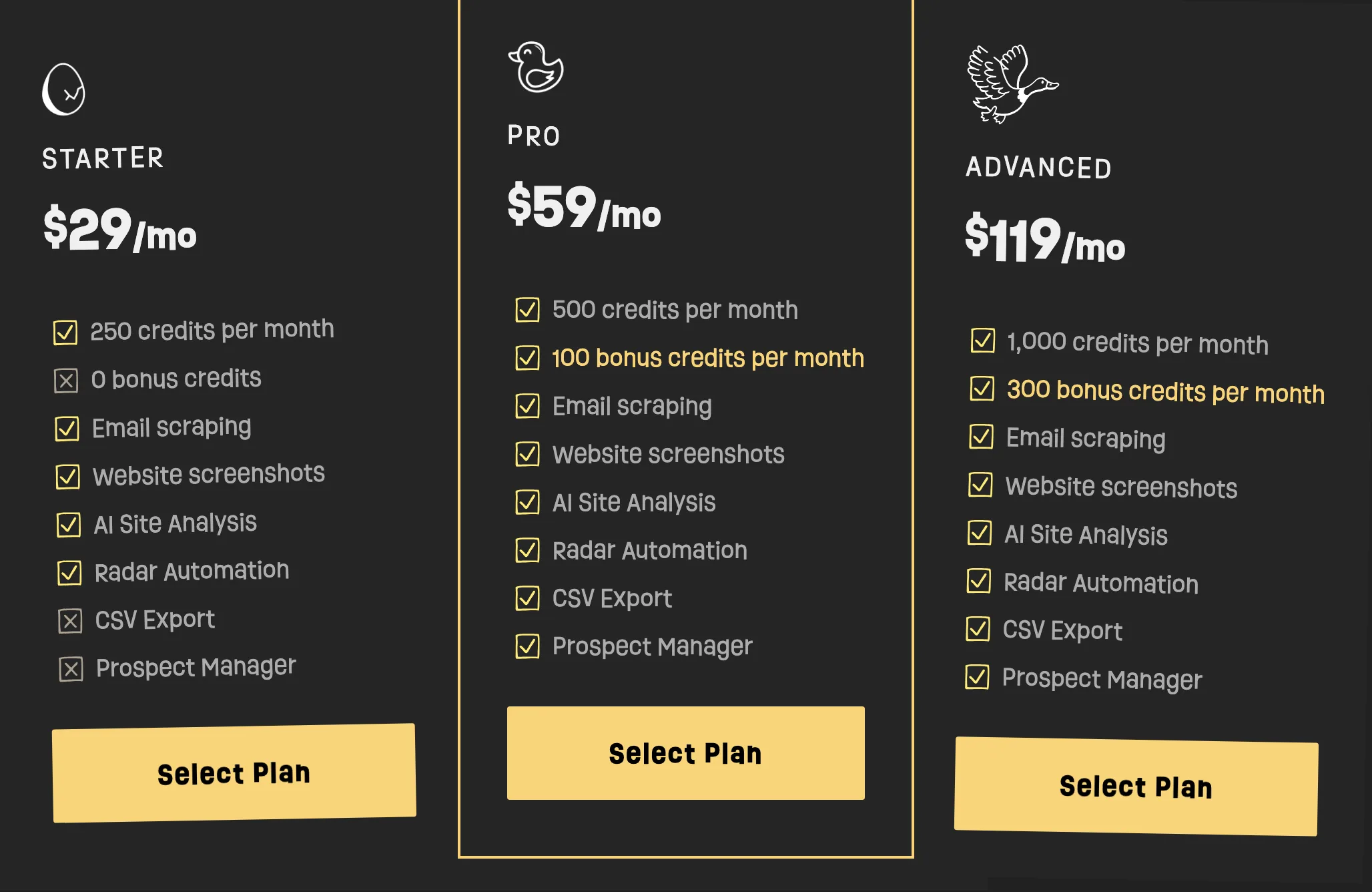
Its plans are $29, $59 and $119 a month, or 40% less paid a year at a time. The credits run 250, then 500 plus a 100 bonus, then 1,000 plus a 300 bonus. One credit buys one business, with its contact info, a screenshot and a quality score. CSV export starts on the $59 Pro plan. Their pricing page lists three paid plans and no free tier or trial, so the cheapest way in is $29 a month.
What Ugly Site Scraper does better
Give Ugly Site Scraper its due, because this part is real: it runs the deepest site analysis of any tool in this comparison. It looks harder at a prospect’s current site than LeadReef does, and rolls what it finds into a single quality score. That is more raw signal about the site than LeadReef puts on screen, and if a thorough teardown of what is wrong is the thing you are buying, Ugly Site Scraper gives you the most of it. We are not going to pretend otherwise.
It also drafts outreach, the same as we do: one-click messages, plus that branded audit report to attach. So the drafting is not where these two products separate. Neither is the judging. The one place they separate is what the prospect actually receives.
Where LeadReef takes a different path
What Ugly Site Scraper hands the prospect is a report about their website. What LeadReef hands them is the website: a prototype, a designed replacement page built from that business’s own reviews and photos, that the owner can open and react to before paying anyone.
A report tells an owner their site is bad. Most of them already suspect that. A prototype shows them a modern version of their own site, their name and their photos already in place, and that is a different conversation. One asks the owner to agree with a critique. The other asks them to react to a finished thing. The second is a much shorter distance to a yes, which is why the prototype sits at the centre of LeadReef and the audit report is the end of the line at Ugly Site Scraper.
LeadReef’s read of the current site surfaces as one number you can act on: an opportunity score from 0 to 100, plus plain problem labels. The labels cover four things you can see on every lead. How the site looks. How it works on a phone. Whether search can find it. And whether it has been left to rot. Then Fisher AI builds the prototype and drafts the cold email and the SMS. LeadReef never sends anything. You send them yourself, so the relationship stays yours.
Fisher AI also looks wider for the businesses in the first place. It searches three surfaces where Ugly Site Scraper searches one. Maps is on every plan. On Pro and Scale, Ads adds businesses already paying to get found, and Open Web reaches failing sites that sit in no directory at all.
A worked example
Say you work home services around Denver. You search Fisher AI for plumbers and a ranked list comes back, each row with a 0-to-100 score and the problems on its current site. You stop on a busy shop. Strong reviews, a site years out of date. Pointed at that same shop, Ugly Site Scraper would hand you a polished audit: the platform, the last-update date, the SEO gaps, a screenshot, your logo across the top.
LeadReef hands you a rebuilt landing page for that plumber, made from their own reviews and photos, with a cold email and a text to go with it. You send the email with a link. The owner opens it and sees their own business, redone, instead of a list of its faults. Both of you skipped straight past the part where they have to imagine it.
The prices, side by side
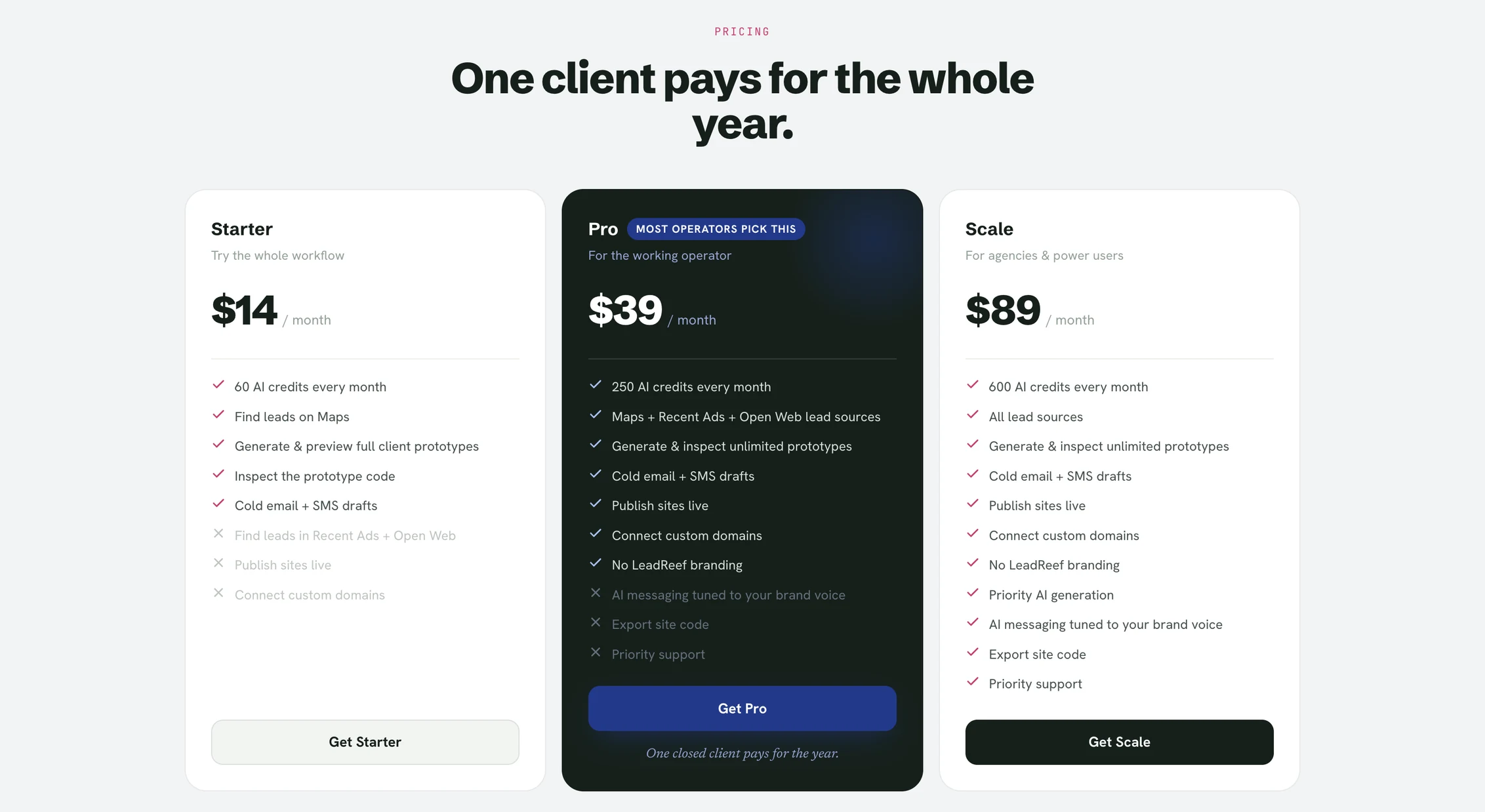
Both at list price, in US dollars. LeadReef’s free plan is zero credits, a look-around rather than a working tier, so real work starts on Starter at $14 a month. Ugly Site Scraper’s cheapest paid plan is $29, or $17 a month if you commit to a year up front. Neither of us has a free working tier; the entry gap is the plainest number here.
Who should pick which
Pick LeadReef if you want to put a built page and a drafted message in the owner’s hands at the lowest entry price, and a scored, labelled read of the site is enough to tell you who to pitch first. It fits the freelancer whose bottleneck is the reply, not the depth of the teardown.
Pick Ugly Site Scraper if the deepest possible analysis of the current site is the point, and a branded audit is your closing document. If you sell on the strength of the teardown itself, they give you more of it than we do.
LeadReef also runs a referral program with a recurring commission, which matters if you are the kind of freelancer who ends up recommending your stack to other freelancers. There is a partner page if that is you.
What it comes down to
Both tools find failing local sites, judge them, and draft you something to send. Ugly Site Scraper judges deeper and hands the prospect an audit of their website; LeadReef hands them the website, a prototype they can open before paying anyone. An audit argues that the site is bad; a prototype shows what a better one looks like with their name on it. LeadReef also starts at $14 against $29. If the deepest read of a site is the thing you sell on, that depth is Ugly Site Scraper’s, and it is real.
How we compared
Everything here about Ugly Site Scraper was read straight off their live pages, the pricing page and their home page. We checked the plan prices, the credit allowances, what the analysis covers, whether it builds anything, whether it drafts outreach, whether a free tier exists, and whether they publish a referral program. We did not buy their product or screenshot its interior. Prices move, so if a number here ever looks off, their own live page is the one that wins. Our own figures come from LeadReef’s public pricing. We run the same head-to-head against other tools in this space; if SiteDrop AI is also on your list, our SiteDrop AI comparison weighs it the same way.
Frequently asked questions
Is LeadReef a good Ugly Site Scraper alternative?
If you pitch web work to local businesses, yes. Both find failing local sites, judge them, and draft you something to send. LeadReef adds the part Ugly Site Scraper does not: it builds the replacement prototype the owner can open. It starts at $14/mo instead of $29.
Ugly Site Scraper vs LeadReef: what is the real difference?
Ugly Site Scraper runs the deeper site analysis, and both tools draft outreach, so neither of those is the difference. The difference is what the prospect gets: Ugly Site Scraper hands them an audit report about their website, LeadReef hands them a built prototype of a better one, plus a cheaper entry price.
Does Ugly Site Scraper build a website?
No. It analyses a prospect’s existing site and drafts outreach messages and a branded audit report; it does not build a replacement. LeadReef builds a prototype landing page from the business’s own reviews and photos.
Does LeadReef send the messages for me?
No. LeadReef drafts a cold email and an SMS in your voice, but you send them yourself. The relationship with the business stays entirely yours.
Which is cheaper, LeadReef or Ugly Site Scraper?
LeadReef starts at $14/mo (Starter) versus Ugly Site Scraper’s $29/mo (Starter). LeadReef also has a $0 look-around plan; Ugly Site Scraper has no free tier.
If you want to see a scored lead and a built prototype with your own eyes, you can create a free LeadReef account and look around. It costs nothing and includes zero credits, so finding and building need a paid plan, but you are not charged until you actually run something.