
WebLeadr alternative: the website grade, or the page itself?
The prices and features for both products are taken from their live pages.
WebLeadr and LeadReef share more ground than most rivals in this space. Each surfaces local businesses with weak sites, each grades the site, and each drafts the outreach. WebLeadr rolls all of that into a cheap one-time buy. If you are weighing up a WebLeadr alternative, the real question is a narrow one, and it turns on what the owner ends up actually seeing.
Since this is our own page, let us name the bias right away. WebLeadr is a fully loaded lead pack, and on price and export it comes out ahead of us, as we will demonstrate. The single thing it never produces is the page itself. LeadReef builds that better site as a prototype, and that is where the two part ways.
The short answer: WebLeadr grades the site, rates the design and drafts a message, sold in one-time packs from $14 for 50 leads. LeadReef scores and drafts as well, then builds the prototype page the owner can open, from $14 a month. And you can try LeadReef free before buying either one.
The side-by-side comes first, then the argument behind each line.
| Feature | LeadReef | WebLeadr |
|---|---|---|
| Pricing model | A monthly plan whose credits reset every cycle | Buy-once packs, no recurring bill; $14 for 50 leads, $24 for 100 |
| Free way to try it | Yes. First 10 leads free, no card | No free tier listed; first purchase throws in 10 bonus credits |
| Judges the existing site | Yes. A 0–100 opportunity score with clear problem tags | Yes. A health grade from A to F plus a 1–10 design score |
| Builds the prototype | Yes, an actual prototype page | No, it only sources and scores them |
| Drafts the outreach | Yes. A cold email and SMS for each business | Yes. One AI-written message for every lead |
| Contacts and bulk export | Contacts are visible, but no bulk export | Phone, email and social; export to CSV, Excel, PDF, JSON |
| Lead sources | Three, named: Maps, Recent Ads, Open Web (the last two on Pro) | Search by location, but the source is never named |
| Recurring partner commission | Yes. It recurs, with 6-month attribution | Nothing offered publicly |
| Best for | Sellers after a built page and a steady stream of leads | Sellers after a cheap, one-off batch of scored leads |
What WebLeadr is
WebLeadr is a lead pack aimed at people who sell websites. Search a location and it hands back local businesses whose sites are weak or missing. Each gets a health grade from A to F spanning SSL, SEO basics, speed and mobile readiness, plus a 1 to 10 design score from AI vision. It gathers the phone, email and social profiles, drafts a tailored outreach message for every lead, and exports the whole set to CSV, Excel, PDF or JSON. It is all laid out on their site.
WebLeadr is priced in one-time packs rather than a subscription. Starter runs $14 for 50 leads, Growth is $24 for 100, and the credits remain as long as your account is active. Your first purchase tacks on 10 bonus credits. There is no monthly bill at all. The figures sit on their home page.
Where paying once beats a subscription
WebLeadr crams a lot into a single cheap purchase, and it shows. The pricing is the first win. You buy a pack once, $14 for 50 leads with 10 bonus credits the first time, and no recurring charge lurks in the background. For a seller chasing one burst, that clears a lower bar than any subscription. The scoring is thorough as well, an A to F health grade and a design score together in one place. It drafts the outreach message for you, and it exports to four formats while we export to none. If your job is to grab a batch, score it, and pass it on, WebLeadr is made for that.
What a subscription buys instead
What LeadReef is left with is the page. Only the page. WebLeadr grades the site and drafts the message, then halts. LeadReef builds a prototype of the improved site, pulled from the business’s own reviews and photos, and drafts a cold email and an SMS to go out with it. LeadReef never sends anything. You send it, so the relationship stays with you. A score tells the owner what is broken. A prototype shows them what right actually looks like.
The scoring and the drafting land close to a draw, and we will not pretend they do not. Both tools rate the site, and both write a first message. Where LeadReef reaches further is in the finding. WebLeadr searches by location but never says from where. LeadReef names all three: Fisher AIsearches Maps on every plan, and on Pro and Scale it adds Recent Ads, for businesses already paying to be found, and Open Web, for failing sites listed in no directory. Two caveats, said plainly. LeadReef has no bulk export and no one-time pack, and pushing the prototype to a live URL is a Pro feature. On price and export, WebLeadr takes it.
A lead, from list to sent email
Suppose you turn up a nail salon with a slow, dated site. WebLeadr grades it a D, rates the design a 3, grabs the owner’s number and email, drafts a message, and lets you export the row four ways, all out of a $14 pack. That is plenty for the money. The one thing it will not do is build the salon a better page. The owner walks away with a grade and a note, not a glimpse of the fix.
With LeadReef you come away with a prototype of that salon’s page, built from their reviews and photos, alongside a cold email and a text drafted to match. You tweak a line and hit send. The owner clicks a link to their own salon, reworked. One tool reads out the score. The other puts the site in front of them.
The scoring side is simple to test against WebLeadr’s grades in your own market: run a LeadReef search for a trade you know well.
Packs against plans
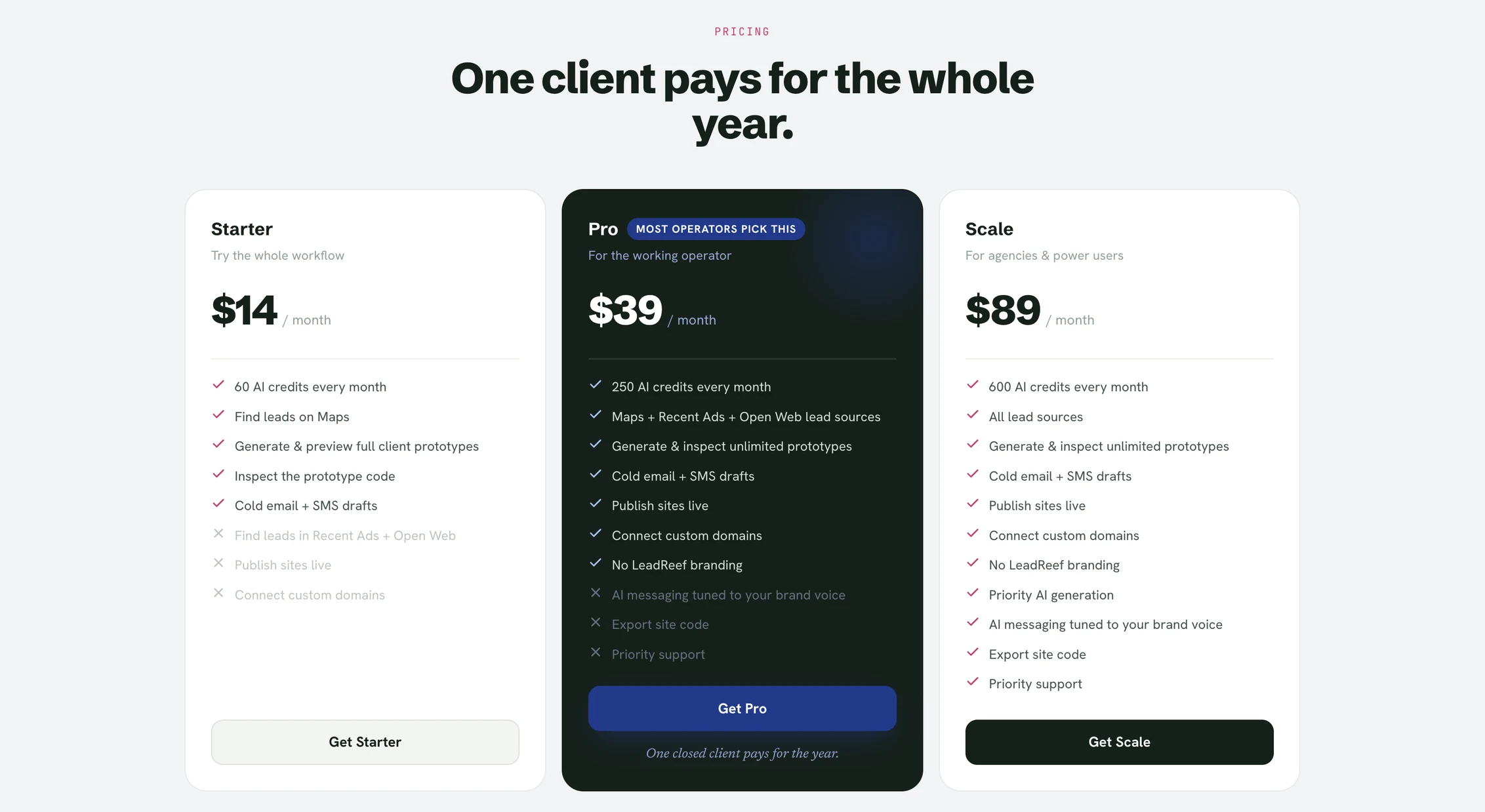
The two run on different clocks. WebLeadr is a one-time buy, $14 for 50 leads or $24 for 100, with no subscription, and the first pack comes with 10 bonus credits. LeadReef is $14 a month, and the credits reset each cycle. Before you spend on either, LeadReef’s first 10 leads are free; WebLeadr lists no free tier. For one short campaign, WebLeadr can be cheaper and asks for no commitment. For steady work, the subscription keeps topping up and folds in the prototype WebLeadr never builds. Choose the clock that matches how you sell.
Which money model suits you
Pick LeadReef if you want to put a built page in front of the owner and you hunt for leads constantly. It scores the lead, builds a prototype, and drafts the cold email and SMS, for $14 a month, across three named sources on Pro. It suits the seller whose edge is a strong pitch, repeated week after week.
Pick WebLeadr if you want a cheap, one-off batch of scored, written, exportable leads with no subscription. On that front it outdoes us, and for a quick campaign it can be exactly the right call.
LeadReef also runs a partner program paying a recurring commission, which counts if you wind up pointing other freelancers at your stack. There is a partner page if that is you.
In one line
These two line up on most of the work: both find weak-site businesses, grade them, and write the first message. WebLeadr does it as a one-time pack, cheaper at the outset, with four export formats included. LeadReef adds the one thing WebLeadr never produces, a built prototype of the site done right, from a broader set of sources, on a plan that keeps refilling. A grade and a message spell out the problem; a prototype is the owner staring at the answer. If what you need is a cheap, no-commitment batch of scored and written leads, WebLeadr is built for precisely that.
How we verified this
The WebLeadr details here are drawn directly from their live pages, chiefly their home page, where the packs, prices and features are laid out. We confirmed the one-time pricing and first-purchase bonus, the A to F and design scoring, the AI-written messages, the contacts and four-format export, and that it builds no page. Their lead source is never stated, so we say as much rather than guess. No WebLeadr pack was bought for this. Prices shift, and wherever one here looks wrong, WebLeadr’s own page is the one to believe. On our side, the numbers are LeadReef’s public prices. To weigh WebLeadr against the full category, read our comparison of tools to find local businesses to pitch too.
Common questions
Is LeadReef a good WebLeadr alternative?
Yes, if what you want is to put a finished page in front of the owner rather than just a grade and a message. Each tool scores the current site and each drafts the outreach. WebLeadr moves one-time lead packs with deep export options; LeadReef assembles a prototype and bills monthly, from $14 up against a $14 one-time pack.
WebLeadr vs LeadReef: what is the real difference?
It comes down to the page. WebLeadr, sold in one-time packs, hands the site a grade from A to F, rates the design 1 to 10, produces an AI message per lead and exports to CSV, Excel, PDF or JSON, yet never builds a page. LeadReef assembles a prototype and drafts both the email and the SMS, drawing on three sources (Recent Ads and Open Web on Pro), all on a subscription.
Does WebLeadr build a website?
No. It grades the current site A to F, rates the design 1 to 10 and drafts a message, but building the replacement falls to you. LeadReef spins up a single-page prototype from the business’s own reviews and photos, then drafts the pitch to accompany it, so the owner is shown a page rather than a grade.
Does WebLeadr write outreach messages?
Yes. It produces an AI message for every lead, so when it comes to drafting the two tools are level. LeadReef writes a cold email and an SMS for each business, and what really sets it apart is the built prototype that ships alongside them. LeadReef never sends a thing; you send every message on your own.
Which is cheaper, LeadReef or WebLeadr?
Their pricing works on different terms. WebLeadr is a one-off buy, $14 for 50 leads or $24 for 100; LeadReef runs $14 a month. For a single push WebLeadr may come out cheaper; for continuing work the subscription tops up credits and bundles in the prototype. WebLeadr lists no free tier, whereas LeadReef’s first 10 leads cost nothing.
Can I try LeadReef free?
Yes. Your first 10 leads are free with no card required, spanning 10 business types across 10 cities. The prototype and the drafted cold email and SMS call for a paid plan, from $14 a month. WebLeadr lists no free tier; the cheapest way in is the $14 one-time pack, plus 10 bonus credits.
The quickest way to judge any of this is on your own market. Run a free LeadReef search: pick one of 10 business types and one of 10 cities, and your first 10 leads cost nothing, no card needed. Paid plans open every business type in any city you choose.