
SiteDrop AI vs LeadReef: which one actually hands you the pitch?
Prices and features for both products come from their own live pages.
If you sell websites to local businesses, the building was never the hard part. Finding an owner who will listen is. So is giving them a reason to reply before they hang up. SiteDrop AI and LeadReef both promise to help with that, and they go about it in nearly opposite ways.
This is our page, so here is the bias up front: we think LeadReef wins for most people doing this work. We will also say the one thing SiteDrop clearly does better, because it is true and because a page that admits nothing is not worth reading. Both tools can generate a page for a business. The question that decides it is what you can actually put in front of the owner, and whether it is finished.
Here is the shape of it before the detail.
| Feature | LeadReef | SiteDrop AI |
|---|---|---|
| Entry price | $14/mo, Starter | $25/mo, Starter |
| Free plan to look around | Yes. $0, 0 credits | No free tier or trial |
| Judges the existing site | Yes. 0–100 opportunity score, plain problem labels | Limited. Flags no-website leads; 5 searches/mo on entry |
| Builds the prototype | Yes, a full prototype page | Yes, AI website generation |
| Drafts the outreach | Yes. Cold email and SMS you send | No outreach drafting |
| Built-in invoicing | No | Yes, from the Starter plan |
| Recurring partner commission | Yes. Recurring, 6-month attribution | None publicly offered |
| Lead sources | Three: Maps, Ads, Open Web (last two on Pro) | One lead search; sources not published |
| Lead searches on the entry tier | Shared credit pool; no fixed monthly cap | 5 per month, up to 50 results each |
| Best for | Freelancers who want a judged lead, a ready prototype and a drafted pitch at the lowest entry price | Operators who want site-building and invoicing in one place |
What SiteDrop AI is
SiteDrop AI is a website builder for people who sell web work to local businesses. Its Lead Finder searches a category in a city and returns verified phone, address and website data, flagging the businesses with no website as the warmest prospects. Its generator then builds an AI website for the business. It also bills: invoicing is baked into the product, which is unusual in this category.
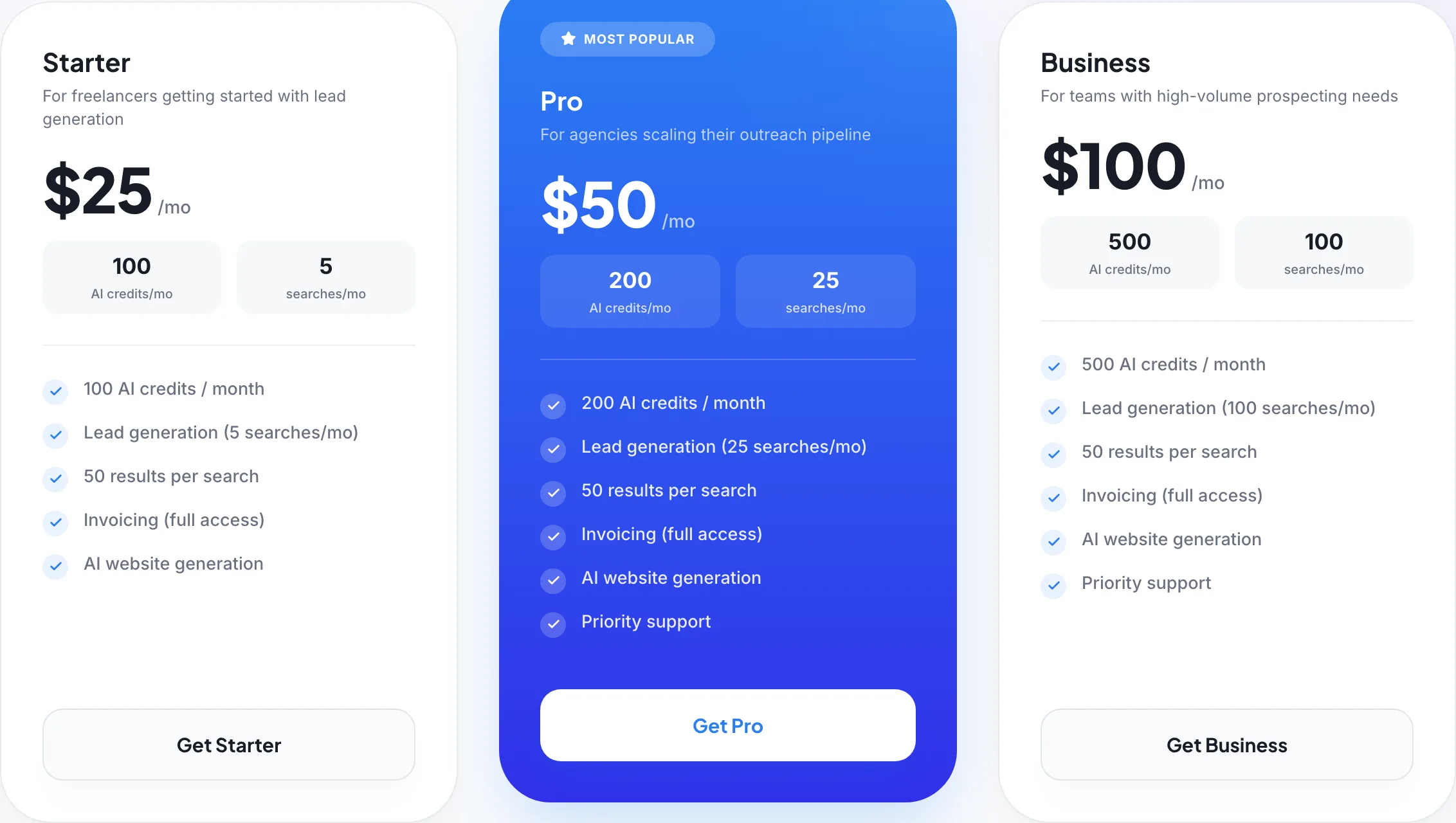
The plans are $25, $50 and $100 a month. Each caps the lead search at 5, 25 and 100 searches, at up to 50 results per search, with 100, 200 and 500 AI credits attached. There is no free tier and no trial. The cheapest way in is $25 a month, taken from their pricing page.
What SiteDrop AI does better
Give SiteDrop its due. Invoicing is built in, from the cheapest plan up, and you can send a client an invoice without leaving the tool. If the shape of your business is one login that carries you from finding a lead all the way to getting paid, that is a real advantage. LeadReef does not have it. We hand you the prototype and the drafted message, then get out of the way, and the invoice happens in whatever you already use. That is a fair reason to choose SiteDrop, and we would rather write it down than hope you miss it.
Where LeadReef takes a different path
SiteDrop is a builder with a finder attached to it. LeadReef runs the other way. The thing you put in front of an owner is a prototype: a designed replacement for their landing page, built from the reviews and photos already on their business listing, ready to open and judge before anyone pays a cent.
That order is the whole point. Tell an owner you can build them a better website and you are asking them to imagine it and to trust you. Send a link to a page that already shows their business, their photos, their five-star reviews, laid out the way a site made this year would be, and you are asking for something much smaller. A reaction. People react faster than they imagine, which is why the prototype sits at the front of LeadReef and not the end.
One pipeline gets you there. Fisher AI finds local businesses whose current site is failing them: outdated design, broken on mobile, invisible in search, slow, insecure. It searches three surfaces, and each answers a prospecting question a single-surface competitor cannot. Maps returns fresh local listings on every plan. On Pro and Scale, Ads adds businesses already paying to get found, so their budget and intent are proven, and Open Web reaches failing sites that sit in no directory at all. Every lead carries a single opportunity score from 0 to 100 and a set of plain problem labels, so you work down from the worst sites instead of opening each result to check. Then it writes the prototype and drafts a cold email and an SMS for you to send.
LeadReef never sends anything. You send the email and the text yourself, from your own address and number, so the relationship stays yours.
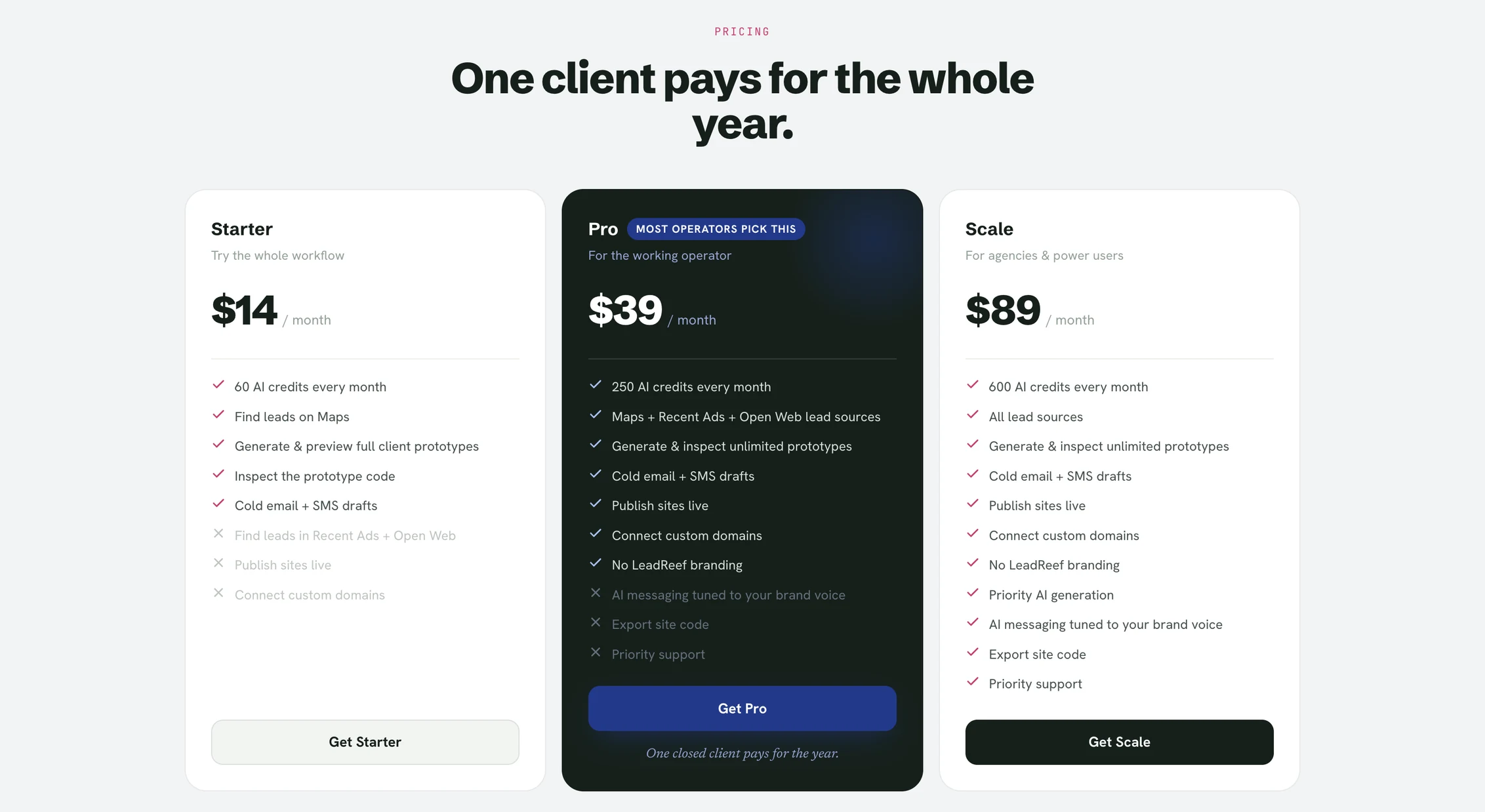
A few things are worth knowing before the free plan disappoints anyone. Credits are the unit of work. A search runs about two credits per source, and a build needs credits sitting in your balance; the button tells you when there are not enough. The free plan grants zero credits, which is why it is a look-around and nothing more. Two honest limits sit on top of that: the drafts come in a single house voice unless you pay for the $89 Scale plan, and publishing the prototype to a live URL the owner can click is gated to Pro. None of this is buried in the app. It is just easier to read now than to hit later.
A worked example
Picture a concrete run. You sell to home-services businesses around Denver, so you open Fisher AI and search Denver plumbers. A ranked list comes back. Each row shows the rating, the review count, the state of the current website and the opportunity score. The low scorers you ignore, because a plumber with a quick, modern site is not a prospect. You stop on one near the top: hundreds of reviews, a strong rating, and a site scoring high because it is years out of date and hard to use on a phone. Busy business, bad website. That is the lead you want.
You open it and LeadReef builds the prototype: a landing page for that plumber, drawing on their own reviews and the photos from their profile, in a layout from this decade rather than the last. Beside it sit a cold email and a text, written for this business, pointing at what is wrong with the current site without being rude about it. You edit one line so it sounds like you, then send it. The owner taps the link and sees their own shop, rebuilt. There is nothing hypothetical left for them to picture.
The prices, side by side
Here are both products at list price, in US dollars. LeadReef’s free plan is genuinely zero credits, worth repeating because it surprises people: you can sign up and look around, but finding and building both cost credits, so real work starts on a paid plan. That plan is Starter, at $14 a month. SiteDrop’s cheapest paid plan is $25. The gap at the front door is the plainest number on this page.
Who should pick which
Pick LeadReef if what you want at the end is a finished pitch: a scored lead, a built prototype, and a cold email and SMS ready to send, at the lowest starting price in this set. It fits the freelancer whose hard problem is the first reply, and who already has a way to bill.
Stay with SiteDrop AI if invoicing under the same roof matters to you more than the opportunity score or the drafted outreach, and paying more at the entry tier to get it is a trade you would make.
One aside for a certain reader. LeadReef also runs a referral program with a recurring commission, which matters mainly if you are the kind of freelancer who ends up recommending your stack to other freelancers. There is a partner page if that is you.
What it comes down to
Both products build a page for the business. The gap is everything on either side of that build: LeadReef scores the site the owner already has and drafts the cold email and SMS you send, SiteDrop does neither. Only one of them tells you which business to send it to and what to say. It is also the cheaper way in, $14 a month against $25. If billing a client under one roof is what you need, that is SiteDrop’s, and we do not have it.
How we compared
Everything here about SiteDrop AI came from their own live pages, the pricing page and the Lead Finder page. We checked the plan prices, the credit allowances, the lead-search caps and result limits, whether a free tier exists, whether they publish a referral program, and what the Lead Finder returns. We did not buy their product or screenshot its interior. Prices move, so if a number here ever looks off, their own live pricing page is the one that wins. Our own figures come from LeadReef’s public pricing. We run the same head-to-head against other tools in this space; if Ugly Site Scraper is also on your list, our Ugly Site Scraper comparison weighs it the same way.
Frequently asked questions
Is LeadReef a good SiteDrop AI alternative?
If you pitch web work to local businesses, yes. SiteDrop builds a site and adds invoicing. LeadReef finds a business whose current site is failing, scores that opportunity 0–100, builds the replacement prototype, and drafts the cold email and SMS you send. It starts at $14/mo instead of $25.
LeadReef vs SiteDrop AI: what is the real difference?
SiteDrop is a site builder with a lead finder attached; its entry tier caps lead search at 5 a month. LeadReef is built the other way round: it judges the prospect’s existing site, hands you a prototype built from that business, and drafts the outreach. SiteDrop’s edge is built-in invoicing; LeadReef’s is that the whole find-judge-build-draft pipeline is one product at a lower entry price.
Does SiteDrop AI have a free plan?
SiteDrop AI has no free tier and no trial. Its cheapest plan is $25/mo. LeadReef has a free plan at $0 with 0 credits, so you can sign up and look around before paying, though building and finding both spend credits.
Does LeadReef send the cold emails for me?
No. LeadReef drafts a cold email and an SMS in your voice, but you send them yourself. The relationship with the business stays entirely yours.
Which is cheaper, LeadReef or SiteDrop AI?
LeadReef starts at $14/mo (Starter) versus SiteDrop AI’s $25/mo (Starter). LeadReef also has a $0 look-around plan; SiteDrop has no free tier.
If you want to see a scored lead and a built prototype with your own eyes, you can create a free LeadReef account and look around. It costs nothing and includes zero credits, so finding and building need a paid plan, but you are not charged until you actually run something.