
Thyonix vs LeadReef: nearly the same tool, so what actually differs?
Every figure below is read from Thyonix’s live pages and LeadReef’s.
If you sell websites to local businesses, you have probably met Thyonix and LeadReef in the same search. They do almost the same thing, in almost the same order: find a local business with a weak site, score it, build a preview of a better one, and draft the message. The overlap is real. This page is about the parts that are not.
This is our page, so here is the bias up front: with two tools this close, we are not going to tell you LeadReef wins across the board, because it does not. We will hand Thyonix the things it genuinely does better, then show you the one place LeadReef reaches further. Thyonix is cheaper to start, £9 against $14, so where LeadReef wins it has to win on fit, not price.
The table sums it up; the sections below explain each row.
| Feature | LeadReef | Thyonix |
|---|---|---|
| Entry price | $14/mo, Starter | £9/mo, Prospector |
| Free plan to look around | Yes, but $0 buys 0 credits | Yes. 100 leads, 1 preview, 1 send |
| Judges the existing site | Yes. 0–100 opportunity score, plain problem labels | Yes. Scores each lead by opportunity |
| Builds the prototype | Yes, a full prototype page | Yes, an AI website preview |
| Drafts the outreach | Yes. Cold email and SMS you send | Yes. Email and WhatsApp |
| Lead sources | Three: Maps, Ads, Open Web (last two on Pro) | One: Maps |
| Recurring partner commission | Yes. Recurring, 6-month attribution | None publicly offered |
| Best for | US-market sellers who want SMS and reach past a single search | Sellers who want a free tier to start, or who pitch on WhatsApp |
Thyonix in one paragraph
Thyonix is a find-to-outreach tool for freelancers and agencies. It searches Maps for local businesses with no website, an outdated one, or thin SEO, and scores each by opportunity. It then builds an AI website preview from the business’s real services, reviews and visuals, and drafts an email or a WhatsApp message to go with it. A visual pipeline tracks who opens, clicks and visits. Every fact here is on their site.
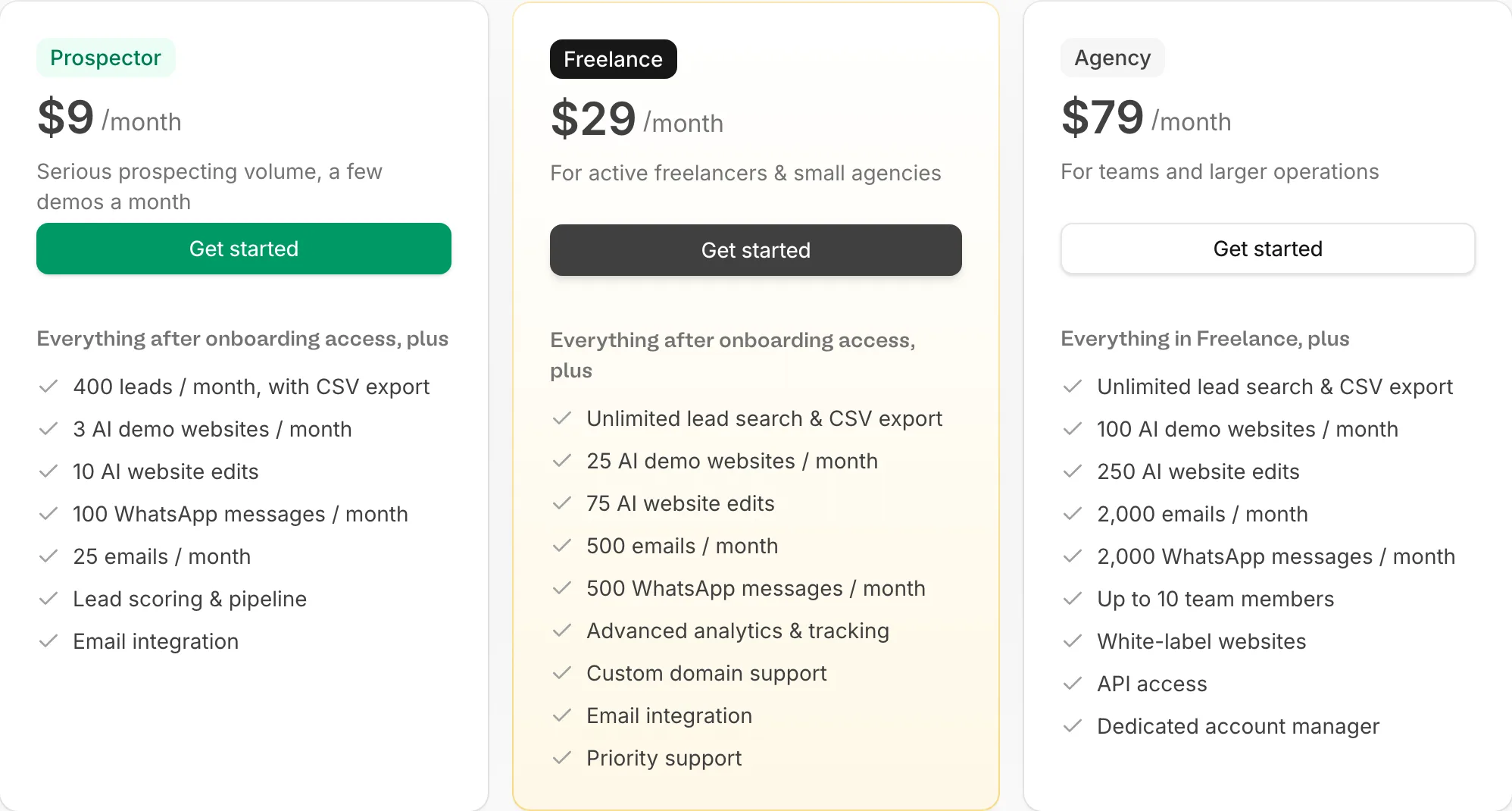
Thyonix starts free: 100 leads, one preview and one send, no card. Its paid plans are £9, £29 and £79 a month. Prospector, the £9 tier, gives 400 leads, 3 AI demo websites, 10 AI website edits, 25 emails and 100 WhatsApp messages a month; the higher tiers lift the caps and add seats and white-label. There is no SMS channel. The numbers are on their pricing.
Where Thyonix is genuinely ahead
Thyonix earns real credit here, and plenty of it. Its free tier is a real one: 100 leads, a built preview and a live send, before you pay anything, so you can run the whole loop once and watch it work. LeadReef’s free plan is a look-around with zero credits, which is not the same offer. Thyonix also drafts for WhatsApp, which LeadReef does not, and if your prospects live on WhatsApp that outweighs everything else on this page. Its pipeline tracks opens, clicks and site visits out of the box too. None of that is us being generous. It is what they built.
What LeadReef does with a lead instead
So where does LeadReef pull ahead? In where it looks. Thyonix searches one surface, Maps, on every plan it sells. LeadReef searches three. Maps is on every plan. On Pro and Scale, Ads adds businesses already paying to get found, so their budget and intent are proven, and Open Web reaches failing sites that sit in no directory at all. A single-surface finder can only return what that surface holds. The prospects who never rank in a Maps search never reach Thyonix, at any price, and that is the one edge it cannot buy.
The rest is close, and we will say so. LeadReef scores each lead 0 to 100 and labels the problems in plain words. They cover four things you can see on every lead. How the site looks. How it works on a phone. Whether search can find it. And whether it has been left to rot. Thyonix scores by opportunity too. Both build a preview the owner can open. Both draft the outreach; LeadReef writes a cold email and an SMS, Thyonix an email and a WhatsApp. LeadReef never sends anything either way. You send it, so the relationship stays yours.
And then there is how each one meters the work. Thyonix counts five things separately on Prospector: 400 leads, 3 AI demo websites, 10 AI website edits, 25 emails and 100 WhatsApp messages a month. Each has its own ceiling. Find a fourth business worth building for in week two and you are done building until the month turns, however many of those 400 leads you never touched. The quota that runs out first decides your month.
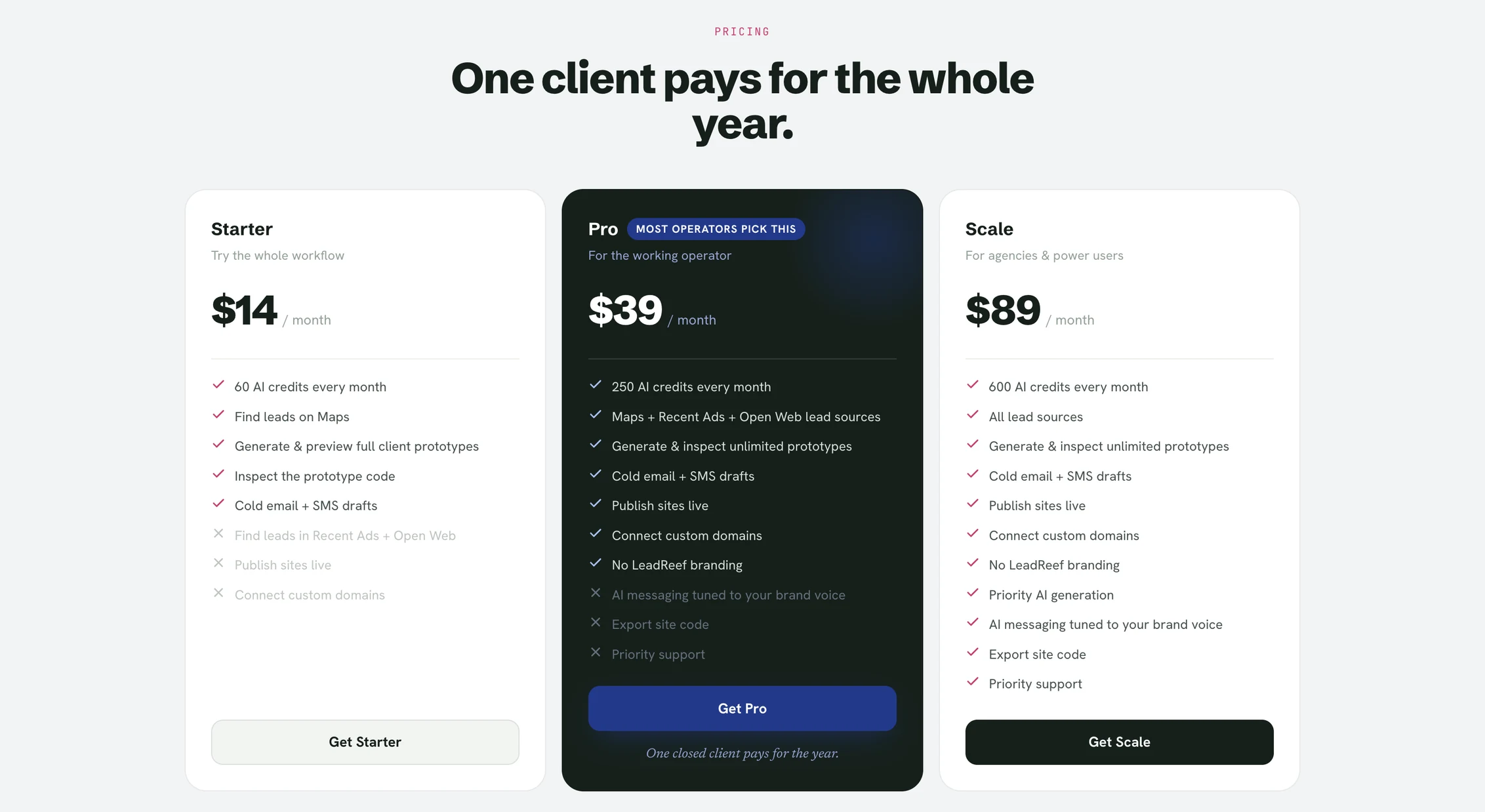
LeadReef meters one thing: credits. A plan grants a single pool, and every action draws on it — finding a lead, building a prototype, drafting the email and SMS, editing the page afterwards. Nothing else is capped. Spend a whole month searching if you are filling a pipeline; spend it all building if you already know who you are pitching; build one prototype and edit it nine times if that is what the client needs. No action is rationed against another, and there is no per-item ceiling to hit — only the balance, which you can see before you spend it.
One lead, end to end
Say you sell in the US and you want plumbers around Denver. Both tools hand you Maps plumbers, score them, and build a preview. On LeadReef’s Pro tier you also run Recent Ads and Open Web. A plumber quietly buying Google ads, or one whose broken site never ranks in Maps, lands in your list where a plain Maps search would have buried them. You build the prototype from that plumber’s own reviews and photos.
Then the message goes out. Because you are pitching in the US, LeadReef drafts an SMS, the channel most of your prospects actually read, rather than a WhatsApp most of them do not check. Same loop as Thyonix. A wider top of funnel, and a text that lands.
Free tiers, and what they actually include
Thyonix is cheaper at the door: £9 a month against LeadReef’s $14. Its free tier also does more than LeadReef’s, which grants zero credits, and its £9 Prospector plan carries more leads and a WhatsApp channel. LeadReef’s Starter is $14 for 60 credits, and its reach advantage arrives on Pro at $39, where the Recent Ads and Open Web sources switch on. If entry price is all you weigh, take Thyonix.
Which one fits your week
Pick LeadReef if you sell where SMS beats WhatsApp, which in the US is almost everywhere, and you want to reach past a single Maps search once you are on Pro. It suits the seller whose ceiling is how many good prospects they can find, not how they message them.
Pick Thyonix if you want to run the whole loop free before paying, or your market runs on WhatsApp. For a lot of freelancers outside the US, that is simply the honest answer.
LeadReef also runs a referral program with a recurring commission, which matters if you end up recommending your stack to other freelancers. There is a partner page if that is you.
The short version
Thyonix and LeadReef run the same loop: find, score, build a preview, draft the message. Thyonix does more of it at the entry tier and lets you try it free, and if your market is on WhatsApp it may simply be the better tool for you. Where LeadReef pulls ahead is reach: three lead surfaces against one, two of them on Pro, so it finds prospects a single Maps search never will. A wider net, and a text your US prospects open. If a free trial and a WhatsApp channel are what you need, both are Thyonix’s, and they are real.
How we checked
We read every Thyonix detail here off their live pages, mostly their home page, where the plans and limits are listed. We checked the plan prices, the lead and message caps, the free tier, the channels, the single data source, and whether they publish a referral program. We never signed up for or paid Thyonix. Prices shift, so where a figure here has gone stale, Thyonix’s live page beats this one. Our numbers are LeadReef’s published prices.
Questions people ask
Is LeadReef a good Thyonix alternative?
If you sell in a market where SMS beats WhatsApp and you want to reach past a single lead source, yes. Thyonix is the closest tool to LeadReef there is: both find local businesses, score them, build a preview and draft outreach. LeadReef’s edge is that it searches three lead sources instead of one, with Recent Ads and Open Web on Pro, and drafts an SMS. Thyonix is the cheaper door, at £9/mo against LeadReef’s $14.
Thyonix vs LeadReef: what is the real difference?
They run the same loop, so most of it is a tie. Thyonix adds a genuinely usable free tier, a WhatsApp channel and built-in open and click tracking. LeadReef searches three lead sources rather than one, with Recent Ads and Open Web on Pro, so it reaches prospects a single search never surfaces, and it drafts an SMS instead of a WhatsApp. It comes down to fit, not price.
Does Thyonix have a free plan?
Yes, and a real one: 100 leads, one website preview and one outreach send, with no card. LeadReef’s free plan is $0 with 0 credits, a look-around only, so finding and building need a paid plan.
Does LeadReef send messages on WhatsApp?
No. LeadReef drafts a cold email and an SMS for you to send yourself; it has no WhatsApp channel. Thyonix drafts an email or a WhatsApp message. Pick by the channel your prospects actually read.
Which is cheaper, LeadReef or Thyonix?
Thyonix is cheaper to start: £9/mo against LeadReef’s $14, and its free tier does real work where LeadReef’s grants zero credits. Its £9 Prospector plan also carries more leads. LeadReef’s multi-source reach arrives on Pro at $39, where the Recent Ads and Open Web sources switch on.
To see a scored lead and a built prototype yourself, you can create a free LeadReef account and take a look. It is free and holds zero credits, so finding and building still need a paid plan, and nothing is billed until you run something.