
GetSiteFinder alternative: the site, and the pitch to send it
Every figure below is drawn from GetSiteFinder’s live pages and from LeadReef’s own.
Anyone hunting for a GetSiteFinder alternative is, more often than not, selling websites to local businesses. On that front, GetSiteFinder and LeadReef open in the same way: track down a business whose web presence is broken, and build it something better. Of the two, GetSiteFinder is, to be fair, the stronger builder. The two diverge in what comes after the site is built.
This is our page, so we will name the bias plainly. GetSiteFinder checks each lead harder and builds a fuller site than LeadReef does, and we will point out exactly where. What it never does is write the message that puts that site in front of the owner, and filling that gap is LeadReef’s job. It is also the cheaper of the two.
The short answer: GetSiteFinder verifies each lead more thoroughly and builds a fuller, publishable site. LeadReef builds a one-page prototype, then drafts an email and an SMS for the owner, set for you to send. It opens at $14 a month against $20, and you can run a search free before paying a cent.
Here is the quick version before the detail arrives.
| Feature | LeadReef | GetSiteFinder |
|---|---|---|
| Entry price | $14/mo, Starter | $20/mo, Standard |
| Free way to try it | Yes. First 10 leads free, no card | Free signup; credits are on the paid plans |
| Judges the existing site | Yes. A 0–100 opportunity score with problems named in plain words | Yes. Both a presence and an opportunity score |
| Builds the prototype | Yes, a single prototype page | Yes, publishable multi-page sites |
| Drafts the outreach | Yes. A cold email and SMS for you to send | No. It drafts no outreach |
| Lead sources | Three: Maps, Recent Ads, Open Web (the last two on Pro) | One: Maps only |
| Recurring partner commission | Yes. Recurring, with 6-month attribution | Nothing offered publicly |
| Best for | Sellers held up by the pitch rather than the build | Sellers who want the hardest verification and a publishable multi-page site |
GetSiteFinder in one paragraph
GetSiteFinder is a lead engine aimed at web designers. It combs Maps for local businesses and vets each one with live DNS, SSL and uptime checks, catching the parked and expired domains a plain listing search lets slip by. Each lead earns a presence score from 0 to 100 and an opportunity read taken from its reviews and rating. Then the building starts: a full multi-page site in roughly a minute, with menus, service lists and contact forms, ready to publish on a custom domain and wired for billing. All of it is spelled out on their site.
GetSiteFinder’s Standard plan runs $20 a month for 200 credits, along with five free credits a day and ten AI builds; the $40 Pro tier raises that to 400 credits and thirty builds. Six-month plans trim 20% and annual ones about 38%. Signup costs nothing, but the working credits live inside the paid plans. Those figures are on their pricing.
Where GetSiteFinder outbuilds us
Begin with verification, which is where GetSiteFinder digs deepest. Instead of noting a missing website and moving along, it resolves the domain, inspects the certificate, and flags the parked and expired ones, so the leads it passes you are genuine. Its builder reaches further than LeadReef’s as well. It produces a multi-page site rather than a single page, publishes it to a custom domain, and even sets up billing. If a finished, live, sellable website out of one tool is what you want, GetSiteFinder builds more of it than we do. We are not going to pretend otherwise.
Why LeadReef stops at one page
One piece is left over for LeadReef. The message. GetSiteFinder builds the site and stops there. It drafts no outreach whatsoever. LeadReef builds a prototype and then writes the pitch that goes with it: a cold email and an SMS, drafted for that particular business, naming what is wrong with the current site without insulting the owner. LeadReef never sends anything. You do the sending, so the relationship stays yours.
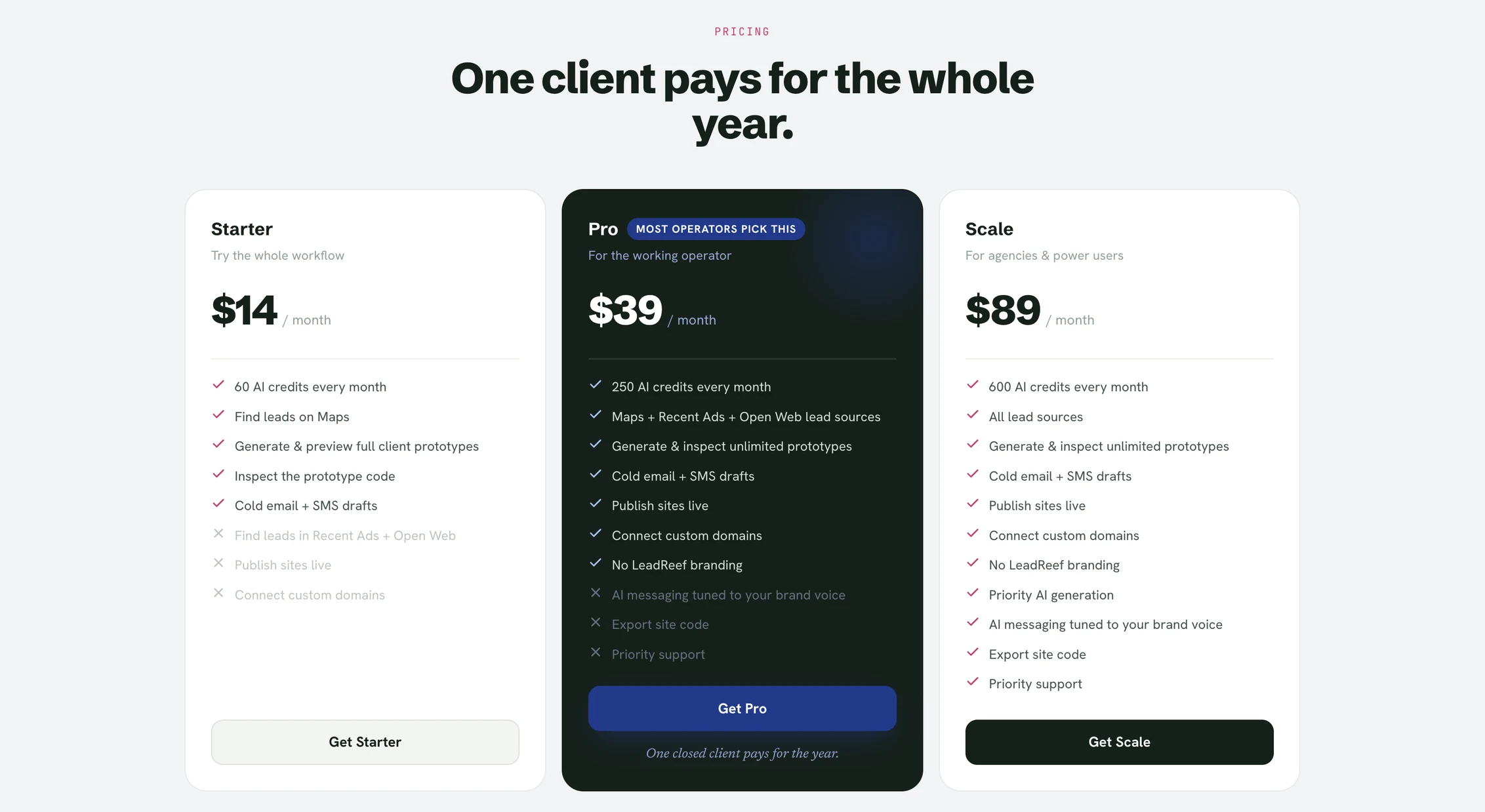
The read on the site is close to even. LeadReef scores each lead 0 to 100 and labels the problems in plain words, much like GetSiteFinder does. Where LeadReef casts a wider net is the finding. GetSiteFinder searches a single surface, Maps. LeadReef’s Fisher AI searches three. Maps sits on every plan. On Pro and Scale, Recent Ads pulls in businesses already paying to be found, and Open Web reaches failing sites listed in no directory at all. One caveat we will state plainly: publishing the prototype to a live URL is a Pro feature on our side, so GetSiteFinder takes the publishing win at the entry tier.
A single prospect, worked through
Suppose you turn up a plumber in Denver with a dead site. GetSiteFinder confirms the domain is parked, scores the lead, and builds a complete multi-page site you could publish that same afternoon. The one thing it will not do is draft the email that makes the plumber look. That part falls to you.
With LeadReef you come away with a prototype of that plumber’s page, put together from their reviews and photos, plus a cold email and a text drafted to go alongside it. You tweak a line, send it, and the plumber clicks a link to their own business, made over. The build is the easy half. The send is the half that books the job.
Ahead of any of that, you can run a LeadReef search on a trade you already sell to and weigh its scores against what your own eye would have judged.
The two price ladders
GetSiteFinder opens at $20 a month; LeadReef’s Starter is $14. Signing up for GetSiteFinder is free, but its free daily credits arrive with a paid plan. LeadReef’s free search is the real thing: ten leads, no card, enough to watch how it scores a market. Building and drafting then kick in on Starter, and at that level LeadReef is the cheaper option. GetSiteFinder’s steeper price buys more building; LeadReef’s lower one buys the pitch on top of the page.
Who each one is really for
Pick LeadReef when the outreach, not the build, is what holds you up. It scores the lead, builds a prototype, and drafts the cold email and SMS to send it with, for $14 a month, spanning three lead sources on Pro. It suits the seller who can close once a prospect replies but struggles to get that reply.
Pick GetSiteFinder when you want the hardest verification and a full, publishable, billable site, and you do not mind writing the outreach yourself. As a pure builder it goes further than we do, and for some sellers that is the entire job.
LeadReef also runs a referral program with a recurring commission, which counts if you wind up recommending your stack to other freelancers. There is a partner page if that is you.
Where that leaves you
Both tools take a struggling local business and hand it a better web presence. One handles the building job more fully, with tougher checks and a live, billable result spread over several pages. The other stops at a lone prototype but tacks on what its rival leaves out completely: the email and text that place the page in the owner’s hands, at a lower price and from more lead surfaces. A site nobody has been pitched is just a file; the message is what sells it. If your real job is to deliver a finished, verified, publishable website, buy the tool that builds more, and that one is theirs.
How we verified the numbers
Every GetSiteFinder fact here is taken from their live pages, chiefly their home page, where the plans, credits and features are listed. We looked at the prices and credits, the verification checks, whether it drafts outreach, the single data source, and whether they publish a referral program. We did not buy or log in to GetSiteFinder. Because prices shift, GetSiteFinder’s own live page has the final say if a number here looks off. LeadReef’s figures here are its public pricing. If you are still weighing up the whole category, our guide to tools for finding local businesses to pitch covers the others.
Common questions
Is LeadReef a good GetSiteFinder alternative?
Yes, when what slows you down is the outreach rather than the build. Each one finds local businesses, scores them and gives them a site. GetSiteFinder produces a fuller, publishable one yet writes no message; LeadReef makes a prototype and drafts the cold email and SMS that carries it. It also opens at $14/mo versus $20.
GetSiteFinder vs LeadReef: what is the real difference?
GetSiteFinder checks each lead harder and builds more of it: a multi-page site you can publish and invoice from. The one thing it skips is writing the outreach. LeadReef builds a prototype and drafts the email and SMS that lands it in front of the owner, at a lower price and across three lead sources rather than one, with Recent Ads and Open Web on Pro.
Does GetSiteFinder write outreach messages?
No. It finds and verifies leads and builds sites, yet it never drafts the email or the text you send, so writing the pitch falls to you. LeadReef writes a cold email and an SMS for that particular business, calling out what is wrong with the current site, and you are the one who sends them.
Does LeadReef build multi-page sites?
LeadReef assembles a single-page prototype out of the business’s own reviews and photos, then drafts the outreach. GetSiteFinder puts together full multi-page sites you can publish and invoice from; when a complete, live website is what you are after, it builds more of it.
Which is cheaper, LeadReef or GetSiteFinder?
LeadReef, at $14/mo next to GetSiteFinder’s $20 Standard plan. Signing up for GetSiteFinder costs nothing, but its working credits, the five free daily ones among them, arrive with the paid plans. LeadReef also lets you search free before you pay, giving your first 10 leads at no cost and with no card.
Can I try LeadReef free?
Yes. A free LeadReef search hands back your first 10 leads with no card, drawn from 10 business types across 10 cities, so you can size up the scoring against real businesses. The prototype and the drafted email and SMS call for a paid plan, which opens with Starter at $14/mo.
The quickest way to judge any of this is on your own market. Run a free LeadReef search: pick one of 10 business types and one of 10 cities, and your first 10 leads cost nothing, no card needed. Paid plans open every business type in any city you choose.