
Web Design Questions to Ask Clients Who Replied to Your Cold Pitch: Six Questions, Ten Minutes, No Selling
The first call with a local owner who replied to your cold pitch is not the discovery call page 1 scripts. You already know the site; what you cannot see is the business behind it. Six questions, ten minutes, no selling, and one sentence that ends the call.
The owner wrote back. You sent a cold email about their website, maybe with a prototype attached, and the reply says “give me a call” or “when are you free to talk?” You have never sold anything, so you search for web design questions to ask clients and find lists of fifteen, twenty and two hundred and five questions about brand personality, ideal customer, five-year vision and KPIs. None of them is for this call. Those lists are for a client who came to you with a brief. Yours came because you told them something about their site was broken.
This piece is the call for that situation: why the discovery-call scripts on page 1 do not fit it, the six questions that do, a ten-minute script for someone who has never run a sales call, what to say when “how much?” comes up early, and the one sentence that ends the call. Everything that happens after the call, the proposal and the domain and the logins, is its own job and gets its own piece. This one stops when you hang up.
Why the web design discovery call on page 1 is a different call
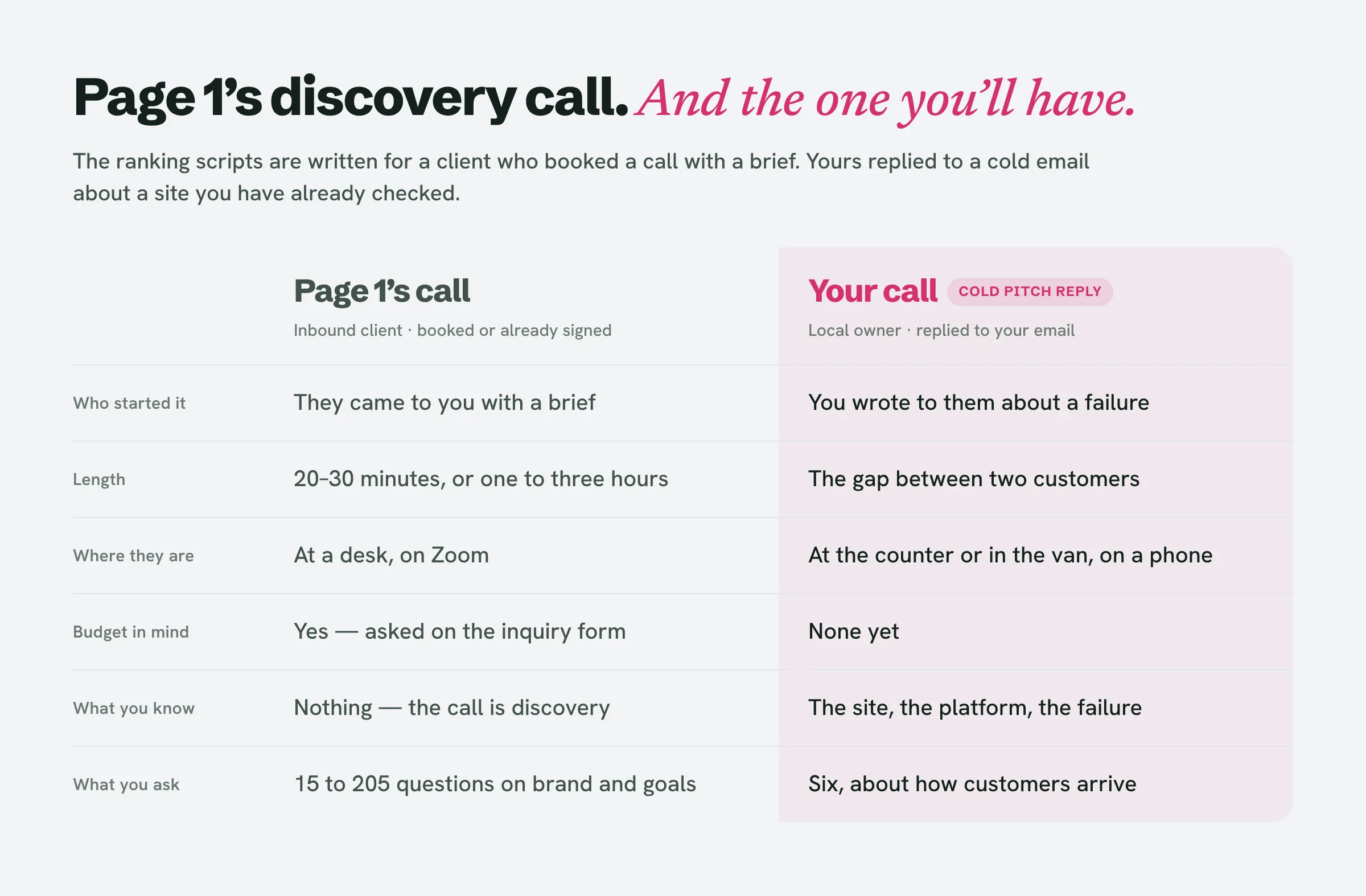
Read the ranking pages for discovery-call questions side by side and the assumptions are the same on every one. Local Creative plans a twenty-to-thirty-minute conversation with a client who has booked a call and is being sized for a $3,000-plus project. Radical Web Design’s twenty questions come after the client has filled in a written brief, and the call runs “anywhere from one hour to three.” Jennifer Bourn’s discovery questionnaire goes out after the contract is signed; before signing, she gathers only scope, budget and timeline through an inquiry form. Penji’s 205 questions assume an existing site with analytics, a CRM and a marketing budget, and give no rule for choosing among them. Highspot’s version says eight to twelve questions and then lists twenty, for a buyer with a buying committee. Three Seven’s opens by assuming the sales process is already over.
In every case the client arrived with a brief, a budget figure and a reason to talk. Yours did not. The owner replied to a stranger’s email, probably from the counter or the van, has not thought about what they want from a website because they were not thinking about the website until Tuesday, and has no number in mind. The call is on the phone, not Zoom. It will last as long as the gap between two customers, which is five to fifteen minutes, not an hour.
There is a second difference, and it is the one that decides what to ask. On an inbound call the designer knows nothing and the client knows everything, so the call is discovery. On yours it is reversed. You already know the site: you ran the sixty-second phone checks before you wrote, you know what platform it is on and what that says about who paid for it, and the pitch named a specific failure. What you cannot see from outside is the business behind the site. How a new customer finds them, how that customer gets in touch, what happens when the phone rings and nobody is there, which jobs the owner actually wants. That is the whole call. If the lead came out of LeadReef, the scan already lists the site’s failures and the prototype is live, so the call starts from the same place: the site is known, the business is not.
The six questions to ask small business owners on the first call
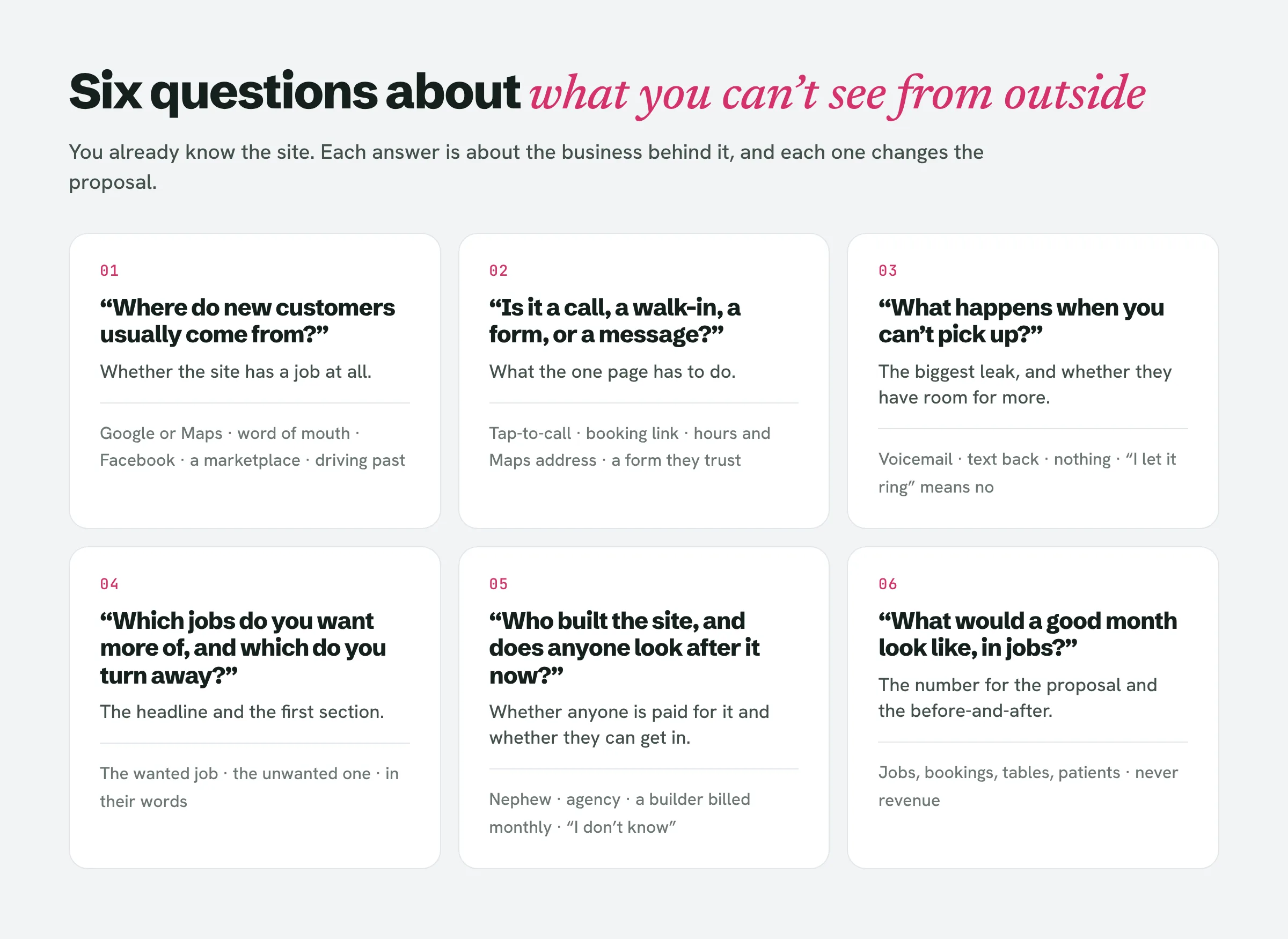
Each question is under fifteen words, which is as long as a question can be before an owner standing in a shop loses the end of it. Each comes with what the answer tells you and what to write down, because the answers are the material for the proposal and later for the before-and-after.
1. “When a new customer finds you, where do they usually come from?” The answer is one of about five things: Google or Maps, word of mouth, a Facebook page, a marketplace like Yelp, Angi or Thumbtack, or people driving past. It tells you whether the website has a job at all. If it is mostly Google, the site is in the path of every new customer and a failure on it costs a call. If it is all word of mouth, the site is a credibility check, which is still a job: in BrightLocal’s 2019 survey of 500 US consumers, 76% said they look at a local business’s website at least half the time when choosing one, and 49% had visited one specifically to find contact details. Write down the source and the owner’s own words for it.
2. “When they get in touch, is it a call, a walk-in, a form, or a message?” This decides what the one page has to do. A trade that lives on phone calls needs a tap-to-call number above the fold and nothing in the way of it. A salon or a clinic that lives on bookings needs the booking link to work on a phone. A shop that lives on walk-ins needs hours, an address that opens in Maps, and photos. Most owners answer “the phone,” and some will add that the form on the current site has never produced anything, which is its own finding. Write down the channel and whether the owner trusts it.
3. “What happens when you can’t pick up?” Voicemail nobody checks, a text back later, or nothing. For a one-person trade this is the biggest leak in the business and the one the site can plug, because a contact form or a booking page that works is a missed call that still turns into a job. It also tells you about capacity. An owner who says “I’m booked two months out and I let it ring” does not need more enquiries and will not pay for a site that produces them. That is a disqualification, and it is better learned in minute four than after a proposal. Write down the answer word for word.
4. “Which jobs do you want more of, and which do you turn away?” This is the money question without a number in it. A plumber who wants bathroom refits and keeps getting dripping taps has told you what the headline and the first section of the page should say, and has told you the site is currently selling the wrong thing. An owner who wants everything has told you they have not thought about it, which is normal, and you move on. Write down the wanted job and the unwanted one, in their words.
5. “Who built the current site, and does anyone look after it now?” A nephew, an agency three years ago, a builder they pay monthly and have not logged into, or “I don’t know.” The platform read you did before the pitch is a guess at this; the owner’s answer confirms it. What you need from the call is whether anyone is paid for the site today and whether the owner thinks they can get into it. Ask one follow-up at most, “do you know who has the login for the domain?”, and take “I think so” as the answer. Do not resolve the domain, the hosting or the handover on this call; that is the first job after a yes, and it is long enough to be its own piece. Write down who built it, what is paid monthly, and whether the owner knows where the domain lives.
6. “What would a good month look like, in jobs?” Not revenue, which most owners will not give a stranger, and not “goals,” which produces nothing. Jobs, bookings, tables, patients. “Two more kitchens a month” is a number you can put in a proposal, price against, and measure after launch with the call-and-booking tally and the Business Profile export. Owners answer this one easily because they count it already. Write the number down exactly.
There is one page-1 question that survives this call. Local Creative asks whether there is anyone else involved in the decision. For a local business that is a spouse, a business partner or the person who built the last site, and knowing it now saves you a proposal that goes to the wrong person. Ask it as the seventh if there is time: “Is there anyone else who’d want to look at this before you decide?”
A ten-minute discovery call script for someone who has never sold
The reason you have never sold is not a problem on this call, because this call has no selling in it. The pitch already made the argument; the owner replied to it; the proposal will make it again with a number. The call is for collecting six answers and writing them down. A beginner who asks six questions and listens does better than a beginner who tries to close, and a reader who takes nothing else from this piece should take that.
Minute 0 to 1. Thank them for replying, say what they saw in one sentence so you are both looking at the same thing (“you replied to the email about the form on your site not working on a phone”), and set the shape of the call: “I’ve got six quick questions, then I’ll put what I’d suggest and the price on one page for you by Thursday.” Naming the day now means you do not have to ask for anything at the end.
Minute 1 to 8. The six questions, in the order above, which runs from what the business is to what the owner wants. One follow-up per question at most. The only published numbers on call length come from B2B cold-calling: Martal, citing Gong’s analysis of ninety thousand calls, reports that successful cold calls run about five minutes fifty seconds against three minutes fourteen for unsuccessful ones, and that the eleven-to-fourteen-question figure often quoted belongs to booked discovery calls, not first conversations. Those are sales reps’ numbers, but the shape holds: a short call with a few questions, not a long one with many.
The stop rule. Martal’s one rule worth carrying over is this: stop asking questions the moment the buyer asks you one. If the owner asks “so what would you do with it?” or “how much?”, the questions are over for now. Answer in two sentences, then return to where you were (“that’s the short version; I’ll put the full one on the page. Can I ask about who built the current site?”). An owner who asks you a question is interested; an owner who is asked a tenth question is not.
Minute 8 to 9. Play it back in one sentence, using their words: “So most people find you on Google, they call, about a third of the calls get missed, and you want more kitchens and fewer taps.” If they correct anything, that correction is the most valuable thing on the call. Write it down.
Minute 9 to 10. The ending, below.
Three rules for the whole ten minutes. Write every answer down as they say it, not afterwards; the owner’s own phrases go into the proposal and the page. Do not describe the fix on the call, because a fix described on the phone is a fix the owner can picture doing themselves or asking the nephew for. And do not apologise for being new; nobody on the call asked.
When “how much?” comes up in the first minute
Some owners ask before you have asked anything, and the page-1 advice, which is to deflect until you have qualified them, is wrong for a call that started with a pitch. If the pitch came with a prototype, the owner has already seen the scope, and a number is the honest answer: give the one number for what they saw and say the page on Thursday will have what it covers and what it does not. If the pitch had no prototype, say one sentence: “I’ll have a number for you by Thursday; the two things that move it are whether we can get into your current site and how many pages you need, which is what I’m about to ask.” Then ask. The full reasoning for answering in writing rather than on a call, and why a range reads worse than a number to a local owner, is in our piece on answering “how much?” when a local business replies to a pitch. On the phone the short version is enough.
How to end the call: one sentence, one day, no second call
“I’ll send you one page by Thursday with what I’d change, what it costs and what I’d need from you. If it looks right, reply yes and we start.” That is the whole close. It names a day, it tells the owner what will arrive and what they do with it, and it asks for nothing on the call. Do not ask for a second call; a local owner who has given you ten minutes between customers does not want to schedule another ten, and the proposal can be read at the kitchen table. Do not say “I’ll put together some options,” because options are a decision the owner has to make and a decision is a reason to not reply. One page, one number, one day.
Then send the page on the day you said. The six answers are most of it; what goes on that page and how it is laid out is the next job and its own piece.
People also ask
What questions to ask on a discovery call?
For an inbound client who booked, the page-1 lists hold: goals, audience, what works and does not on the current site, timeline, budget, other decision-makers. For a local owner who replied to your cold pitch, you already know the site, so the questions are about the business: where customers come from, how they get in touch, what happens to missed calls, which jobs they want, who built and pays for the site, and what a good month is in jobs.
What are good questions to ask a client?
Short ones with a concrete answer. “Where do new customers come from?” produces a fact; “what does success look like?” produces a pause. Under fifteen words, one follow-up at most, and stop when the client asks you something.
What are some good questions to ask during a sales discovery process?
The B2B lists are built around pain, impact and decision process for buyers with committees. For a one-owner business the process and the decision are the same person, so ask about process only: how does a customer reach you today, and what happens when they do.
How to find clients who need a website?
The call above assumes you already have one on the line. Getting there is a list of local businesses whose sites fail the checks a customer hits on a phone, a name to write to, and a pitch that names the failure; the pieces on the sixty-second phone checks and on finding the owner’s name cover that.
Six answers a day needs six calls, which needs six replies
The call is the easy part once you have it. What produces it is a list of local businesses whose websites fail on a phone, a name to write to, and a pitch that names what you found. LeadReef builds that list: it scans a city, flags the sites with problems a customer would run into, attaches the contacts it finds, generates a prototype redesign you can send with the pitch, and drafts the email for you to finish and sign. The first 10 leads are free, from any of 10 business types in any of 10 locations, at leadreef.ai/find. When one of them writes back, you have the six questions.