
Web Design Client Objections to a Redesign: What Local Business Owners Reply, and What to Write Back
Respond to the sentence and you pick a fight. Respond to what the owner is really guarding and a second reply tends to follow.
Most guides to web design client objections assume you are on a live phone call, pitching a first website to a business that has none. That is rarely where redesign pushback shows up. It comes back in writing, a couple of hours after your cold email, from an owner who already runs a site and never asked to hear from you.
Because of that, they land differently. “I already have a website” is not a misunderstanding about your offer. It is an owner defending a choice they made, the person who built it for them, or the money it cost. Reply to the sentence and you spar; reply to what is being defended and a second message usually comes back.
What follows are the eight objections owners genuinely fire back at a redesign pitch, what each is guarding, and a brief written reply for every one, grounded in a fact they can verify for themselves.
Why redesign objections are not the usual list
The articles that rank for objection handling mainly deal with price, timing and “we don’t need a website.” Those suit a business without a site. A business stuck with a poor site has already made the purchase (the no-website versus bad-website split explains why that makes it the stronger lead). The question moves from “do I need this?” to “why would I swap out what I already have?”
Two further things set this apart from the phone-script playbook:
- It is in writing. There is no tone to read and no chance to ask a follow-up on the spot. Whatever you send gets re-read, passed to a partner, or left to sit in the inbox.
- You were not invited. Part of the pushback is aimed at you, not the site: who you are, how you tracked them down, whether the whole thing is a scam.
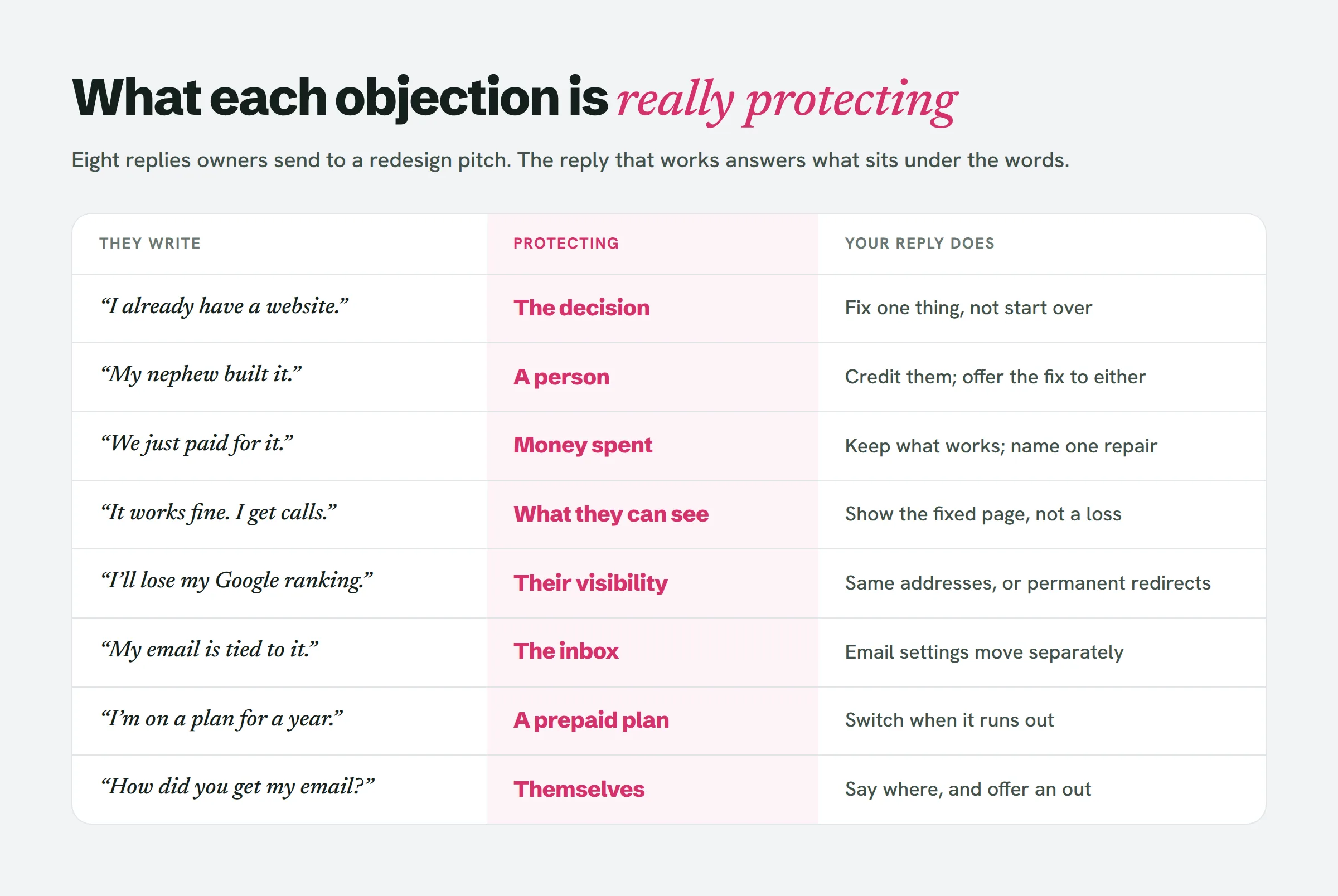
What each objection is actually protecting
Before you reply, put a name to what lies beneath the words. Which reply lands hinges on that.
How to handle sales objections that arrive by email
The usual guidance on how to handle sales objections holds up: acknowledge, locate the true worry, answer it, take one step forward. On the page it tightens up:
- Mirror their wording once. “Makes sense you’d want to keep the site you have” proves you actually read their reply. A single clause, not a paragraph of sympathy.
- One fact they can verify. Not a promise about outcomes. Something plainly true about their site, their domain, or how a move works.
- One small next step they can decline. Send a screenshot, mock up a single page, ask one question. And no “hop on a call” in the second message either.
- Cut it off at five sentences. A long reply to a short objection reads like pressure.
Address only the objection they raised. If they wrote “my nephew built it,” do not pile on rebuttals to price, timing and SEO as well. Every extra defence signals that you came braced for an argument.
Eight objections and what to write back
These are objection handling examples aimed at redesigns alone. Price is covered on its own elsewhere; the short answer sits in the questions at the end.
1 · “I already have a website.”
Protecting: the choice itself. They bought a site once and would rather not put that decision back on the table.
Write back: “Got it, and I’m not asking you to scrap it and begin again. When I loaded it on my phone the call button wouldn’t dial — that’s the single thing I’d sort out. Want a screenshot so you can see it for yourself?”
What the owner takes in is “repair one thing,” not “tear down your website.” The scope only widens once they have seen the problem, never ahead of it.
2 · “My nephew / a friend built it.”
Protecting: a person. Knock the site and you knock someone they care about, or at the very least someone they face across the dinner table.
Write back: “That’s brilliant — they got you online, which loads of businesses never pull off. Sites put together a few years back generally weren’t designed for how people browse today, which is on phones. Glad to send over what I spotted, and they’re welcome to fix it themselves if they’d prefer.”
Handing the fix back to the nephew looks like walking away from the job. Yet it is the reply most likely to keep things moving, because it clears away the loyalty clash. Owners often circle back once the nephew never quite gets around to it.
3 · “We just paid for it” / “It was redone two years ago.”
Protecting: the money already laid out, plus a bit of pride.
Write back: “In that case most of it is probably solid and worth holding on to. The bit I noticed is the booking button on mobile, which lands on an error page. That’s a quick repair, not a rebuild.”
Never hint that they got fleeced. Even when they did, they will stand up for the purchase long before they come round to your view.
4 · “It works fine. I get plenty of calls.”
Protecting: what their own eyes tell them. From the owner’s chair, the phone keeps ringing.
Write back: “Glad to hear it. I can’t see your figures from the outside, so you’d know far better than I would. What I can see is that anyone on a phone trying to book online runs into an error. Want me to mock up that one page working so you can put them side by side?”
This is the objection that most often closes the door, and now and then it should: a business booked solid may genuinely have no use for you. The mockup is the single thing that shifts a mind, because it shows the fix instead of talking about a loss they can’t feel. Making one by hand eats an evening per prospect; LeadReef builds and deploys that prototype for every lead, so the link is waiting the moment this reply goes out.
5 · “I’ll lose my Google ranking.”
Protecting: the one scrap of online visibility they’re sure they have.
Write back: “Reasonable thing to worry about. If the page addresses don’t change, Google sees the same pages with stronger content. Where an address does have to change, a permanent redirect points both visitors and Google at the new one. Google’s own guidance is that those redirects keep their ranking credit, though there can be a brief wobble while it recrawls.”
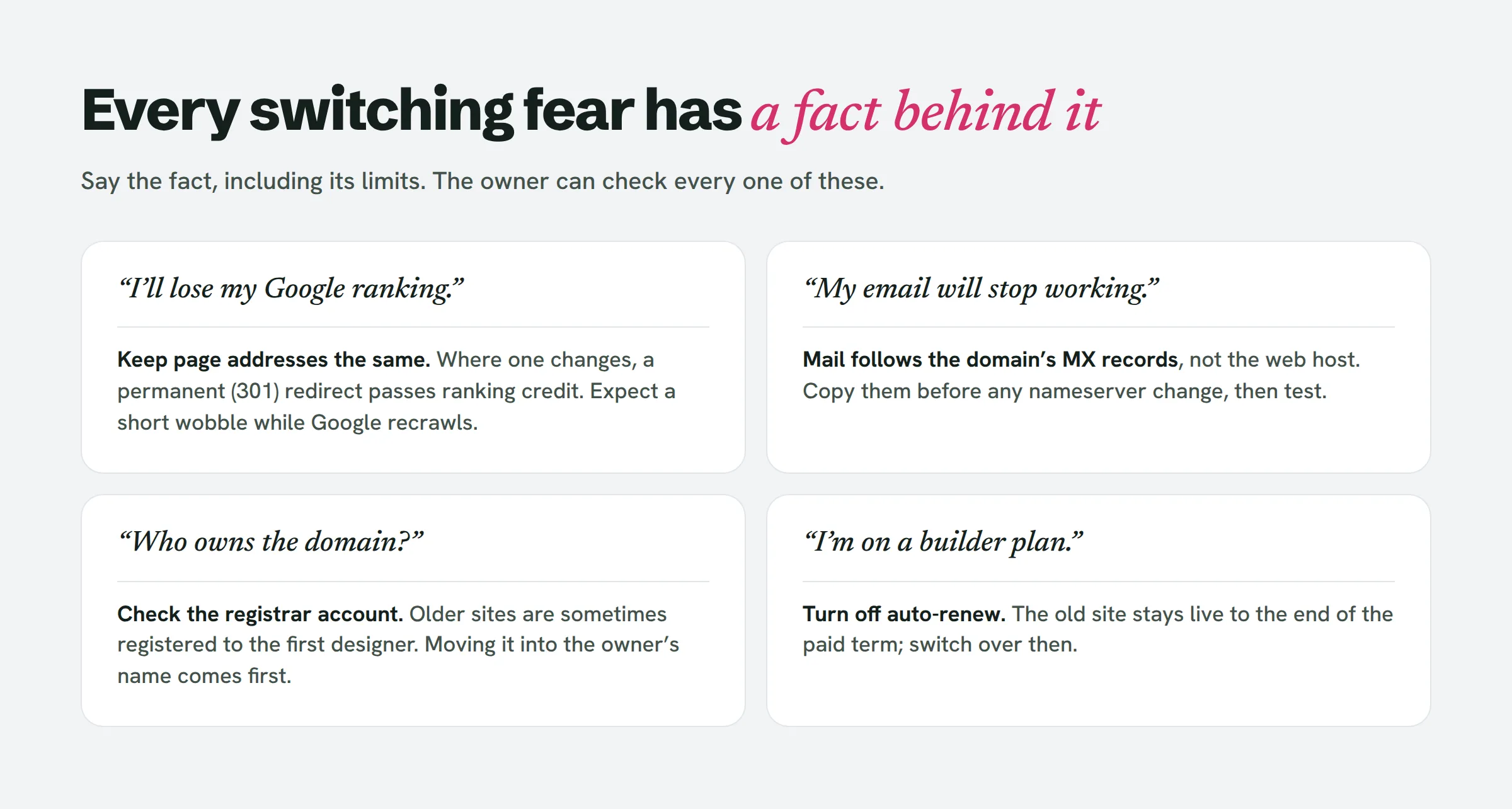
That is accurate, not a pat on the head. Google’s site-move documentation states that 301 and other permanent redirects “don’t cause a loss in PageRank,” and cautions that a temporary fluctuation is normal while the site is recrawled. Give them both halves. Promising zero movement is exactly the kind of claim that torpedoes trust down the line.
6 · “My email is tied to the website” / “What about my domain?”
Protecting: the inbox. For plenty of owners, the thing they dread breaking is email, not the website.
Write back: “Your email runs off a separate setting on your domain, so moving the website doesn’t need to touch it at all. Before I change a thing I’d copy those settings across and confirm mail is still landing. The domain stays registered under your name throughout.”
Here’s what sits behind that: mail is delivered through the domain’s MX records, not through the web host. It only fails if the nameservers move and no one carries the MX records over. Ask, too, whose name the domain is registered in. Older sites are now and then registered to the original designer’s account. When nobody has the registrar login, straightening that out is the first job whether or not there’s a redesign, and offering to help with it is a reply that earns trust.
7 · “I’m on Wix / GoDaddy / Squarespace for another year.”
Protecting: a plan they’ve already paid for and don’t want to throw away.
Write back: “Nothing to cancel. We can build the new version in parallel and flip over when your plan comes up for renewal, or whenever works for you. Just switch off auto-renew so it doesn’t quietly roll over.”
A builder plan is a matter of timing, not a refusal. Note the renewal date and check back in a month ahead of it.
8 · “How did you get my email?” / “Is this a scam?”
Protecting: themselves. An out-of-the-blue email about their website reads like the spam that floods in every week.
Write back: “Reasonable to ask. I came across your business on Google Maps and picked up the address from your contact page. I’m a local web designer — here’s my own site. If you’d sooner not hear from me, just say the word and I won’t email again.”
Reply straight, say where you found them, and hand them an easy exit. If they ask to be taken off the list, do it right away and don’t push back. In the US, CAN-SPAM obliges you to honour opt-out requests in any case. And if your pitches keep dropping into spam to begin with, that is its own problem to fix.
The switching facts, in one place
Objections 5 through 7 are all switching fears, and every one has an answer they can verify. Keep them on hand; they are what sets a designer apart from a stranger holding a template.
What never to write back
- “With all due respect…” Whatever comes next is never respectful.
- “Your competitors all have better websites.” You have no way of knowing that, and it comes across as a threat.
- Guessed numbers. “You’re losing 40% of visitors” fabricates a figure you can’t possibly see. The screenshot carries more weight.
- A second pitch. If they pushed back on one thing, answer that one thing. Firing the original email back with extra adjectives is pressure.
- Silence after a genuine question. “Will my email break?” answered two days later reads as a “yes.”
People also ask
How can I effectively handle client objections?
Figure out what the objection is guarding before you respond: a choice, a person, money already spent, or a fear of switching. Answer that, backed by one fact the owner can verify and one small next step.
What are the 5 most common customer objections?
Across sales generally: price, timing, no need, no authority, and no trust. For a website redesign pitch, the replies owners genuinely send are “I already have a website,” “a friend built it,” “it works fine,” “I’ll lose my ranking” and “how did you get my email?”
What is a 3-step approach to handle objections?
Acknowledge it in their own wording, answer it with one verifiable fact, and put forward one small next step. All in a written reply of roughly five sentences.
What to say when a client says too expensive?
Ask what they’re measuring it against, then trim the scope instead of cutting the price: repair the one failure first, and quote the rest once they’ve watched it work. Don’t debate the number over email before you know what they actually need.
What are the three golden rules for objection handling?
Listen for what sits beneath the words, answer only what was actually raised, and never make a claim you can’t stand behind. On a redesign, that last rule counts for most: the owner can verify everything you tell them.
How to sell websites to local businesses that already have one
Most of how to sell websites to local businesses comes down to picking the right lead and leading with a flaw the owner can verify. The objections arrive after that, and they are hardly ever an outright no. They are an owner shielding something: a choice, a person, a ranking, an inbox. Name it, back your answer with a fact, and ask for one small next step.
If you’d like leads with the flaws already surfaced, LeadReef gives you your first 10 leads completely free. Choose from any of 10 business types and 10 locations, and every lead arrives with its weak spots flagged, contacts attached and a prototype ready to show off. Paid plans unlock every business type worldwide, in any mix you like.