
How to Find Local Businesses Without a Website (And Why the Bad-Website List Pays More)
The no-website list is free, immediate and already combed through. The bad-website list has to be built by hand — and that is precisely what makes it worth money.
Put the question of how to find local businesses without a website to ten people and every one of them says the same thing: pull up Google Maps, type a trade and a city, and hunt for listings that show no website link. It does work. It is also the whole problem. Every guide from the past two years hands out that identical instruction, and a dozen tools sell you the exact same filter. By the time it reaches you, the list is free, instant, and thoroughly picked over.
Hardly anyone pulls apart a second list from that first one: businesses that do own a website — just a bad one. That list is tougher to assemble, and it closes at a higher rate. What follows is how to source each of them, and which one has earned your Monday morning.
Why “no website” and “bad website” are two different markets
People treat these as a single problem. In truth they are two businesses running on opposite psychology.
A business with no website has already settled the matter. Perhaps every job arrives through referrals. Perhaps the Facebook page carries the load. Whatever the cause, they have run without one and stayed afloat, so your opening call goes to arguing that the whole category is even worth caring about. Your rival is not another designer. Your rival is “we’re fine.”
A business with a bad website has already paid for the thing you offer. Somebody talked them into believing a website was worth the money. They picked a vendor, put their name on something, and launched it. The buying decision is behind them and the budget line already exists. Your conversation opens at “is this one doing its job?” — a far shorter walk to a signature than “do you need one in the first place?”
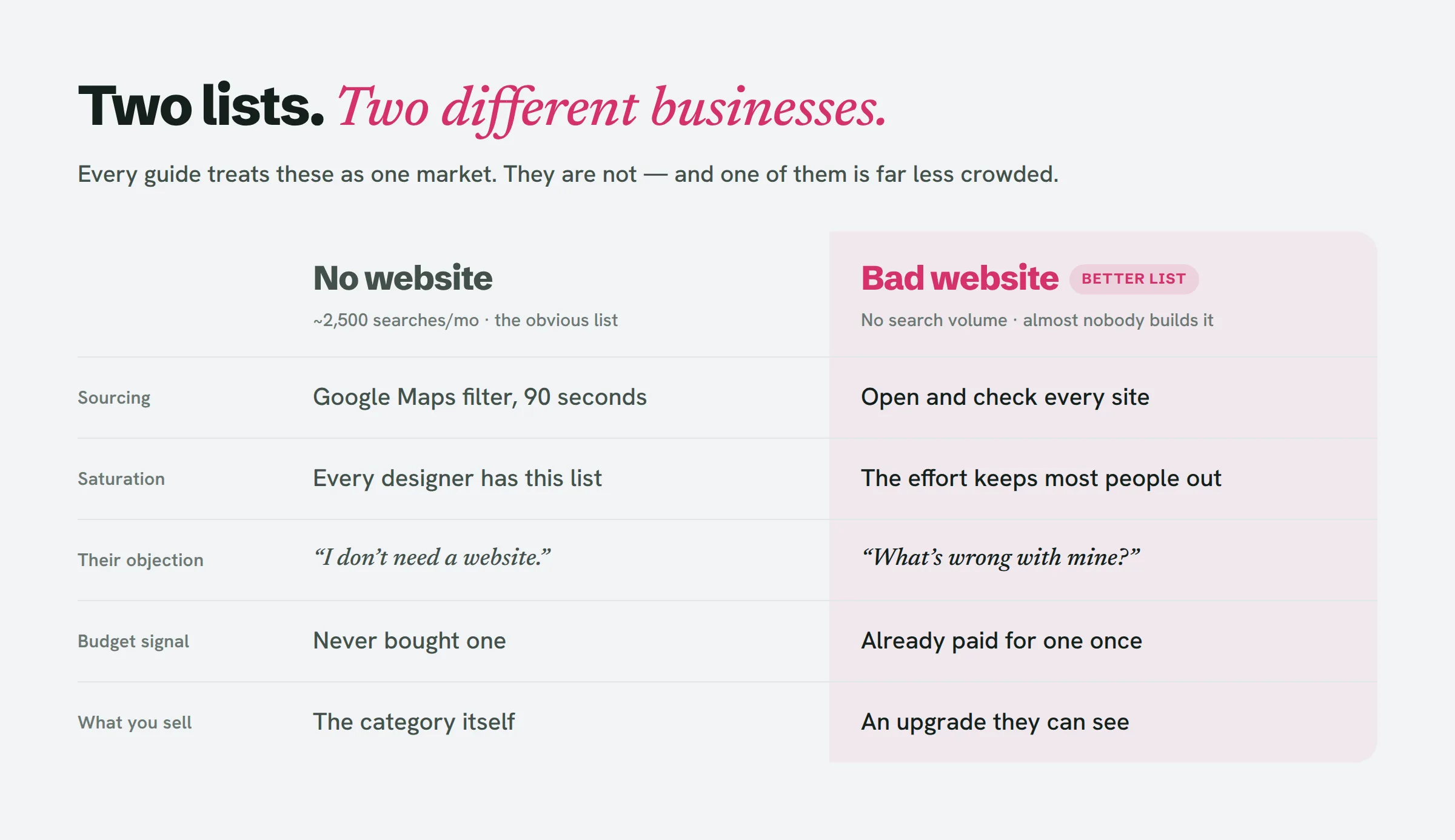
That gap surfaces in how each list is sourced as well, and it explains why one sells at commodity prices and the other does not. Anybody can grab the no-website list inside ninety seconds. Assembling the bad-website list means opening every site on it and forming a judgment about what you see. The barrier is modest, but a barrier that keeps most people away is the sole thing that ever gives a lead list any worth.
How to find businesses without a website using Google Maps
Google surfaces this out of the box, which is at once the convenience and the trap.
Fire up Google Maps, search a trade together with a location — “roofers in Tulsa,” “dentists Fort Collins” — and comb through the results panel. Listings with no website button are the ones to note. Check before you record anybody: a missing button can simply mean the owner dropped a Facebook page or an Instagram profile into the website field, and those call for a different pitch.
Two quick checks earn the extra seconds. The first is review count. An outfit with 80 reviews and no site is a genuine operation that opted out; one with two reviews may not be trading at all. The second is claimed status. An unclaimed listing usually means nobody is even reading what you send.
The candid catch: since this filter ships free and built in, the list you end up with matches everyone else’s list. If you are cold-emailing businesses near me without a website across a mid-sized metro, take it that the owner has already fielded four designers this quarter. Cranking up volume won’t solve that. Standing apart will.
How to find businesses with bad websites (the harder list)
No button hands you this one. You have to load each site and size it up yourself, which is exactly why so few people put in the effort — and why the list stays fresh.
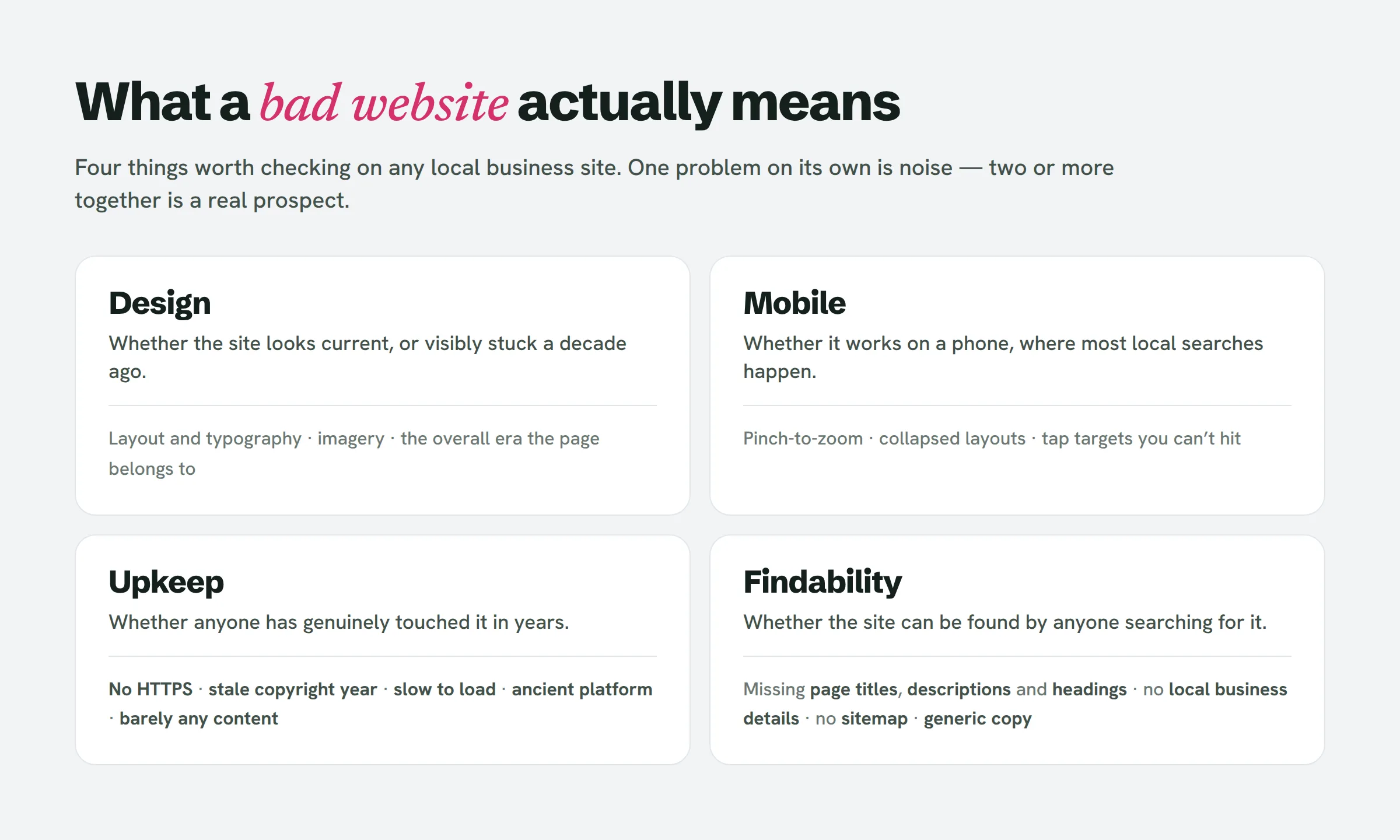
Take the same Maps results, but this time keep the businesses that do carry a URL. Then weigh each one against signals you can genuinely reproduce:
- No SSL. The URL runs on HTTP, or the browser flashes a warning. There’s no arguing with it, and it is bleeding them customers right now.
- Broken on mobile. You end up pinching to zoom, or the layout falls apart on a phone.
- Load time over four seconds — and count anything over eight as a wholly different grade of bad.
- Broken core links. The contact form returns a 404, the phone number isn’t wired up as a tel: link.
- A stale copyright year — a couple of years out is a clue, a decade out is a verdict.
- A dead platform — leftover Flash, table-based layouts, frames, a CMS nobody maintains, a builder that folded.
- Barely any content — a homepage carrying a sentence or two and nothing more.
A lone signal is just noise. A sluggish site could be sitting behind an aggressive CDN. A stale footer year could be parked on a site rebuilt last month. Two signals side by side make a candidate. Three or more mark a business steadily shedding customers without realising it.
The rule that keeps the list honest: a dated colour palette is not evidence. A contact form that won’t submit is. Grade on the things that fail, not on the things you happen to dislike.
Vetting a few dozen sites by hand fills a fair afternoon. Vetting an entire city does not, and that is the moment people either hand it to a machine or quietly walk away. LeadReef runs every check above for you — it sweeps a city, marks what’s broken on each site, and clips the contact details to it — and your first 10 leads cost nothing.
Which businesses that need a website actually have budget
Each list is stuffed with prospects who will never write you a cheque, and weeding them out early is the bulk of the job.
Rule out franchise locations — the site is a corporate call made three states over. Rule out any business whose whole model rides on a marketplace: a cleaner booked wall to wall through Thumbtack has no interest in a website, they want more Thumbtack. Tread carefully with sub-10-review listings; thin reviews usually signal thin volume, which signals no budget.
The profile you’re after is the reverse: heavy review counts, years on the clock, a trade where the jobs are worth real money — roofing, HVAC, dental, legal, speciality retail. A contractor invoicing $12,000 jobs will happily lay out $4,000 on a site that lands two more of them. A nail salon working $40 tickets, in most cases, won’t.
Run that filter over both lists and the list of businesses without a website thins out in a hurry, since the no-site crowd tilts toward the smallest operators. The bad-website list weathers it better — having once paid for a site is itself a budget signal.
Do the maths before you sink a month into this. Audit 200 businesses, pass 60 through your qualification bar, land a decision-maker at a third of them, and you’re holding twenty real conversations. At a 10% close rate that lands two projects. Whether that counts as a good month rides entirely on your price — and that sum is the one most guides on the subject leave out.
The pitch changes depending on which list you are working
The same service, but two separate openings.
With no-website prospects, open on the cost of not having one, and keep it concrete: the searches running in their category this month, the competitor already ranking for the term they’d own. Never lead with “you don’t have a website.” They’re well aware.
With bad-website prospects, open on evidence. A single visible failure, what it’s costing, and what you’d do about it. “Your contact form has been returning an error since at least March — here’s the screenshot. Anyone who filled it out thinks they’ve reached you.” That reads as information, not a jab, and it is remarkably hard to brush off. There’s a first line for each failure if you want the exact wording.
Both land harder when the work is already half-finished. A three-page mockup built on their own photos, or a sixty-second screen recording of their site buckling on a phone, converts several times better than a block of text. It is more work per prospect. Send ten of those in place of two hundred emails.
People also ask
How can I find a local business that doesn’t have a website?
On Google Maps, look up the trade alongside the city and scan for listings that carry no website link. Before you file anyone away, confirm their review count and whether the listing is claimed.
How to find small businesses that don’t have websites?
The Maps approach again, filtered down to one trade. Licensing boards and chamber-of-commerce directories make handy backup sources, because freshly registered contractors tend to show up there well before they build any presence online.
How to find outdated websites?
Load each site off your Maps list and look for absent SSL, layouts that don’t respond, pages that take more than four seconds to load, contact forms that fail, and a footer copyright year no later than 2020. When two or more of those show up at once, you have a qualified prospect.
What businesses need a website the most?
The trades where customers shop around before they phone and where the ticket is large — roofing, HVAC, dental, legal, speciality retail. The ones that rely completely on marketplace bookings have the least need for one.
Do you still need a website in 2026?
Yes, for any business whose customers do their homework before they buy. An independent site is the sole channel the business owns outright; a platform profile can rewrite its terms or vanish overnight.
Where to start
If you can only work one list, work the bad-website list. It takes longer to build because no tool serves it to you, and that is precisely the point — the prospects on it haven’t been pinged eleven times already, they’ve already shown they’ll pay for what you sell, and the evidence writes the pitch for you.
Build it once, and build it right, for a single trade in a single metro. Twenty qualified prospects each carrying a documented failure will out-earn two thousand scraped rows, and you’ll understand exactly why it paid off.
And if you’d sooner skip building the scanner yourself, LeadReef gives you your first 10 leads completely free — choose from any of 10 business types and 10 locations, and back come businesses with their weak spots already flagged and contacts attached. Paid plans unlock every business type worldwide, in whatever combination you like. That’s plenty to try the method on a real city this week and learn what your close rate really is.