
Website Redesign Quote: How to Answer “How Much?” When a Local Business Replies to Your Pitch
The owner has already seen a prototype of their new site. When they write back one line — “How much?” — the scope is fixed. This is the one situation where quoting in writing, with a number in the first line, is the right answer.
You sent a local business a short pitch and a link to a prototype of their new site. Two days later the owner writes back one line: “How much?” This is the moment a website redesign quote either keeps the conversation going or ends it. Most beginners do one of two things. They name a figure off the top of their head and later regret it, or they reply “it depends, can we jump on a call?” and never hear back.
Almost every guide to pricing questions says the same thing: don’t quote before you understand the job, get them on a call first. That advice is written for enquiries that come in, where the seller knows nothing yet. Your situation is the other way round. You made first contact, and you have already built the thing they are asking about. This guide covers what to send, in writing, in each of the situations you will actually meet.
Why the usual advice doesn’t fit a reply to your pitch
We read eight of the pages Google ranks for this question in September 2026: a 2013 SitePoint forum thread, sales coaching posts from Million Dollar Coach (2018) and Quick and Dirty Tips (2011), two long quoting guides from Made Simple Media (2023) and Web Help Agency (updated 2025), OceanWP’s scope-of-work guide (2025), a 2026 owner-facing price guide from The Ghost Runner, and Launch the Damn Thing on listing prices.
They share three assumptions:
- The client came to you. Every scenario is an enquiry, a form or a consultation call. None deals with an owner replying to a pitch they didn’t ask for.
- Scope is unknown until you talk. So the advice is to qualify first: “before I can give you a price I need to find out more about you.”
- The answer is spoken. The scripts that exist are call scripts. None of the eight gives wording for an email or text reply.
None of the eight mentions a prototype. That matters, because a prototype is discovery already done. You chose the pages, wrote the copy and picked the layout. The owner has seen it. When they ask “how much?”, they are asking the price of a specific thing in front of them, and you know exactly what that thing is.
Holding the price back until a call asks a stranger to give up half an hour before they know whether you’re even in their budget. In a sales thread that ranks for this search, a seller describes the stand-off from the other side: prospects refuse a call until they have seen pricing, and go quiet when the pricing arrives without context. With an owner you reached cold, you have no relationship yet to spend on that.
How much does a website redesign cost, as far as the owner knows?
Before you reply, look at what the owner probably saw when they searched. These are the first results for “how much does a website redesign cost” in September 2026:
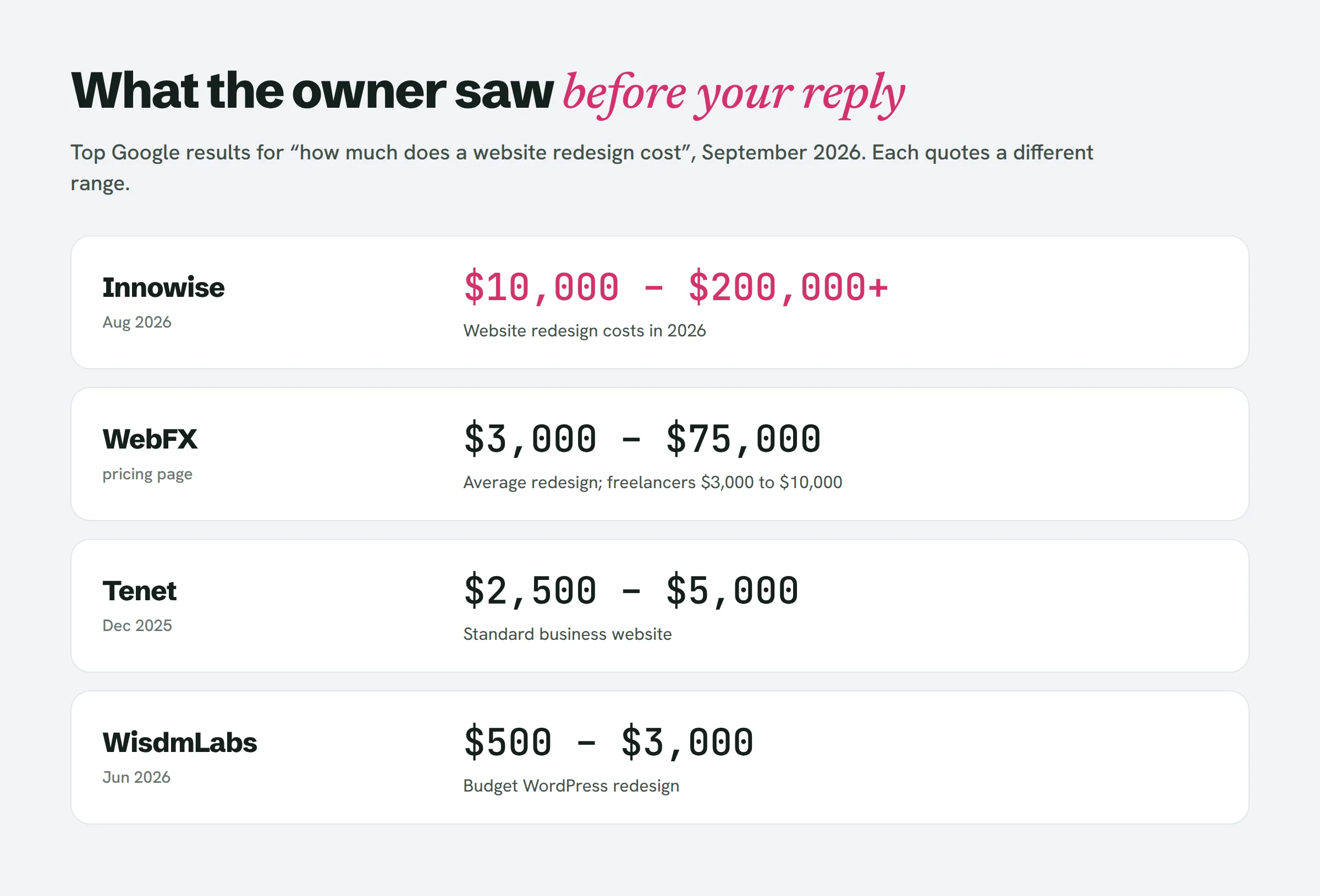
The owner has no way to tell which of these applies to them. If your reply is also a range, say “$1,500 to $5,000”, it doesn’t help. They read the top number and add it to the pile. One number, for the thing they saw, is the first concrete fact about price they’ve been given.
This article doesn’t tell you what that number should be. That depends on your costs, your market and how long the build takes you. It tells you how to send it.
How to quote a website in writing: three situations
What you send depends on how much of the job is already fixed. There are only three cases.
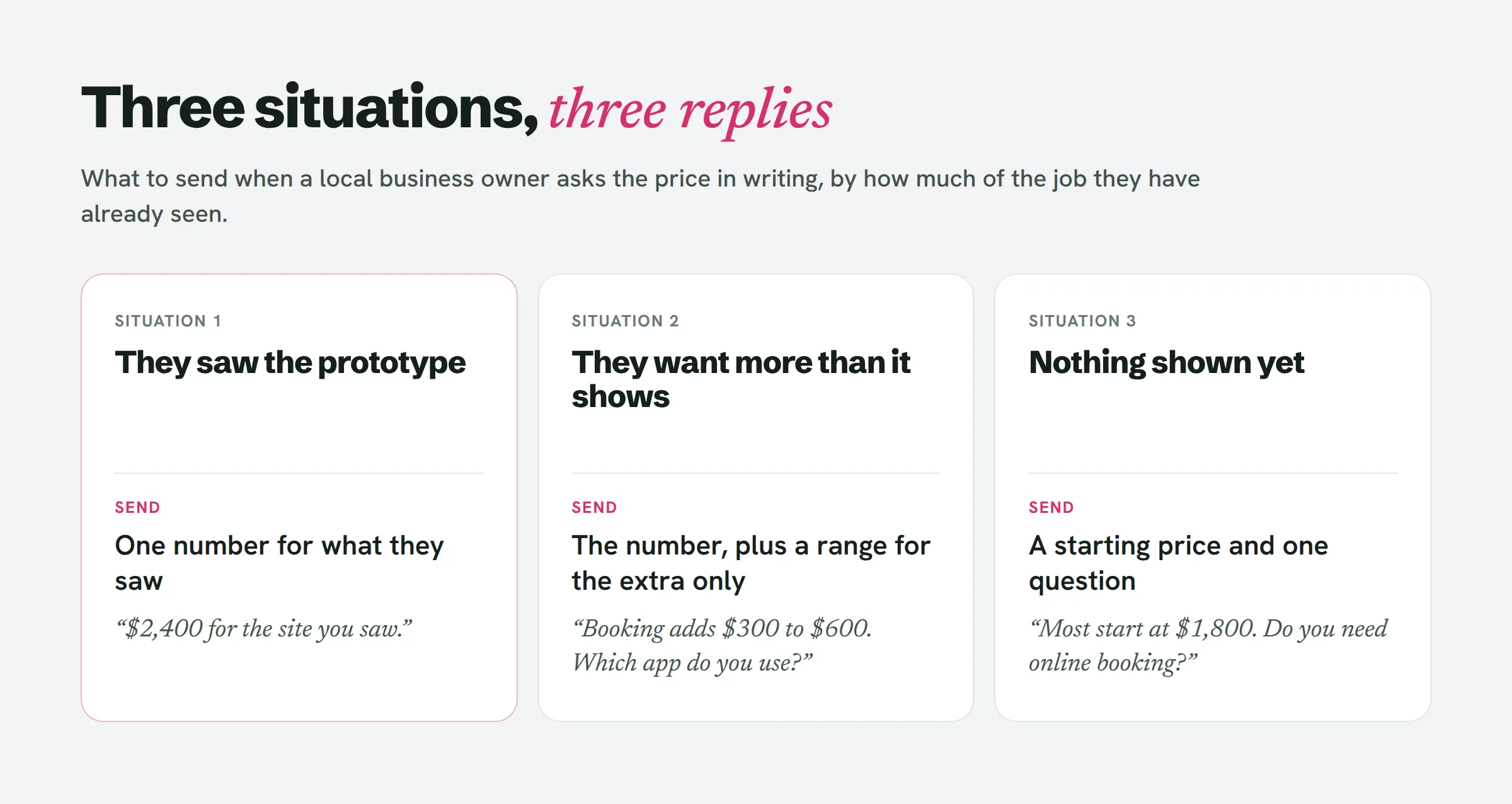
1. They saw the prototype and asked “how much?”
Send one number. The scope is the prototype, so price the prototype. No range, no “starting from”.
Hi Maria, $2,400 for the site you saw, live on your own domain within three weeks of a go-ahead. That covers the five pages in the preview, moving your menu and photos across, and making the booking button work on phones. It doesn’t cover new photography or an online shop. Hosting and the domain come to about $180 a year after that, paid by you directly, so you own them. If you’d like to go ahead, just reply “yes” and I’ll send a one-page agreement and a deposit invoice.
(The dollar figures are an example, not a recommendation.)
2. They want more than the prototype shows
Owners often reply with an extra: “How much with online booking?”, “Could it have a shop?” Keep the number you already have and put a labelled range next to the new part only.
The site as you saw it is $2,400. Online booking adds $300 to $600 depending on whether you keep your current booking app or move to a new one. Which do you use now?
The fixed part stays fixed. The range covers only what you haven’t seen yet, and the question at the end is the one fact that closes it.
3. You didn’t send a prototype, or they haven’t opened it
This is the only case where you truly don’t know the scope. Give a starting price for your usual small site, so they can rule you in or out, and ask one question, not a questionnaire.
Most sites I build for local businesses start at $1,800. The biggest thing that moves the price is whether you need bookings or payments online. Do you?
Then build the preview. A starting price with no preview is the weakest answer you have, which is why the prototype comes first in the pitch.
The five lines every web design quote reply needs
Whatever the situation, the reply carries the same five things, in this order:
- The number, in the first line. Owners on a phone read the first line and maybe the second.
- What it covers, in the owner’s terms: pages, the button that works, the move of their existing content.
- What it doesn’t cover, named. New photos, a shop, ongoing edits, and moving off a builder that doesn’t export, if that applies. Naming exclusions now saves an argument later.
- The running cost per year, as a number, and who pays it. An owner who has been paying a builder monthly will ask this next if you don’t answer it first. Keeping the domain and hosting in their name is also the honest answer to “what happens if you disappear?”
- One next step they can take by replying. “Reply yes and I’ll send the agreement” works. “Let’s book a call to discuss” asks for time before they’ve decided anything. Offer a call as an option, never as the price of the answer.
Three things never go in: an hourly rate (it makes the total unknowable), “it depends” with nothing after it, and a discount they didn’t ask for. If you want to give your first client a lower price, invoice the full price and show the discount as a line, as described in our guide to trading a free website for a testimonial.
When the reply comes back “that’s too much”
Don’t cut the number. Cut the scope, and say which part you’d drop: “I can do it for $1,600 as three pages instead of five, with the menu and gallery on one page.” Lowering the price for the same work tells the owner the first number was made up. Other objections, like “my nephew does it” or “I just paid for this one”, are covered in our guide to web design client objections.
People also ask
How do you answer “how much does it cost?”
In writing, with a number in the first line if you know the scope, and a starting price plus one question if you don’t. After a prototype, you know the scope.
How do I quote for a website?
Price the pages, features and content move you can see, name what is excluded, add the yearly running cost, and give one next step. When a prototype exists, it is the scope.
How much to charge for a website redesign?
It depends on your costs and market, which is why published ranges run from $500 to over $200,000. Work out your own number before you pitch, so the reply takes minutes, not a day.
Is $1,500 a good price for a website?
It sits inside the $500 to $3,000 band for a budget WordPress redesign and below the $3,000 to $10,000 range for freelancers. What matters more is whether it covers your time on the build you’ve already scoped.
How do you respond to clients who say the price is too high?
Keep the price and reduce the scope, naming what you’d drop. Cutting the price for the same work makes every number you’ve sent look negotiable.
The prototype is the quote
The hard part of a website redesign quote is usually not knowing what you’re quoting for. Build the preview first and that problem goes away: the owner asks the price of something real, and you can answer in one line.
Finding local businesses whose sites need that preview is the slow part. LeadReef finds them, builds the prototype and drafts the pitch, and your first 10 leads are free. Choose from 10 business types and 10 locations, in any mix, at leadreef.ai/find.