
Free Website in Exchange for a Testimonial: Why Not a Google Review, and What to Ask For Instead
Nearly all of the free-site bargain holds up. The single piece that does not is exactly the one beginners grab for first: the Google review.
When you have not landed a single client, offering a free website in exchange for a testimonial feels like the natural opening play. A form of it turns up in every “first client” guide: build something for a local business for nothing, ask for a review, feature it on your site, and start charging.
The bulk of that bargain is sound. One piece is not, and it happens to be the piece beginners grab for first: the Google review. Google’s own Maps policy names “free goods and/or services in exchange for posting any review” as forbidden, and states that reviews left this way get taken down. So the marquee item in the swap is the very thing you cannot gather cleanly, and the page 1 guides either gloss over this or actively tell you to ask for it.
This article walks through what the review swap wrecks, what a free or discounted first client can hand you (four items that do more for your next pitch than a star rating), and a brief rule for when building free is even worth it.
Should I work for free to build my portfolio?
The candid answer from the pages that rank pulls in two directions. Design organisations like AIGA and RGD publish stances against spec work: free work cheapens the craft and trains clients to expect it. Beginner guides say “one to three free projects, then quit.” Both are quarrelling over the price. Neither examines the terms carefully, and the terms are where a free project succeeds or fails.
Three things hold true for anyone selling websites to local businesses:
- A free full build costs you an entire project. Chasing content, revisions, the launch, and the support emails afterwards. That is the pricey part, not the design.
- You do not need a client to own a portfolio. A prototype of a real business’s site, produced unprompted and labelled honestly, demonstrates the same skill in a fraction of the time. The portfolio-from-prototypes method lays out that path in full.
- What comes back to you decides whether it paid off. A free build that closes with a fuzzy “thanks, looks great!” was charity. One that closes with a named case study and two introductions was marketing.
So if you do build free, the real work sits in the exchange. Begin by lifting the Google review out of it.
Why “a free site for a Google review” is the one swap to avoid
Two rulebooks apply here, and they are not equally strict.
Google’s rules are the tougher of the two. The Maps user-contributed content policy bans offering “incentives – such as payment, discounts, free goods and/or services – in exchange for posting any review,” and says any content posted because of such incentives will be pulled from Maps. A free website handed over on the understanding that the owner reviews you is precisely that. It makes no difference that the review would be honest.
The real-world cost runs past a single deleted review. Your Business Profile is what a future local client inspects. Reviews that vanish, or a profile flagged for incentivised reviews, is a worse footing than having no reviews at all.
The FTC’s rule is narrower in scope. The US Consumer Reviews and Testimonials Rule (16 CFR part 465, in force since October 21, 2024) does not outlaw incentives for reviews across the board. What it forbids is conditioning the incentive, explicitly or by implication, on the review turning out positive. The FTC’s own guidance adds that failing to disclose an incentive can still violate the FTC Act. “Free site if you leave me five stars” trips the rule. “Free site, and afterwards I’d love your honest feedback” does not, provided you disclose wherever you publish it.
Taken together: under the FTC rule you may swap a free build for honest, disclosed feedback. Under Google’s policy you may not swap it for a Google review at all. (This is a straightforward reading of both documents, not legal advice. If you sit outside the US, check your own consumer-protection rules as well.)
What to ask for instead of a Google review
A review is a feeble thing to ask for anyway. It amounts to a handful of stars and one sentence on a profile your next prospect may never even open. The following four carry more weight when you pitch the next local business, and not one of them clashes with the rules above.
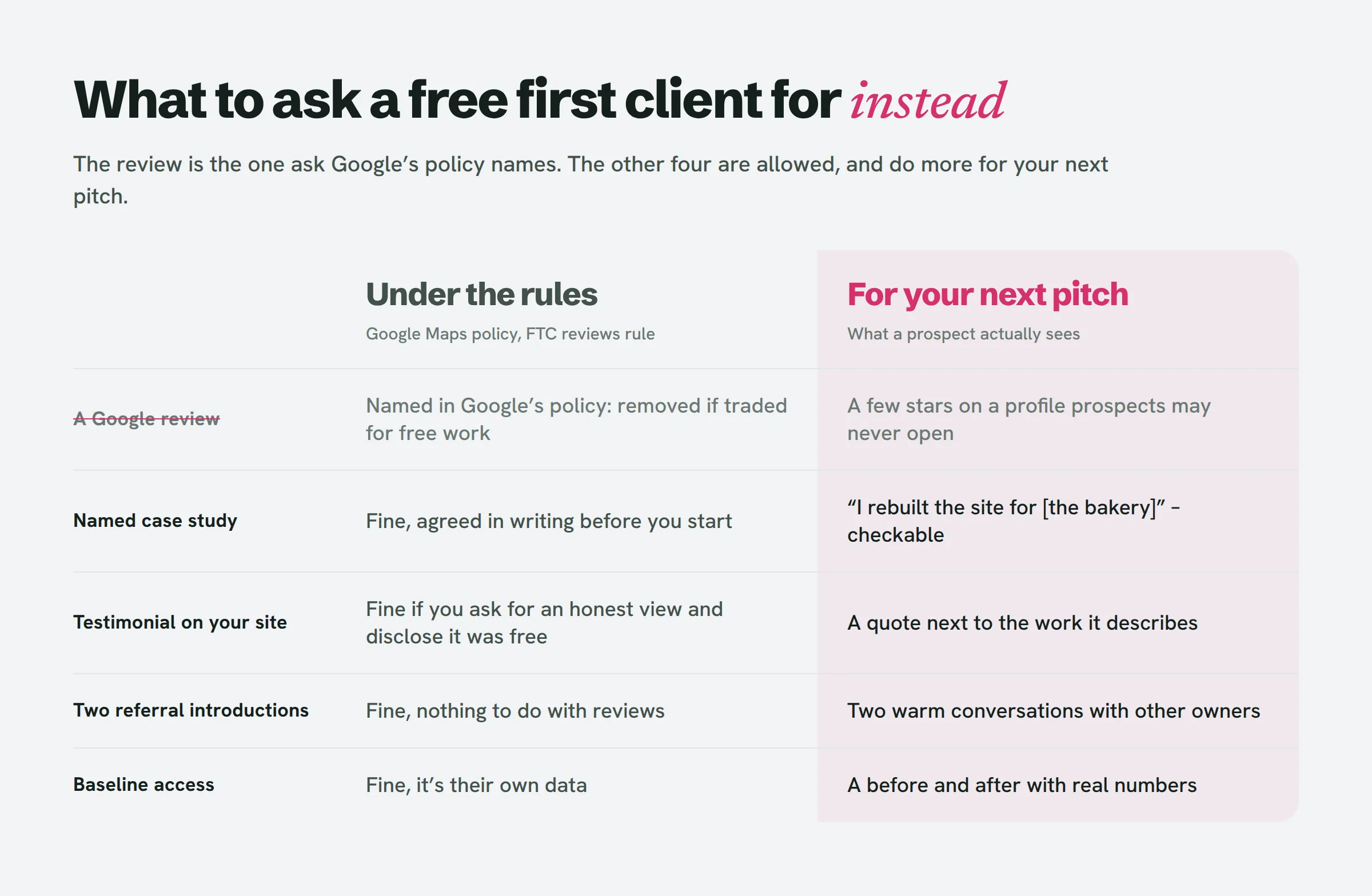
1. Permission to publish a named case study
The single most valuable thing a first client can hand you is their name sitting beside your work. It lets you say “I rebuilt the site for [the bakery on Main Street],” complete with the before and after, rather than “a local business.” Settle it in writing before you begin: you are free to name the business, show screenshots of the old site alongside the new one, and describe the change. That is exactly what a web design case study calls for, and it is what a doubtful prospect will check.
2. A testimonial on your own site, asked for with no conditions and disclosed
A testimonial for your portfolio is permitted, subject to two rules:
- Ask for their genuine view, whatever it turns out to be. Do not propose wording or a score, and do not hinge the free work on a positive answer. If what they write is tepid, that itself tells you something worth knowing.
- State that it was free or discounted. A brief line beneath the quote will do: “Built at no charge as one of my first projects.” Concealing the arrangement is precisely what the FTC guidance cautions against. It also costs you almost nothing: a prospect who knows you were just getting going trusts the quote more, not less.
3. Two referral introductions
Local business owners are connected to other local business owners: the café next door, the supplier, the friend running a salon. Ask them to make two introductions a few weeks after launch, once the site has earned its keep. A warm introduction from someone the owner already trusts outranks any pile of stars, and it converts one free project into two paid conversations.
4. Access to a baseline
Ask the owner to add you as a manager on their Google Business Profile (or to export its performance figures) before the switch, and to jot down calls and bookings across a month. With no before, all you can claim is that the new site looks nicer. With one, you can show what changed, and that is the line that persuades the next owner to pay.
Discount for your first web design client: the cleaner option
A steep discount usually beats free, for three reasons. The owner has skin in the game, so they reply to your emails and send over the photos. The project is a genuine purchase, so the client is a genuine customer. And a paying customer is free to leave a Google review like anyone else, so long as you ask after the work and the price never turned on it.
Two details make it work:
- Invoice the full price, then take the discount off as its own line. “Website: $1,200. First-client discount: −$900. Total: $300.” The owner sees what the work is genuinely worth, and your next quote does not read like a price hike.
- Never bind the discount to a review. “I’m taking on a few first clients at a lower rate” is a pricing decision. “Half price if you review me” is the swap Google bans, just with a smaller number attached.
Spec work in web design: where free actually makes sense
“Spec work” (short for speculative work) means producing work in the hope of getting paid for it. The design world objects to it because the client walks away with something for nothing while the designer shoulders all the risk. For a beginner selling to local businesses, three sorts of free work get bundled under that label, and they are not the same bargain.
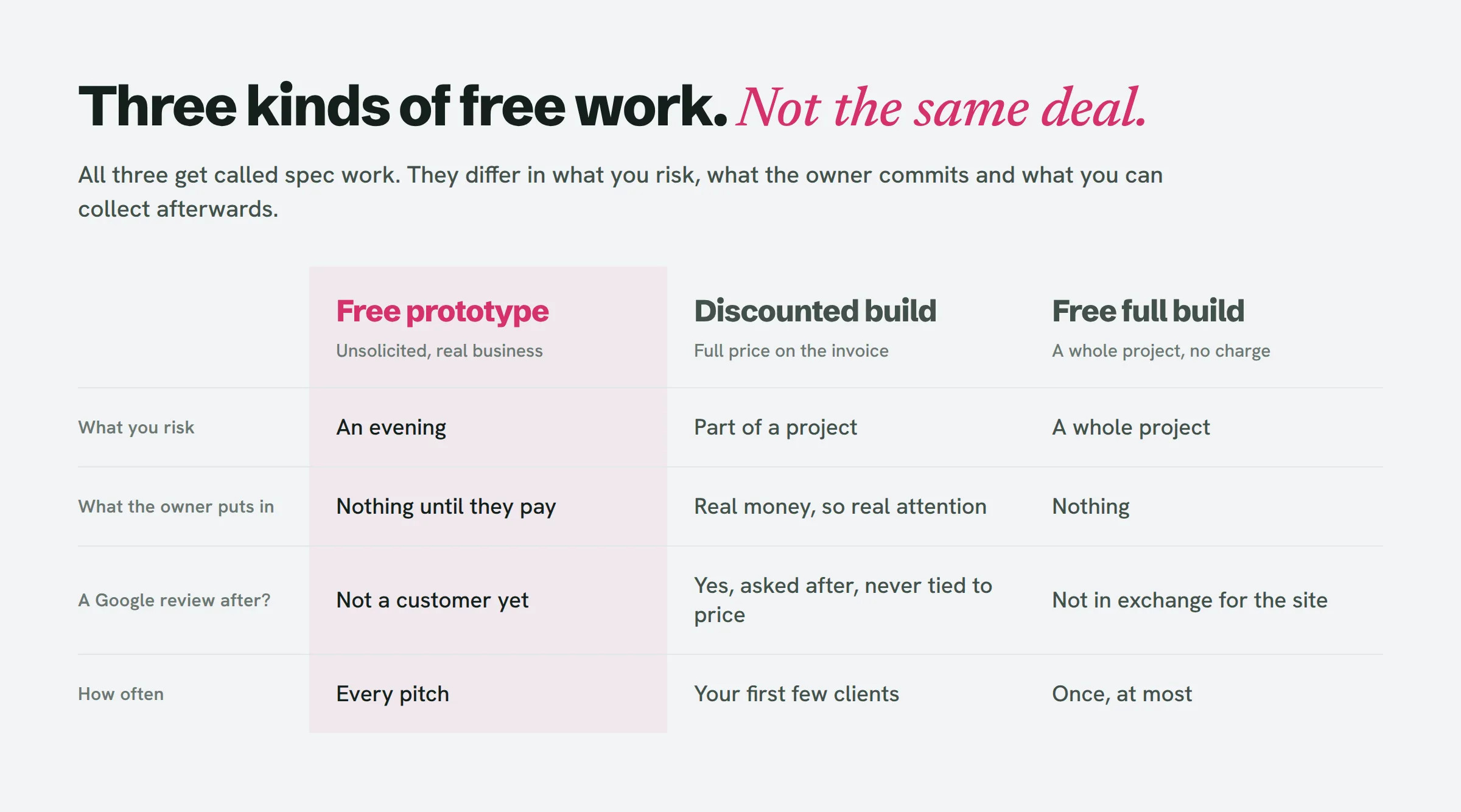
- A free prototype, unsolicited. You build a first cut of a real business’s site and show it off. The owner gets nothing usable until they pay you, and all you have put at stake is an evening. This is the version worth repeating, because the prototype doubles as the pitch. Building one by hand for each prospect eats an evening; LeadReef locates businesses with weak sites and ships a prototype for every lead, so the evening goes into the pitch instead.
- A discounted full build. Covered above: for most people, the strongest first-client setup.
- A free full build. Worth doing once at the very most, and only when every one of these holds:
- You would have built something similar anyway, for the practice.
- The scope is written down: how many pages, how many revision rounds, and an end date.
- The domain and hosting sit in the owner’s name from day one, so no clumsy handover looms later on.
- The exchange is the four asks above, agreed before you start, with no Google review anywhere in it.
If you cannot secure all four, charge something, even a token amount.
People also ask
How much should I charge for website design as a beginner?
Charge enough that the client treats the job as real and you walk away with a genuine invoice. A common approach is to name your ordinary local rate and then apply an openly labelled first-client discount, so the true price is on record and the reduction is plain to see. The exact figure matters less than having the scope written down.
Where can I get testimonials?
From anybody you have genuinely worked for: a first client who paid a reduced rate, a free build set up on honest terms, or a former employer who watched you deliver. Request their candid opinion with nothing attached to it, and note any free or discounted deal right beside the quote.
Where do testimonials go on a website?
Right next to the work they refer to. A quote sitting on the case-study page for that project, carrying the business name and a link through to the live site, beats a rotating slider of first names on your homepage, because a prospect can actually verify it.
Can you build a portfolio website for free?
Yes. The free tiers offered by the big builders and static hosts cover a portfolio comfortably. The trickier question is what fills it. Prototypes built for actual local businesses, plus one or two named projects showing a before and an after, produce a far stronger portfolio than template demos do.
How to get your first web design client without giving a project away
Build free once at the most, and trade the work for a named case study, a disclosed testimonial, two introductions and a baseline — never for a Google review. For most first clients, a discount invoiced at full price is the cleaner arrangement. And to assemble a portfolio without surrendering a whole project, prototypes get it done at an evening apiece.
If you want a list of local businesses whose sites are worth rebuilding, LeadReef hands you your first 10 leads completely free. Choose from any of 10 business types and 10 locations, and every lead arrives with its weak spots flagged, contacts attached and a prototype ready to show. Paid plans unlock every business type worldwide, in any combination.