
Website Redesign Proposal for a Local Business: One Page, Built From the Call, Answered by Reply
The proposal a local owner reads after your pitch, prototype and ten-minute call is one page, not six: their words, the failure, what changes with the prototype link, one price, the yearly running cost, the three things you need, a day count, a validity date and “reply yes”. A filled-in example is at the end.
You said “one page by Thursday” on the call. Now it is Wednesday night and every website redesign proposal template you can find has a cover page, an executive summary, a bio, a case-study section, a pricing table with three packages and a signature block, and the proposal software that publishes those templates says the proposals that win run to six pages and eight sections. None of that is for the owner of a plumbing firm who gave you ten minutes between jobs, has already seen the prototype of their own site, and will read what you send on a phone.
This piece is the one page for that owner: why it is one page when the data says six, the seven blocks it carries in order, where each block’s content comes from (most of it is the six answers from the call), what the templates include that you leave out, the day you name and the way they say yes. There is a filled-in example at the end. What happens after the yes, the deposit, the domain and the logins, is its own job and its own piece.
Why a one page proposal when the proposal software says six
The two companies with the most data on proposals both argue against one page. Better Proposals, from a reported 180,000 signed proposals, puts the ideal at six pages and eight sections (introduction, service description, process and timescales, case study, investment, guarantee, next steps, terms) and says of one-page templates that “one page just won’t cut it,” allowing them only for small jobs with existing clients. Qwilr’s review of just over a million proposals sent through its tool found that those of six pages or fewer were accepted 66% more often than longer ones, which is a ceiling, not a target. Proposify’s 2026 report on 742,137 proposals gives no page count at all and says length “depends on the complexity, the deal size, and sales stage.”
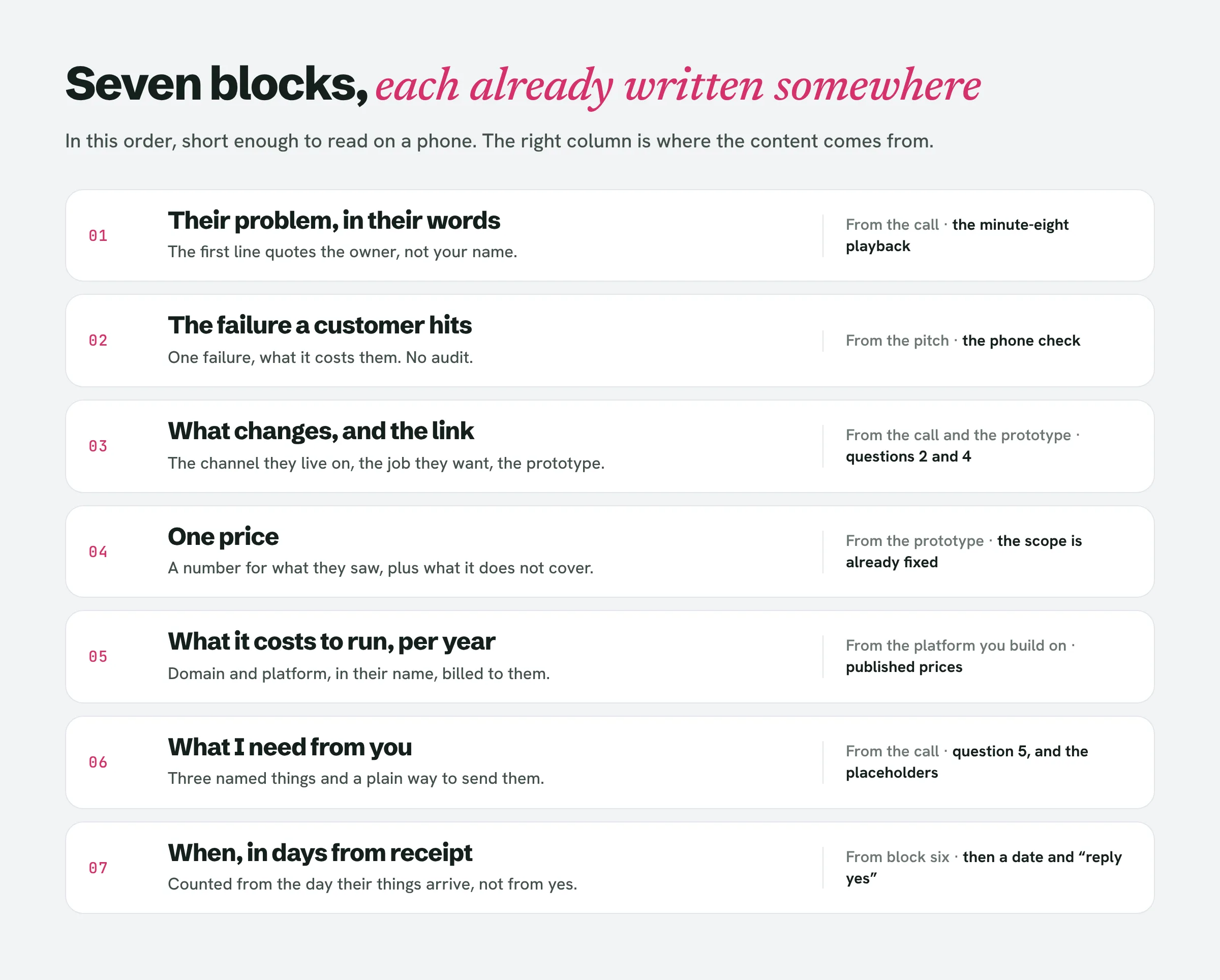
Sales stage is the point. Those six pages exist to do three jobs for a buyer who has not met you: introduce you, prove you can do the work, and discover what they need. In your case all three happened before the document. The pitch introduced you, with a named failure on their own site. The prototype proved the work, on their own business, better than any case study of someone else’s. The call did the discovery, and you wrote the answers down. Better Proposals’ own exception, the small job for a client who already knows you, describes a local owner who has replied to your email, opened your prototype and spent ten minutes on the phone with you more closely than it describes a stranger. Better Proposals also reports where readers spend their time: 34.6% on the introduction page and 27.1% on the investment page, which is to say on the part that is about them and the part that is the number. A one page proposal is those two parts with the connective tissue cut.
There is a second reason that has nothing to do with data. The owner will read this on a phone, probably in the van, and Proposify’s figure for the gap between opening a proposal and closing it is two and a half days on average. A PDF with a cover page and a table of contents does not survive a phone screen; a page of short blocks does. So the one page is not a PDF attached to an email. It is the email, or a single page at a plain link, with the prototype linked from inside it.
The website proposal format: seven blocks, in this order
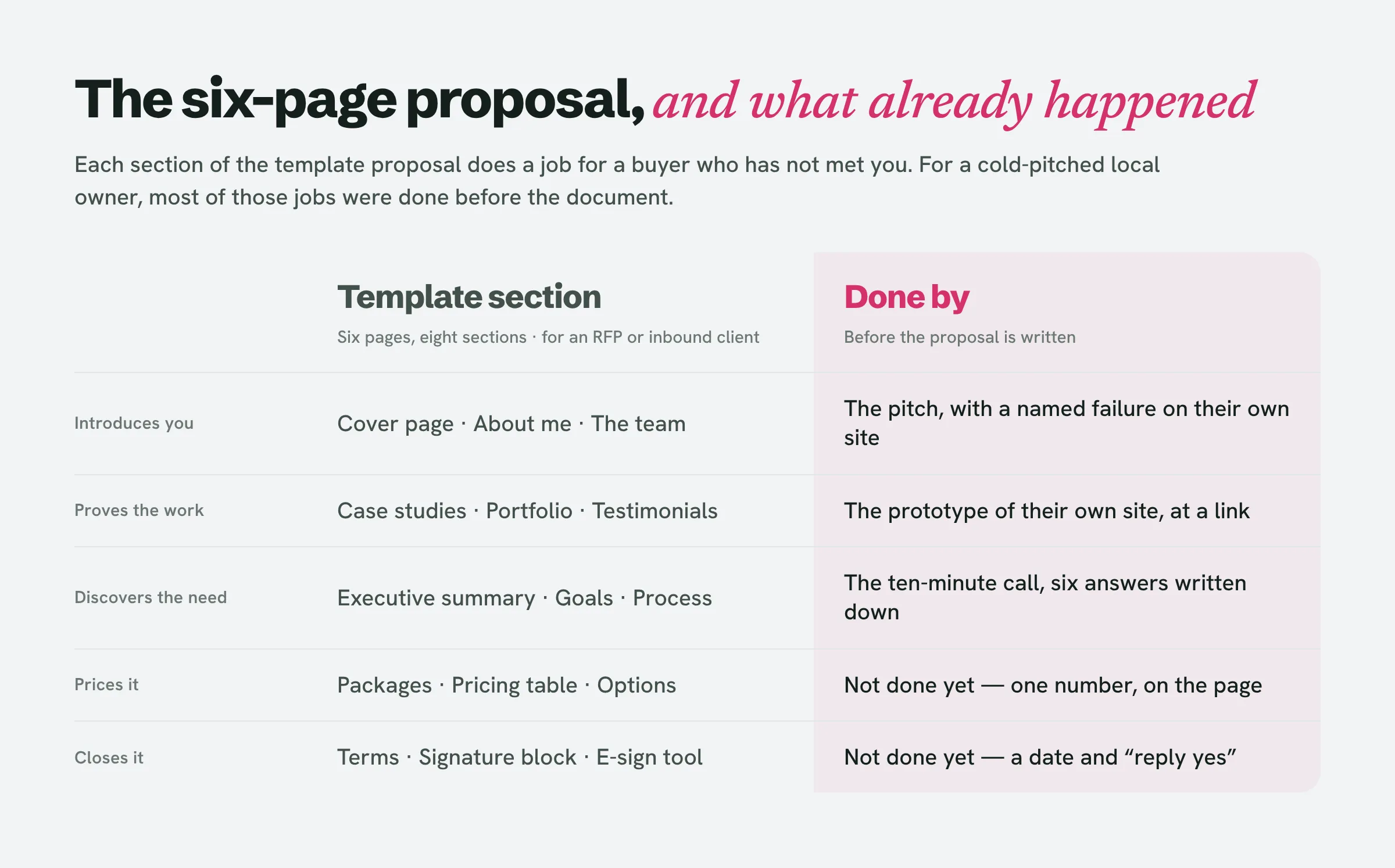
Every block is short enough to read on a phone without scrolling inside it, and every block’s content comes from something you already have: the pitch, the prototype or the six call answers.
1. Their problem, in their words. The first line is not your name and not “Proposal for”. It is the thing the owner told you on the call, quoted back: “You said most new customers find you on Google, they call, and about a third of the calls get missed because you’re under a sink.” That line does the work a template’s introduction and executive summary do, in one sentence, and it does something they cannot: it proves you listened. Of the twelve ranking pages read for this piece, only Wix Studio’s guide says to reflect the call “in the client’s words”; Webflow’s says the opposite, restate it in your own. Use theirs. The playback sentence you used in minute eight of the call is this line.
2. The failure a customer hits. One or two sentences naming what you found on the current site and what it costs them, which is the pitch restated for someone who may have forgotten it. “On a phone your contact form doesn’t submit, and your number isn’t tappable, so a customer who can’t get through has no second way to reach you.” No screenshots, no audit, no list of eleven issues. One failure the owner can check themselves, which they already did, or they would not have replied.
3. What changes, and the link. What the new page does about the failure, tied to the answers from questions two and four: the contact channel they live on and the job they want more of. “One page. Your number is the first thing on the screen and it dials when tapped. A form that works on a phone and texts you the enquiry. Bathroom refits at the top, with the three photos you mentioned; the small repairs further down.” Then the prototype link, with one line saying what it is: “Here is the page as it would look, with placeholder photos until yours arrive: [link].” The prototype is the case-study section. Every template read for this piece has a case study, a portfolio or a testimonials block, and a beginner with no clients has nothing to put there; the owner’s own site, rebuilt, is worth more than three strangers’ sites anyway. If the prototype came out of LeadReef it is already deployed at a link you can paste; if you built it by hand, deploy it before you send, because a screenshot is not a page the owner can tap through.
4. One price. A single number for what they saw at the link. Not a range, not three packages, not a table. The reasoning is in our piece on answering “how much?” when a local business replies to a pitch, and the short version is that the prototype has already fixed the scope, so there is nothing for a range to cover, and a choice of packages is a decision, and a decision is a reason not to reply. The one addition the proposal makes to the quote rule is a second line for what the price does not include: “This covers the page you saw and putting it live on your domain. It doesn’t cover new photography, writing beyond what we discussed, or changes after launch; those are priced separately if you want them.” Whether to ask for part of the number up front, and how, is its own piece.
5. What it costs to run, per year. The line almost nobody writes and the one an owner who has been burned before is looking for. The site needs a domain and somewhere to live, and the owner pays for both after you leave, so say what, to whom, and how much. “Your domain stays in your name and renews at about $11 to $23 a year depending on where it’s registered. The site itself runs on [platform] at about $[x] a year, billed to your card, not mine.” The numbers depend on what you build on: at renewal, a .com costs $10.46 at Cloudflare, $18.68 at Namecheap and $23.19 at GoDaddy (prices checked 14 October 2026), and a builder plan runs from roughly $132 a year at Hostinger to $228 at Squarespace, with Webflow at $180 and Wix around $213; our piece on picking a platform for client sites has the full table and what happens when each bill lapses. Eleven of the twelve ranking pages omit running costs entirely; Wix Studio’s mentions “domain registration” as a recurring hard cost to flag and stops there.
6. What I need from you. Three things, named, with a plain way to send them. Not “content” and not a questionnaire; the three things the prototype has placeholders for. “Six to ten photos of recent jobs, phone photos are fine, sent to this address or by text. The login to wherever your domain is registered, or the name of the person who has it (you thought it was your nephew). A yes or no on the three services I’ve listed, and any I’ve missed.” This block exists because the timeline in the next block depends on it, and because getting photos and text out of a local owner is the slowest part of every small project. Only Qwilr’s guide lists what the client must supply, and it lists it for an agency intake, not as three items on one page.
7. When, counted in days from the day your things arrive. Not a date, because the date depends on block six, and not “two to three weeks” with no anchor. “Once the photos and the domain login are in, the page goes live within [n] days. I’ll send you the finished version at the same link for you to check first, and I’ll fix anything you spot in that window at no charge.” Count from receipt, say so, and the owner who takes three weeks to send photos cannot read the delay as yours. One of the twelve pages, One Week Web Designer’s, gives a timeline in days; the rest give milestones, dates or nothing.
Then two lines that are not blocks. A validity date: “This price holds until [date, two weeks out].” Wix Studio’s guide recommends an expiry and PandaDoc’s one-page template carries a thirty-day one; the rest of page 1 omit it, and without it the proposal sits in the owner’s inbox as an open offer for a year. How to say yes: “Reply yes to this email and we start. No forms.” Every ranking page that covers acceptance at all routes it through an e-signature tool; a reply is a contract-free yes that a local owner will send from a phone, and whether the project needs a signed agreement on top is a separate question with its own piece.
What the website redesign proposal templates include that you leave out
The templates read for this piece carry between five and nine sections. Cut, do not trim, the ones that do a job already done. The cover page and the title, because an email has a subject line, and “Your new page, as discussed Tuesday” is the title. About me and the team, because there is no team, and the owner asked everything they wanted to know about you on the call; if you must, one line at the bottom: “I’m [name], I build one-page sites for trades in [city].” Case studies and testimonials, replaced by the prototype of their own site, as above; a beginner’s first proposal with an empty social-proof section reads worse than one without the section. Packages and options, cut for the reason in block four. Process and methodology, because an owner does not want to know about discovery, wireframes and revision rounds; block seven says when it goes live and that they check it first, which is the whole process from their side. Terms and conditions, because this page is an offer, not a contract; whether you need one is its own piece. A signature block, replaced by “reply yes.”
What survives from the templates is the order of the parts: problem, solution, price, timeline, next step. Every one of the twelve pages agrees on that order and they are right. What they add around it is for a buyer who has not met you.
A website redesign proposal example, filled in
The whole page, for a made-up plumber, so you can see the length. The details are invented; the shape is the point.
Subject: Your new page, as we discussed Tuesday
Hi Dave,
You said most of your new customers find you on Google and call, and that about a third of the calls get missed when you’re on a job, and that you’d rather be doing bathroom refits than dripping taps.
On a phone, your current site’s contact form doesn’t submit and the phone number isn’t tappable, so a customer who can’t get through has no other way to reach you.
Here is the page as it would look, with placeholder photos until yours arrive: [link]. One page. Your number is the first thing on the screen and it dials when tapped. A short form that works on a phone and texts you the enquiry. Bathroom refits at the top with three photos; repairs and boilers below.
$1,400 for the page you saw and putting it live on your domain. It doesn’t cover new photography, writing beyond what we discussed, or changes after launch; those are priced separately if you want them.
To run: your domain stays in your name and renews at about $11 a year. The site runs on Squarespace at $228 a year, billed to your card, not mine. There is nothing else.
I need three things from you: six to ten photos of recent refits (phone photos are fine, text them to this number); the login to wherever your domain is registered, or the name of whoever has it; and a yes or no on the three services listed on the page.
Once those are in, the page goes live within 10 days. You’ll see the finished version at the same link first, and anything you spot in that window I fix at no charge.
This price holds until 29 October. Reply yes to this email and we start. No forms.
[Name], [phone]
Just over three hundred words. It fits on a phone with two scrolls, and every sentence in it came from the pitch, the prototype or the call.
People also ask
How to write a 1 page proposal?
Start with the reader's problem in their own words, say what you will do about it, give one price, say what it costs them afterwards, say what you need from them, say when, and tell them how to say yes. Leave out everything that introduces you or proves you, if that has already happened. For a local owner who has seen a prototype of their own site, it has.
What are 5 things all proposals should include?
The twelve ranking guides agree on five parts in the same order: the problem, the solution, the price, the timeline, and the next step. For a local business add two the guides skip, the yearly running cost and the three things the owner must send you, and attach a date the price holds until.
How to write a proposal for a website?
For an inbound client with a brief, the template guides from Webflow, Wix Studio and Qwilr are fine: seven to nine sections, a cover, a schedule, a signature. For a local owner who replied to your cold pitch, write the seven blocks above as an email, link the prototype from inside it, and ask for a reply rather than a signature.
How much do freelancers charge for website design?
Published prices for a redesign run from a few hundred dollars to six figures depending on who is asked, which is why the proposal carries one number for the page the owner has already seen rather than a range. How to arrive at that number when an owner asks before any call is covered in our piece on answering “how much?”.
The proposal is the last step of a list
One page, seven blocks, three hundred words, sent on the day you said. It is short because everything hard happened earlier: finding a local business whose site fails on a phone, finding the owner’s name, building the prototype, writing the pitch, running the call. LeadReef does the first part of that list for you: it scans a city, flags the sites with problems a customer would hit, attaches the contacts it finds, generates a prototype redesign and deploys it at a link, and drafts the pitch for you to finish. The first 10 leads are free, from any of 10 business types in any of 10 locations, at leadreef.ai/find. When one of them replies and the call is done, the proposal is an evening’s work, and most of it is already written.