
How to Ask for a Deposit When You Have No Case Studies: The Version for a Local Business Owner Who Just Said Yes
How to ask for a deposit as a new freelancer: the words for the proposal, the email and the call, a $1,500 example, and the terms a stranger will accept.
The owner of the plumbing firm replied “yes” to your one-page proposal on Thursday. You have no case studies, no reviews, no business name on the invoice yet, and every guide on how to ask for a deposit tells you the same thing: fifty per cent up front, non-refundable, it’s standard, say it with confidence. That advice was written for a freelancer who does not know the client. Your problem is the opposite one. The client does not know you, and they are about to be asked to send money to a stranger with a Gmail address.
This piece is how to ask for a deposit when you are the unknown party: why the standard rule is aimed at the wrong stranger, the number for a job under $3,000, the four terms that make the deposit something an owner can say yes to, the exact words for the proposal, the email and the phone, the two objections you will hear and what to reply, and the four things that have to be true before you build anything. How you take the money and what the invoice looks like is its own piece, and so is whether the project needs a signed contract.
Why the web design deposit percentage on page 1 is sized for the wrong stranger
Twelve pages rank for the deposit queries a freelancer types, and they agree on the number: 25 to 50 per cent, with 50 for anything under about $5,000 (Contra), for “most project-based work” (Toggle Time Tracker) and for a new client’s first project (Landolio). They also agree on why. Toggle: “the less you know about a client, the higher your deposit should be.” Landolio’s table, for a new client: “No track record — protect yourself.” Freelance Cake goes further and says to require 100 per cent from new clients. Three freelancers interviewed by Creative Agency Book collected deposits from day one, and one of them, after twelve years, offers the line that explains what the deposit is really for: “If the client pays the up-front part, they always pay the last one.” The deposit is a test of whether the client is serious.
Every one of those sentences has the freelancer as the party with something to lose and the client as the unknown. For you, the direction is reversed. The owner has seen a prototype of their own site at a link, had a ten-minute call with you, and read one page. That is everything they know. They have no way to check that you finish projects, because you have not finished one. The deposit you ask for has to survive their question, not yours, and the twelve pages never write that question down: why would I pay someone with no reviews before they have done anything?
The answer is that you have done something. The owner is looking at it. That is the one advantage a beginner who pitched with a prototype has over every freelancer those twelve pages were written for, who asks for half before showing a thing, and the rest of this piece is built on it. It only holds if the prototype is a live page the owner can tap through, not a screenshot: if it came out of LeadReef it is already deployed at a link, and if you built it by hand, deploy it before the deposit conversation, because “pay me and I’ll show you” is the sentence this whole approach exists to avoid.
Freelance payment terms for a $1,500 site: the number, and the four terms around it
Take a one-page site at $1,500, built in eight working days once the owner’s photos and domain login arrive. The number is half: $750 to start, $750 when the site goes live. Not because half is standard, although it is, but because the buyer-facing pages on the same search results tell owners what to expect, and half is inside it. Contra’s guide for people paying a designer says “between 25% and 50%”, Clio Websites’ says “somewhere between a quarter and half”, and DeskTeam360’s page on freelance web designer costs tells owners that “full payment upfront is almost always a scam.” An owner who looks up whether your terms are normal will find that half is and that 100 per cent is a warning sign, so never ask for all of it, whatever the project size, and whatever Landolio’s “small project under £500, 100%” row says. Round the deposit to a figure that goes through as one card payment without a conversation: $750, not $749.50, and for a $1,200 site $600, not “50% of the quoted amount”.
The number is the part page 1 gets right. The four terms around it are the part it leaves out, and they are what turn a stranger’s deposit into one an owner will pay.
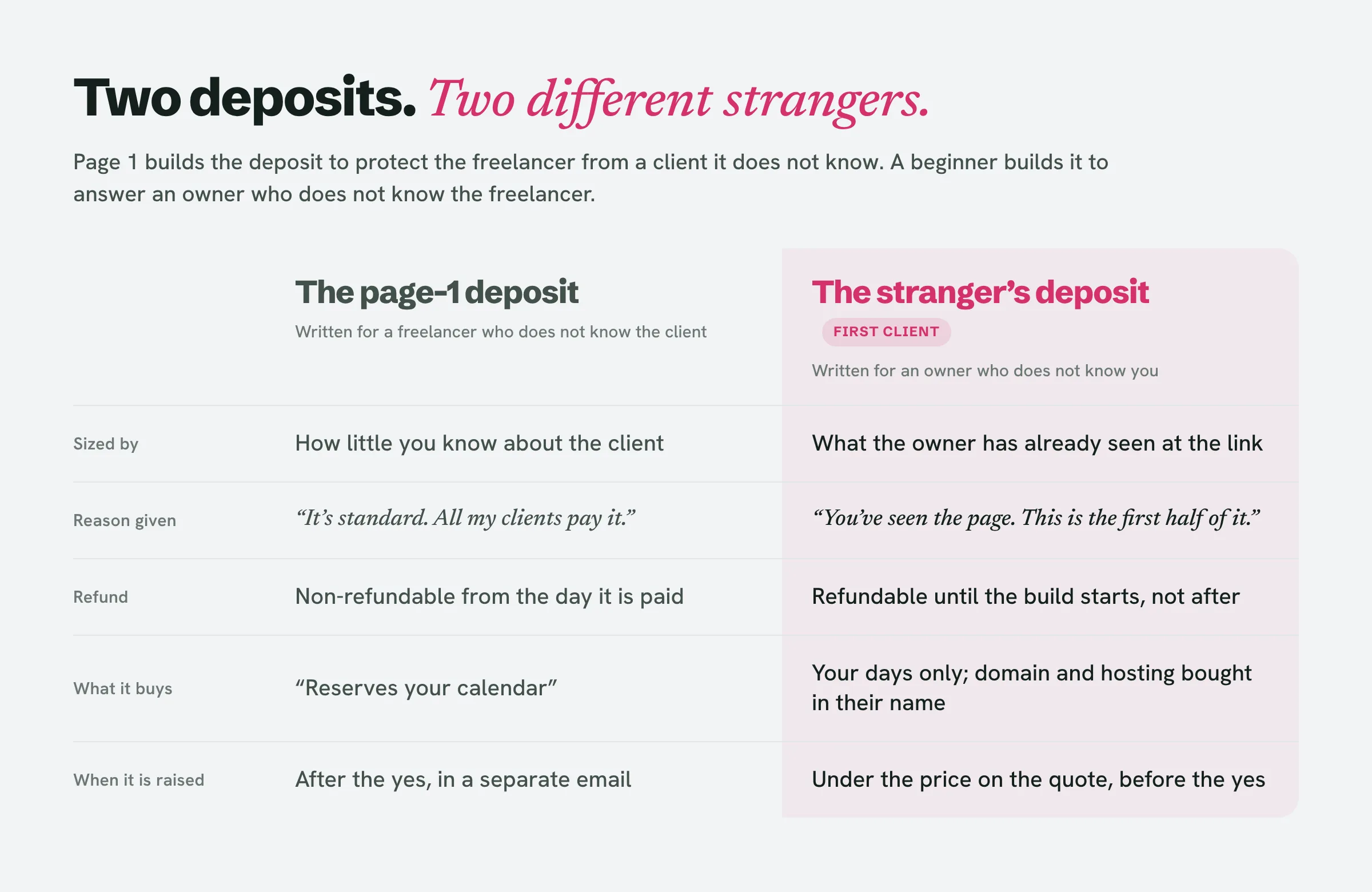
It is attached to the page they have seen. The proposal line says what the deposit is for in words the owner can verify by tapping the link: “Nothing was due until you had seen the page. You have, so the first half is due before I start on your version of it.” Eleven of the twelve pages say the deposit “reserves your calendar” or “covers initial setup”, which is true and unverifiable. Yours is the price of turning a prototype they have already judged into their live site.
It is refundable until the day the build starts, and not after. This is the opposite of Freelance Cake’s “non-refundable deposit” and Landolio’s clause, “non-refundable once work has begun”, and it costs you nothing, because before the build day you have spent nothing on this owner. The prototype was built on your own time to win the job. Once you start on their version, with their photos and their copy, the deposit covers days you cannot get back, and that is when it stops being refundable. Invoice Simple’s guide, the only one of the twelve that reads the law, notes that whether a kept deposit holds up depends on “your state, the contract wording, and whether the client is a consumer or a business”, and that “courts often look at whether the amount you keep reasonably matches your real costs.” A deposit that is refundable until you have real costs is the version of that rule a stranger can agree to.
Nothing bought with it is in your name. The domain is registered in the owner’s registrar account, or stays in the one they already have. The platform plan goes on the owner’s card at the platform, not on yours to be reinvoiced; our piece on what to build client sites on has the reasons and the prices. So the deposit buys one thing, your days, and the owner can be told so: “The $750 is for my time. Your domain and your hosting are paid by you, to them, in your name, and I’ll set both up with you so you hold the logins.” An owner who has been burned by a designer who owned the domain, and many have, hears that sentence before anything else.
The start is a condition, not a date. Work begins when four things are true, and the deposit is one of them. The others are below.
How to ask for a deposit politely: a sample for the proposal, the email and the phone
Page 1 is right about one thing and you should take it: raise the deposit before the yes, not after. Invoice Simple lists “asking after the client has said yes” as the common mistake; Ruul says to include the terms “in your initial proposal, before the conversation reaches contract stage”; Furrsati’s rule is “don’t ask for the deposit after you’ve started.” For you that means the deposit is a line in block four of the one-page proposal, directly under the price, so the owner’s yes is a yes to the deposit too. Three versions, for the three places it comes up.
How to ask for a deposit on a quote: under the price. Two sentences, no heading:
$1,500 for the page you saw at the link, put live on your domain. Half ($750) before I start, refundable in full until the day I begin; the other half when the site goes live. Your domain and hosting are paid by you, in your name; I’ll set them up with you.
How to ask for a deposit in an email, after the yes. This is the one most guides script, and theirs run to a page. Yours is the terms repeated plus a way to pay, because the owner has already agreed to them:
Thanks, Dan. As on the proposal: $750 now, $750 when the site goes live. The payment link is below; card is fine, and paying by card means you can dispute it with your bank if I vanish, which I won’t. I’ll start the day it clears and I have the photos and the domain login, and I’ll confirm the go-live date that morning.
[payment link]
Write that card sentence. A card payment gives the owner a reversal right that a bank transfer or a cheque does not, and saying so out loud is the cheapest trust you will ever buy; Furrsati’s guide mentions that a direct deposit “can be reversed or disputed” as a risk to the freelancer, which is exactly why it reassures the owner. Which processor to use, what it costs you and how the invoice is laid out is the invoicing piece, not this one.
On the phone, if they ask before they have read it. One sentence, and then stop talking: “Half to start, half when it’s live, and the first half is refundable until the day I begin.” If they want to know why, the reason is the page they have seen, not your policy.
What not to say, in any of the three: “it’s standard” or “all my clients” as the reason. You have no clients, and the owner may know it. The reason is always the thing they can check, which is the prototype and the refund line.
What to say to “can I pay when it’s done” and “I don’t know you”
You will hear one of two things, and they are different objections.
“Can I just pay the lot when it’s done?” This is the owner’s cash-flow question, and it is reasonable from someone who pays their suppliers on delivery. The reply is the test from the Creative Agency Book interview, stated as your own: “The first half is the only thing that tells me you’re going ahead. Without it I’m building on a maybe, and I’d be doing it instead of the next job.” Then offer what you can move: the date, not the amount. “If it’s easier, we start on the first of the month and you pay then.” Ruul’s guide suggests splitting a milestone off instead; for a two-week job there is nothing to split, and three payments on a $1,500 project is, in Creative Agency Book’s words, “more admin work than needed.” Two payments, and the second one on the day the site goes live, not on a date. Self-Made Web Designer’s schedule puts a 35 per cent payment “within 1 month” of the deposit regardless of progress, and Clio’s buyer guide lists exactly that pattern, a payment tied to a date rather than a deliverable, as a red flag owners should watch for.
“I don’t know you.” Nobody says it this plainly; it arrives as “let me think about it” or “can you send me some other sites you’ve done.” This is the objection none of the twelve pages answers, because their freelancer is the one with the track record. Your reply has three parts the owner can verify. The work: “The page at the link is the work; it’s yours, built for you, and it’s what you’d be paying for.” The refund: “If I don’t start, you get it back, in full.” The name: “Your domain and your hosting are in your name from day one, so nothing of yours sits with me.” If the owner wants other sites, our piece on building a portfolio out of prototypes for real local businesses is how to have two or three more pages like theirs to point at, and the one on a free first site in exchange for a testimonial is the case against giving this one away to avoid the deposit conversation.
If the answer is still no, the Freelance Cake and Toggle line is the right one: walk away. An owner who will not pay half after seeing the page will not pay all of it after seeing the site. The one exception page 1 allows is SumUp’s, for well-known large companies with a purchase-order process. A plumbing firm is not one.
Web design payment terms the owner can check: four things true before the first build day
The deposit is not the start. Eleven of the twelve pages have “work begins when the deposit clears” or something like it, and none of them connects the deposit to the thing that actually stalls a small website, which is the owner never sending the photos. Toggle, Landolio, Invoice Simple and Ruul all gate the start on money; Creative Agency Book’s Karen Carps gates it on “the signed contract, SOW, and deposit in full”; nobody gates it on the materials. Your proposal already named the three things the owner must send, and the timeline already counts from the day they arrive. The deposit joins that list, so the start is four conditions, and you build nothing until all four hold.
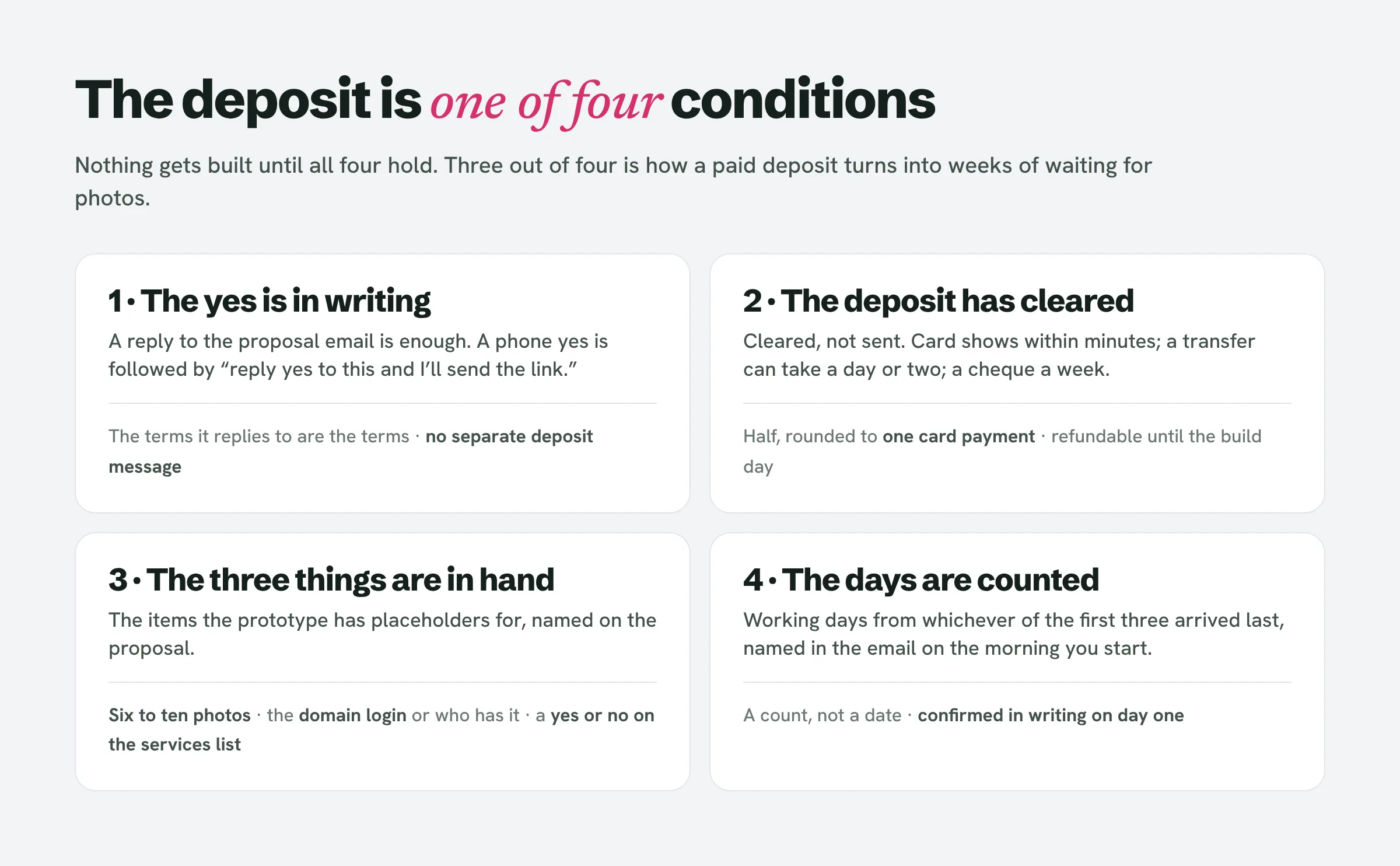
The yes is in writing. A reply to the proposal email is enough: “Reply yes and we start.” A verbal yes on the phone is followed by “I’ll send the proposal now; reply yes to it and I’ll send the payment link.” Whether the project needs a signed agreement on top of that is its own piece. If you are in New York, the Freelance Isn’t Free Act requires a written contract for freelance work worth $800 or more, so the reply-yes route needs the terms to be in the email it replies to.
The deposit has cleared. Cleared, not sent. A card payment through a processor shows as paid within minutes; a bank transfer can take a working day or two; a cheque is a week. Say “the day it clears” in the email so a Friday payment and a Monday start are the same thing to both of you.
The three things are in hand. Six to ten photos, the domain login or the name of who has it, and the yes or no on the services list. If the deposit is paid and the photos are not, the clock has not started and you say so, kindly, once: “Got the payment, thank you. As soon as the photos land I’ll start and give you the date.” SumUp’s guide makes the observation that explains why this works: “when a client has already put down money for your work, they’re likely to be more involved.” An owner who has paid sends photos. An owner who has not paid sends them when they get round to it.
The days are counted from the last of them. Eight working days from whichever of the above arrived last, said in the confirmation email on the morning you start. The proposal promised a count, not a date; this is where the count begins.
The deposit’s job in that list is not to protect you from a client who will not pay. You have seen the page, they have seen the page, and the test the twelve pages describe has already happened on their side when they replied yes. Its job is to be the thing that makes the other three happen in the same week.
People also ask
How do I ask a client for a deposit?
Put it under the price on the proposal, before they say yes, as two sentences: the amount, when it is due, and what happens to it if you do not start. Repeat the same two sentences in the email that carries the payment link. The ask is never a separate message, because a separate message makes it a negotiation.
What is a reasonable deposit percentage?
Half, for a website under about $3,000, with the other half on the day the site goes live. The pages owners read say 25 to 50 per cent is normal and that full payment up front is a scam signal, so stay inside the band and never ask for everything, however small the job.
Is it normal for contractors to ask for a deposit?
Yes, and the owner knows it, because they have paid one to a plumber, an electrician or a printer. The difference with a website is that the owner can be shown the work before paying; a contractor cannot. Use that.
How to request an upfront payment?
State the terms before the yes, send a payment link the day after it, let the owner pay by card so they hold a dispute right, and start on the day the payment clears and the materials are in. Do not start before any one of those.
How to politely ask to be paid?
For the deposit, by making it a condition of the start rather than a request after it. For the final half, by tying it to a day the owner is looking forward to, the go-live, rather than to a date on a calendar, and by saying on the proposal that this is how it works.
The deposit is the last thing you ask for before the work
Half, rounded, under the price, refundable until the morning you start, spent on nothing that is not in the owner’s name, and one of four conditions for the first build day. It is a short list because the hard part, the thing the owner is paying half for, already exists at a link, and because you found a business whose site was quietly losing it customers, found the owner’s name, built the prototype and ran the call before you ever mentioned money. LeadReef does the front of that list: it scans a city for local businesses with sites that fail the checks a customer hits, attaches the contacts it finds, generates a prototype redesign and deploys it at a link, and drafts the pitch for you to finish. The first 10 leads are free, from any of 10 business types in any of 10 locations, at leadreef.ai/find. When one of them replies yes, the deposit is two sentences you wrote before they did.