
Web Design Cold Call Script: Word-for-Word Openers, Voicemail and the Legal Check
A good web design cold call script is short enough to say in under 90 seconds, built on one specific problem you saw on the prospect's own website, and ends with a small ask such as permission to email a screenshot, never a request to buy. Before you dial, spend two minutes on the prospect's site, because what you find decides which of three openers you use and whether you should call at all.
Most guides hand you one generic script and a list of objections. This one does three things the top-ranking pages skip: it ties the opener to what you actually saw on the site, it gives you a voicemail script, and it covers the legal basics of cold calling businesses in the US and UK, so you know what you can dial.
What should a web design cold call script contain?
Every call that works for a freelancer selling websites has the same four beats, in this order:
- Who you are, in one breath. Your first name, that you build websites for local businesses, and nothing more.
- One observation. A fact about their site or its absence that they can check themselves in ten seconds.
- One consequence. What that costs them in terms they already care about: missed calls, lost bookings, customers who leave.
- One small ask. Permission to send a screenshot, a short email, or a 10-minute call. Not the sale.
Competitor guides agree on the shape. LeadRadar's framework runs Attention, Insight, Request and tells you never to ask for the sale on the first call (LeadRadar); Gonovu's version aims for under 90 seconds and cites a 5-10% positive response rate (Gonovu). Treat that rate as a vendor claim, not a promise. Track your own from the first day.
The 2-minute pre-call check that picks your opener
Generic scripts fail because the opener is generic. Open the prospect's site on your phone, not your laptop, and look at five things in this order:
- Does it exist? Search the business name plus the city. If the only results are Maps, Facebook and directories, it has no real site.
- Does it work on a phone? Pinch-zoom needed, text cut off, a tap-to-call button missing.
- Does it look like a different decade? Our guide to how to tell if a website is outdated lists the visible signs.
- Is there a way to act? A phone number you can tap, a booking link, a form that submits.
- Is it secure and fast? A browser warning, or a page that takes several seconds to show anything.
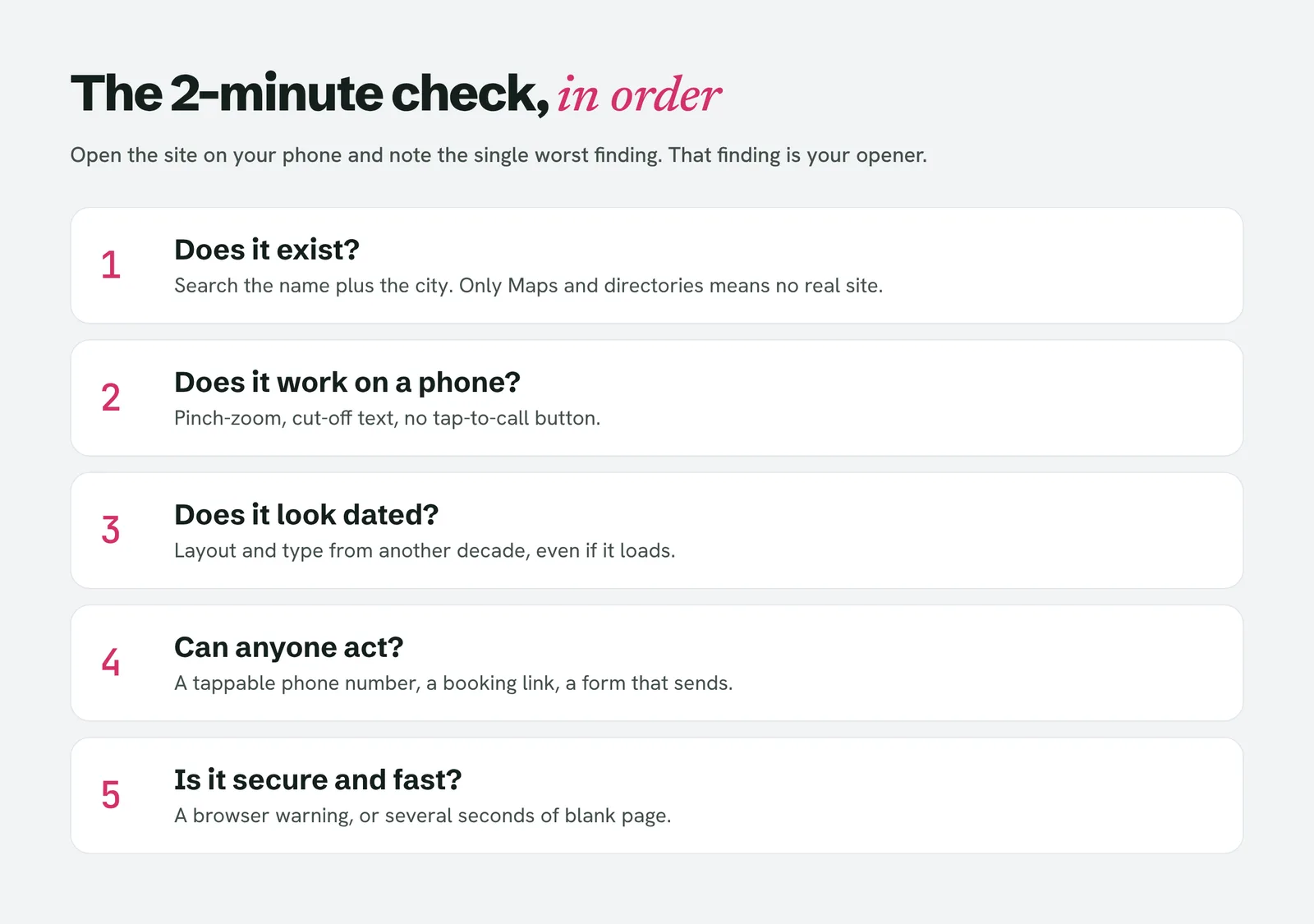
Write down the single worst finding. That one finding is your opener. If you want to skip the manual version for a whole list, LeadReef surfaces the specific problem for each local business it finds, so you start every call with something real.
Script 1: the business with no website
"Hi, is this Maria? My name is Sam. I build websites for local businesses and I will be quick. I searched for plumbers in Dayton and found your Google listing with 84 reviews, but no website. So when someone clicks, they land on a directory page with your competitors next to you. Would it be okay if I emailed you a one-page example of what yours could look like? You would not need to decide anything."
Why it works: the review count proves you looked at this specific business, the consequence is visible in the search result, and the ask costs nothing. Swap in the real number from their listing every time.
Script 2: the site that breaks on a phone
"Hi, is this Dev? I am Sam, a local web designer. I was looking at your salon's site on my phone this morning and the booking button sits underneath the footer, so I could not find it. Most of your customers probably look you up on a phone too. Can I send you a screenshot so you can see what I saw?"
The screenshot is the point. It turns your opinion into something they can verify, and it gives you a legitimate reason to send an email right after the call. Pair it with the sequence in our cold email follow-up template.
Script 3: the outdated site that still works
This is the hardest call, because the owner thinks the site is fine. Lead with something good, then name the gap:
"Hi, is this Priya? I am Sam, I design websites. Your dental practice has some of the best reviews in the area, and I wanted to say that first. The website does not say any of it: the design looks about ten years older than the practice does. I would like to show you a quick before-and-after. Do you have ten minutes on Thursday?"
How do you get past the gatekeeper?
Do not pitch the receptionist. Ask for the owner or manager by name, in a plain voice: "Is Maria available? It is Sam, calling about the website." If you do not have a name, find the owner of the business before you dial. If the owner is out, do not explain your pitch. Ask when is a good time to call back and what to call them, then write both down. A receptionist who gives you a time has just made your second call a warm one.
What should you say in a cold call voicemail?
Four of the six pages I read for this topic say nothing about voicemail. Here is the structure that fits in 20 seconds:
"Hi Maria, this is Sam, a local web designer. I looked at your plumbing business's website on my phone and found one thing that is costing you calls. I will email you a screenshot now. My number is 555-0142, that is 555-0142. Thanks."
Rules: say your number twice and slowly, name the finding but not the fix, and do send the email within the hour so the voicemail and the inbox tell the same story. Leave one voicemail per prospect, not one per attempt. Leave the message yourself in your own voice. Pre-recorded drops are a different legal category, covered below.
When should you email instead of calling?
Not every prospect should get a call. Use this rule:
- Call when you have a name or a direct line, the business is open, and your finding takes one sentence to say.
- Email first when the only number is a general line, the finding needs a screenshot to be understood, or the business is closed for the day.
- Do both for your best prospects: a short call, then the screenshot email within the hour.
If your calls keep stalling on the same pushback, the answers in our web design client objections guide cover "we already have a site", "how much is it" and "send me information".
Can you legally cold call businesses?
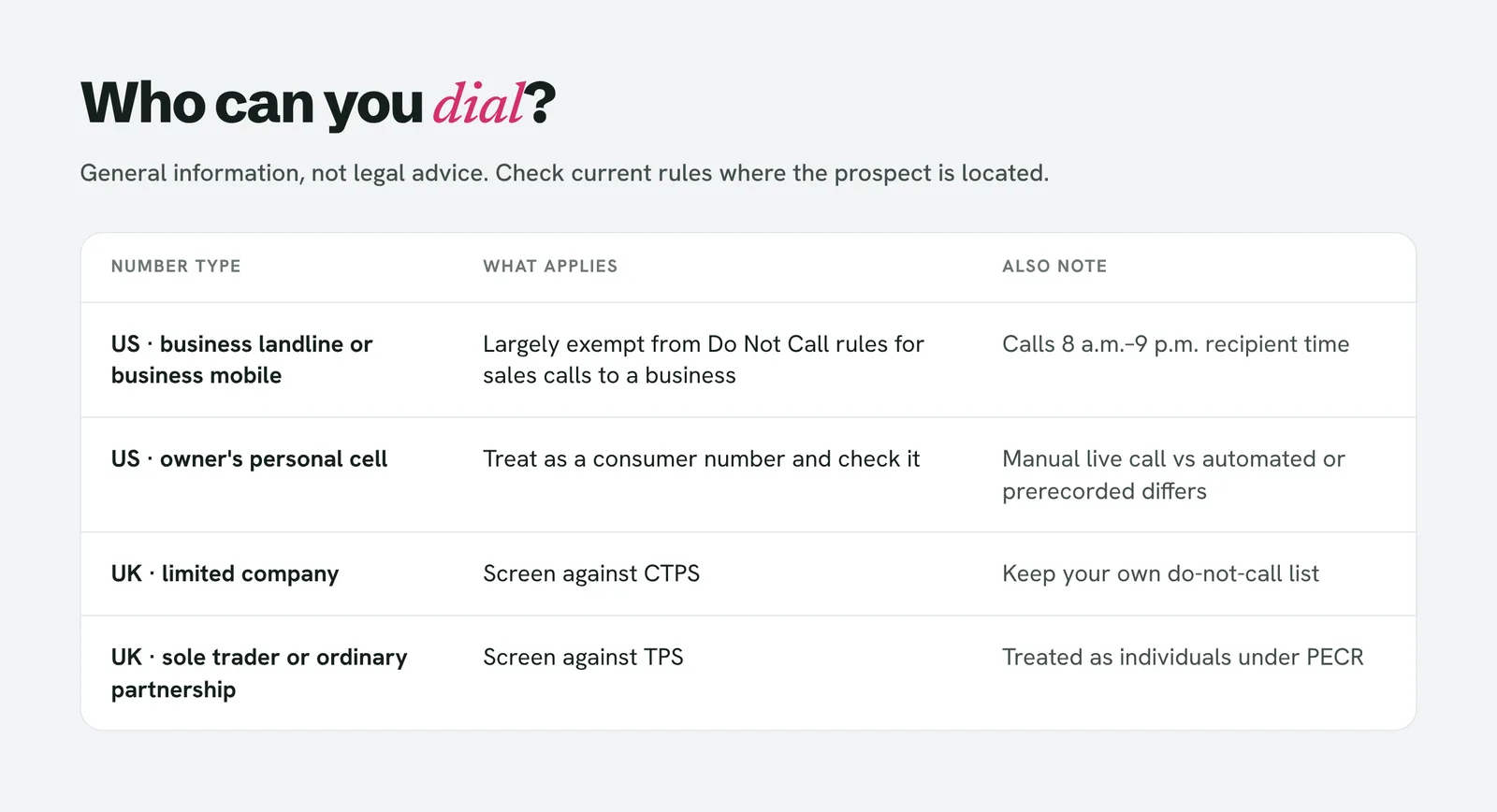
Generally yes, with limits that depend on where you and the prospect are. This is general information, not legal advice, and the rules change, so check the current text before you build a calling routine.
United States. The FTC's Telemarketing Sales Rule applies to most consumer calls, but calls to a business to induce it to buy goods or services are largely exempt from its Do Not Call provisions, with narrow exceptions such as certain office and cleaning supplies. See the FTC's 2024 rule amendment. The National Do Not Call Registry is for personal numbers (donotcall.gov), so a number a business uses for business is not what it covers. Still, the rule's calling window is 8 a.m. to 9 p.m. in the recipient's time zone, and some states add their own rules.
Three practical traps:
- Sole proprietors with a personal cell. Many local trades list the owner's mobile as the business number. If it is also a personal line, treat it as a consumer number and check it.
- Prerecorded or auto-dialed calls and ringless voicemail. US consent rules for cell phones are much stricter for automated and prerecorded calls than for a person dialing by hand. A voicemail you leave live is not the same thing as a bulk voicemail drop.
- Recording. Several states, including California, require every party's consent to record a call. Do not record unless you say so at the start.
United Kingdom. Under PECR, limited companies and other corporate bodies can register with the Corporate TPS (CTPS), while sole traders and most ordinary partnerships are treated as individuals and register with the TPS. A B2B list can therefore contain both kinds, and the ICO expects you to screen against both and keep your own do-not-call list. See the ICO's telephone marketing guidance.
Whatever the country, keep your own do-not-call list. If anyone says "do not call again", write the number down and never dial it. It costs nothing and it is the habit regulators look for first. For email rules, see is cold emailing illegal.
How many calls should you make, and what should you track?
Small, steady blocks beat heroic days. A sensible start is two blocks of ten calls on weekday mornings, when owners of service businesses are more likely to pick up. Gonovu suggests mid-morning Tuesday to Thursday, which is a hypothesis worth testing on your own list, not a law. Log four things for every dial, in a spreadsheet if you have to:
| Field | Why it matters |
|---|---|
| Business type | Shows which trades answer and which do not |
| The finding you opened with | Shows which opener earns replies |
| Outcome (no answer, gatekeeper, no, send info, meeting) | Gives you your real rates |
| Next action and date | Keeps the follow-up from slipping |
After 50 calls you will know more about your market than any guide can tell you.
People also ask
What is the best opening line for a cold call?
State your first name, what you do in six words, and one fact about their business: "I build websites for local businesses, and I noticed your booking button is hidden on a phone." A specific, checkable fact beats a question like "how are you today?" because it proves the call is not a mass dial.
Is B2B cold calling illegal?
Not in general. In the US, calls to businesses are largely outside the Do Not Call rules, though personal cell numbers, automated calls and state laws can still apply. In the UK, you must screen against the TPS and CTPS and honour objections. Check the rules where the prospect is located.
Does B2B cold calling work?
It can, especially for local service businesses where the owner answers the phone. Vendor guides quote success rates of 5-10%, but those are marketing claims. Log your own results over 50 calls before you decide.
What are some good scripts for cold calling?
Use one script per situation: no website, a site that breaks on a phone, and an outdated site that still works. Each opens with one fact you verified, names one consequence and asks for one small step, such as permission to send a screenshot.
Can you legally cold call businesses?
Usually yes. US business-to-business sales calls are largely exempt from the Do Not Call provisions, and UK calls are allowed unless the number is on the TPS or CTPS or the person has objected. Sole traders, mobile numbers and recorded or automated calls are where problems start.
Your first week
On day one, build a list of 30 local businesses in one trade and write the worst finding next to each name. On days two to four, make ten calls each morning, and send the screenshot email within the hour. On day five, count outcomes and rewrite your weakest opener. If you want the list and findings ready faster, LeadReef gives you the first 10 leads free with no card: pick from 10 business types and 10 cities on the find page, then see our pricing only if you outgrow the free tier.