
How Many Cold Emails to Get a Client? The Arithmetic for Freelancers Pitching Local Businesses
Whether fifty silent emails means something is wrong, or just that fifty is not many, depends on a number you can calculate before you send another word.
You've sent fifty careful emails to local businesses and nobody has answered. So you search how many cold emails to get a client, and page 1 gives you a range: 50 to 100 in one guide, 300 to 1,500 in another, "a few hundred" in a third. None of them tells you whether your fifty silent emails mean something is wrong, or just that fifty is not many.
This article answers both. First, how many people you need to email for one paid job, built step by step from published numbers so you can swap in your own. Then the part nobody on page 1 covers: at what point zero replies stops being bad luck and becomes a result.
Why cold email response rate figures disagree
Every number on page 1 comes from the same kind of source: sales teams sending software pitches from sending platforms, at thousands of emails a day. That's worth knowing for three reasons.
- Averages flatter you. Instantly's 2026 benchmark report puts the average reply rate at 3.43% across billions of emails. But reply rates are skewed: a few campaigns get 10% or more and pull the average up. Smartlead's sample of 850 million emails puts the middle sender at 0.74% of contacts — about one reply per 135 people. Most senders are closer to the median than the mean.
- Some count emails, some count people. A 3.43% rate "per email sent" and a 0.74% rate "per contact" are not measured the same way. If you send each business three emails, your per-email rate looks a third of your per-person rate. Count people.
- Nobody publishes local business numbers. None of the seven pages we read breaks out how plumbers, dentists or cafés respond compared with software buyers. The ratios below are the best published figures, not local ones. Your own tally will be better within a month.
Work back from one paid client: the cold email conversion rate, step by step
Don't start from emails. Start from the job and work backwards. Three ratios do all the work:
- Replies that are interested. Not every reply is a yes. One worked example uses about a third; other sources put it anywhere from 15% to 50%. Use one in three.
- Interested replies that become paying clients. Positive reply to client runs at 20–30%. Use one in four.
- Your reply rate — the number that changes most with how well you choose and write.
Multiply the first two: one paid client takes about four interested replies, or about twelve replies in total. That part barely moves. What moves is how many people you have to email to collect twelve replies.
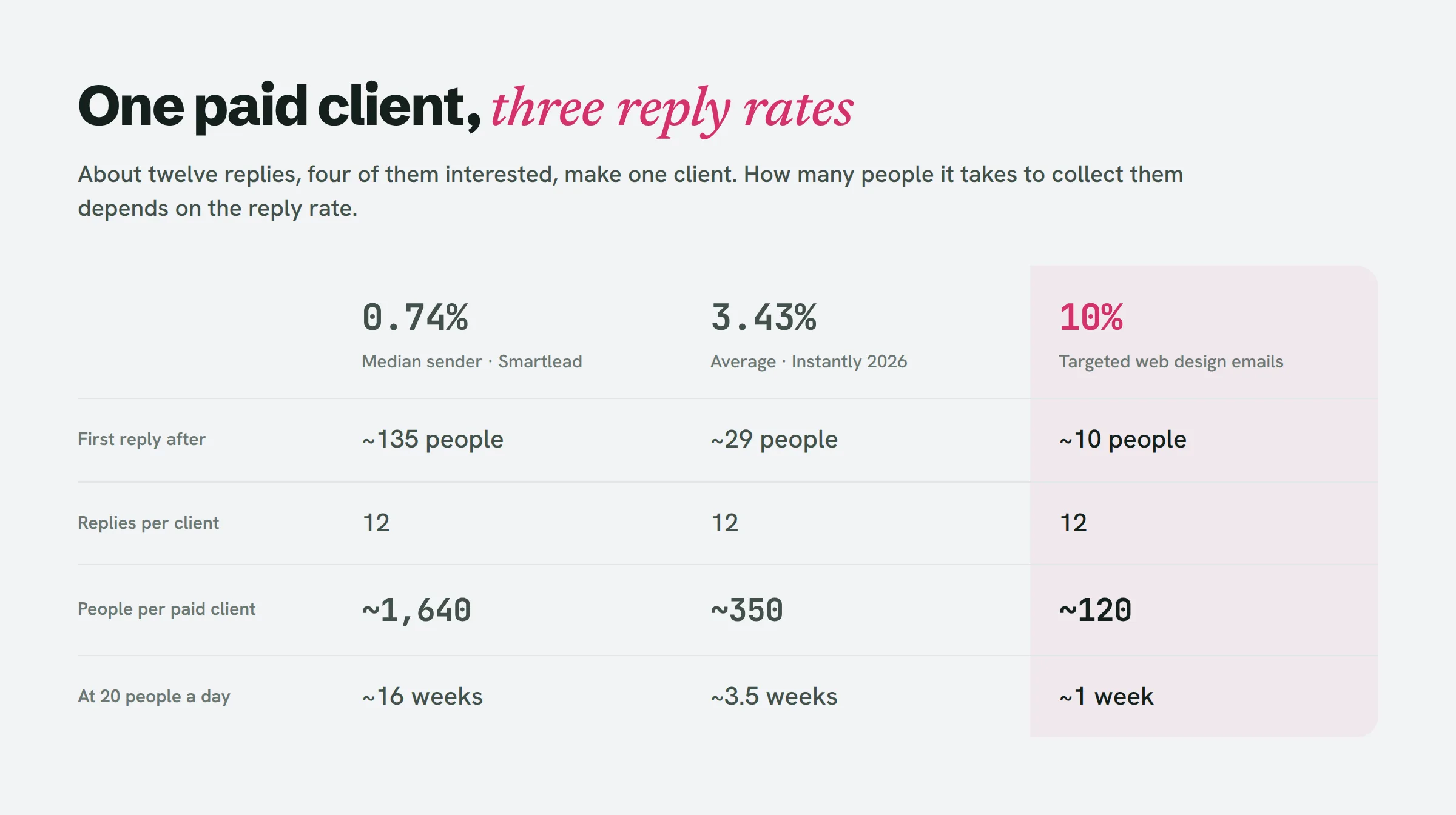
- At the median sender's 0.74%, twelve replies take about 1,600 people. That is where the "300 to 1,500" answer comes from, and at twenty careful emails a day it's four months of work for one job.
- At the 3.43% average, it's about 350 people. At twenty a day, a client every three to four weeks.
- At 10%, the middle of the 5–15% range for well-targeted web design emails, it's about 120 people. This is what the whole game is about.
That also answers the cold email conversion rate question. People quote 0.2% — one deal per 500 emails — which sits between the median and the average here. It's a result, not a target. You change it by changing the reply rate, and the reply rate is set before you write a word: by who is on the list.
How to get web design clients to reply: what moves the rate from 1% to 10%
Every page we read agrees on the direction, even if the numbers are loose. Emails that name something specific about the business get more replies than templates. Under 1% on a generic list against 5–15% on a targeted one is a consistent finding; 1–3% on average against 15–20% for emails that name a concrete gap is another.
For a web designer, the concrete gap is usually on the business's own website: it doesn't work on a phone, the booking link is broken, the opening hours contradict Google. A list of businesses where you can see a real problem, written to one at a time, is what moves you from the median column to the right-hand one. The sixty-second phone check from our guide on how to tell if a website is outdated is one way to build that list by hand. LeadReef does the same search automatically, flagging the site problems and attaching contacts for each business.
Follow-ups count too. One benchmark attributes 42% of all replies to emails after the first one. A person who got one email hasn't really been tested yet.
How many cold emails should I send before I judge the results?
Here's the question page 1 skips. You've emailed fifty businesses and got nothing. Is your campaign bad, or is fifty too few to tell?
You can work it out. If your true reply rate is p, the chance that n people all stay silent is (1 − p) to the power n. That gives this table:
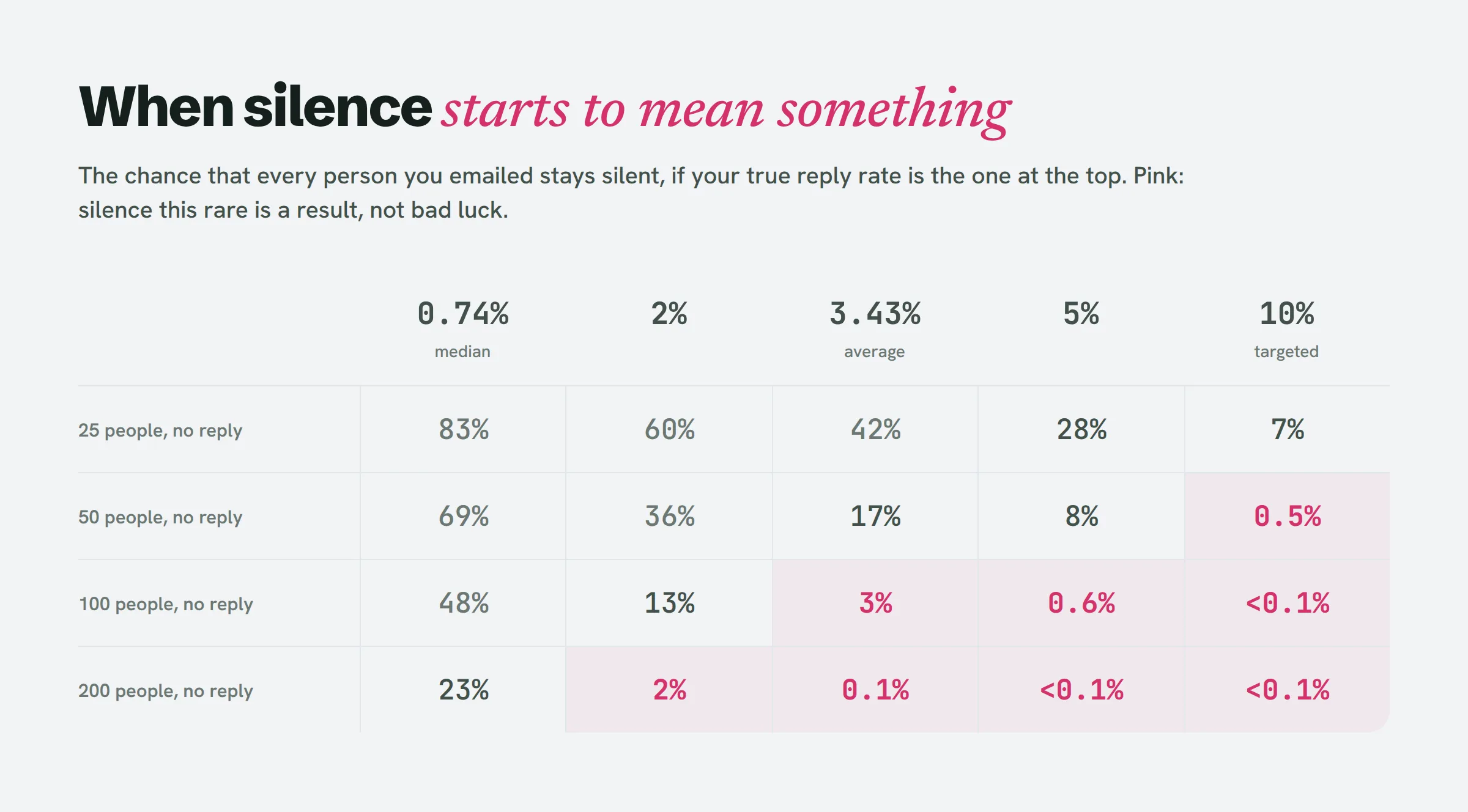
Read it like this:
- After 25 people with no reply, you've learned almost nothing. Even an average campaign stays silent that long four times in ten.
- After 50 — the number people usually worry about — silence happens 17% of the time to an average sender and 69% of the time to a median one. It's disappointing, not proof.
- After 100, a campaign that really gets 5% would stay silent less than 1% of the time. If you're aiming for that, silence at 100 means something needs to change.
- After 200, anything above 2% would almost never produce zero.
The rule of three
There's a shortcut statisticians use for exactly this. If something hasn't happened in n tries, its true rate is probably below 3 ÷ n — that's the 95% upper bound, and it's accurate enough from about 30 tries up.
- Zero replies from 50 people: your rate is probably under 6%. That still includes the 3.43% average. Keep going.
- Zero from 100: probably under 3%. You're below average.
- Zero from 150: probably under 2%. At that rate one client takes about 600 people. Change something now.
So the stopping rule is simple. Decide the reply rate you need to make the work pay — for most solo designers that's at least 5%. Divide 3 by it. That's how many people to email before judging: 60 people for a 5% target, 30 for 10%. If you reach it with zero replies, stop sending the same thing. Change the list first, then the opening line, not both at once.
One reply changes the picture too. A single reply from 60 people doesn't prove you're at 5%, but it does mean you aren't at zero. Keep counting until you have about ten replies before trusting your own rate to one decimal place.
Keep one tally, per person
For this to work, count carefully:
- One row per business, not per email. Follow-ups go in the same row.
- Mark the date of the first email and whether they replied, and how.
- Note which list and which opening line each person got, so a change can be traced to a result.
A spreadsheet with five columns is enough. What counts as a reply for a local business — from an out-of-office to a phone call the next day — is its own question. Decide your rule before you start and keep it the same.
People also ask
What is a good reply rate for cold emails?
Across B2B platform data, 3–5% is a normal well-run campaign and 10% or more is top tier. For a web designer writing to local businesses one at a time about a problem on their own site, 5–15% is the published range to aim for. Below 2% after 150 people, something is wrong.
Is cold email still effective in 2026?
Yes, but averages are falling. One Reddit thread on page 1 reports a drop from 8% to 3% over 18 months, and the benchmark reports show the same direction. Specific, hand-written emails to a well-chosen list are what still work.
How to get clients for web design?
Pick businesses with a visible problem on their website, email them one at a time about that problem, follow up, and track every person you contact. At a 10% reply rate, about 120 people should produce one paying client.
How do you get your first client?
Get the reply rate up before you scale the sending. Twenty people chosen well will tell you more than two hundred chosen badly, and the rule of three tells you when you've sent enough to judge.
The short version
One paid client takes about twelve replies, four of them interested. Whether that means 120 emails or 1,600 depends almost entirely on the reply rate, and the reply rate depends on the list. Count people, not emails, and don't judge silence until you've emailed 3 ÷ (your target rate) people.
If you'd rather start from a list of businesses that have something visibly wrong with their site, LeadReef gives you your first 10 leads completely free. Pick any of 10 business types and 10 locations, and each lead comes with its website problems flagged and contacts attached. Paid plans open up every business type worldwide, in any combination.