
How Many Businesses Are in My City, and How Many of Them Need a Website? Count It in an Afternoon
No published percentage tells you whether your own town can feed a one-person web studio. This piece counts it in three parts: a denominator from the Census, a rate from a twenty-listing sample per trade, and a conversion of the result into months of pitching. It takes an afternoon and it is specific to your city.
Type “how many businesses are in my city” into Google and you get an eleven-year-old Quora thread, a 2015 think-tank report and, at the top, an AI Overview that confidently sizes up a town you have never heard of. Type the question a designer actually means, how many of them need a website, and you get statistics pages that disagree with each other by a factor of four or more. None of that tells you whether the town you live in can feed a one-person web studio. This article gives you a way to count it yourself, with three parts: a denominator from the Census, a rate from a twenty-listing sample per trade, and a conversion of the result into months of pitching. It takes an afternoon and it is specific to your city, which no published percentage is.
How many small businesses don’t have a website? Page 1 can’t agree, and that is the point
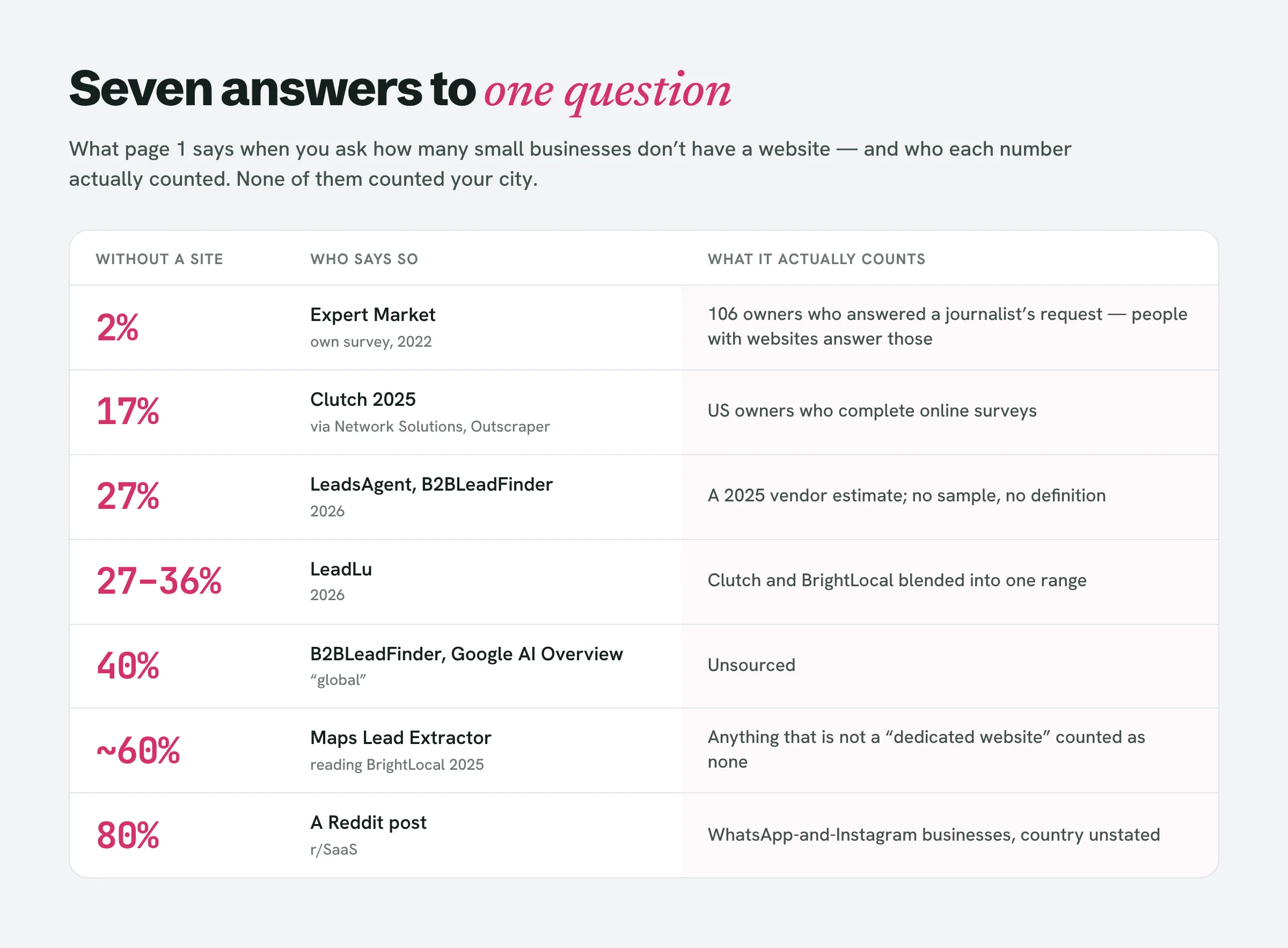
The same search returns eight pages and at least seven different answers. Clutch’s 2025 survey, as quoted by Network Solutions and Outscraper, says 17% of small businesses have no website. LeadsAgent says 27%, citing a 2025 Smart Soft Solutions figure; B2BLeadFinder says 27% for the US and 40% globally, citing “industry surveys”; LeadLu gives 27% to 36% from Clutch and BrightLocal together. Maps Lead Extractor reads BrightLocal’s 2025 report as “around 40% have a dedicated website” and concludes roughly 60% do not. A LinkedIn post says 45%, a Reddit thread says eight in ten, and Expert Market’s own 2022 survey found 98% of its 106 respondents had one.
| Published figure | Who says it | What it actually counts |
|---|---|---|
| 2% without | Expert Market, 2022 | 106 owners who answered a journalist's request — people with websites answer those |
| 17% without | Clutch 2025, via Network Solutions and Outscraper | US small-business owners who complete online surveys |
| 27% without | LeadsAgent, B2BLeadFinder, 2026 | a 2025 vendor estimate, no sample or definition given |
| 27–36% without | LeadLu, 2026 | Clutch and BrightLocal blended |
| 40% without | B2BLeadFinder, Google's AI Overview | “global”, unsourced |
| ~60% without | Maps Lead Extractor reading BrightLocal 2025 | counts anything that is not a “dedicated website” as none |
| 80% without | a Reddit post | WhatsApp-and-Instagram businesses, country unstated |
They disagree because they are not measuring the same thing. The population differs: an owner who fills in an online survey is already online, and the 33 million “small businesses” the SBA counts include every freelancer and side-hustler with no shopfront and no reason to want a site. The definition differs: some count a Facebook page as a web presence, some count only a domain the business owns, and most never say. And the publisher differs: a lead-finding tool is paid when the number looks big, a survey firm selling to owners is paid when it looks small. Not one of the eight pages explains any of this, and not one gives you a number for a city rather than a country.
So stop looking for the right percentage. Count.
County Business Patterns: the denominator for your city
The Census Bureau publishes two annual series that together count every business in your county by trade. County Business Patterns (CBP) covers establishments with paid employees, by NAICS industry code, for every county, ZIP code and metro area; the latest release is for 2023. Nonemployer Statistics (NES) covers businesses with no paid employees, by industry and county, latest 2024. For local trades the second series is not a footnote: a one-van plumber, a solo barber renting a chair, a landscaper with a trailer and a nephew paid in cash are all nonemployers, and they are exactly the businesses with the thinnest web presence.
The walk-through takes fifteen minutes on data.census.gov. Open the CBP table for your county, or the ZIP codes that make up your city if the county is much bigger than the town, and filter to the six-digit NAICS codes for the trades you would want to build for. Eight that cover most of a local designer’s market:
| Trade | NAICS |
|---|---|
| Plumbing, heating and air-conditioning contractors | 238220 |
| Electrical contractors | 238210 |
| Roofing contractors | 238160 |
| Landscaping services | 561730 |
| Beauty salons | 812112 |
| Barber shops | 812111 |
| General automotive repair | 811111 |
| Offices of dentists | 621210 |
Write down the establishment count for each. Where a cell is small the payroll figures may be withheld, but the count of establishments is the number you need and it is published. Then open NES for the same county and add the nonemployer count for the same industries; the detail is coarser at county level, so for a trade like plumbing you may only get the construction-trades group, and you will have to apportion it by eye. Rough is fine. You are not writing a thesis, you are deciding whether to spend the autumn pitching.
What you now hold is something no statistics page has: the number of plumbers, salons and dentists that exist in your county, from a count that includes the ones that have never been on Google Maps at all.
Why Google Maps can’t give you the count, but can give you the rate
The obvious shortcut is to search “plumber” and your city on Google Maps and count the pins. It does not work, and the reason matters for the next step. Maps shows you a slice of the trade, not the trade: the list ends after a few pages, and the vendors who scrape it for a living report that a single query tops out somewhere between about 200 and 500 results, biased towards the centre of the map, before it stops (OpenWeb Ninja, May 2026, which recommends tiling a city into small boxes to get a complete list). In a mid-sized county that slice is a fraction of the CBP figure, and it over-represents the businesses that have bothered to keep a listing current, which skews it towards the ones that already have a site.
So the roles are fixed. The Census gives you how many. Maps gives you what share of them, because a sample of twenty listings is a perfectly good way to estimate a rate even when it is a useless way to estimate a total.
The twenty-listing sample, by trade
If you have read the niche article on this site you know the bucket check; here it becomes a measurement. For each trade on your list, search it with your city on Maps, take the first twenty listings and press the website button on each. Record what happens:
- Nothing. No site at all.
- A brand page. A franchise or brokerage domain the owner does not control.
- A platform page. A booking or ordering service that owns the customer.
- Their own site, and it fails. Run the sixty-second phone check; two fails and it is in this bucket.
- Their own site, and it is fine.
Your addressable rate for the trade is the fourth bucket, plus the first bucket in a trade where customers compare quotes before they call. Divide by twenty. Twenty is a small sample and the honest reading of a result like 6 of 20 is “somewhere between a sixth and a half”; if a trade’s count is big enough that the difference changes your plan, do forty. The point of the sample is not precision, it is that the rate comes from your city’s listings instead of from a vendor’s blog.
Doing this for a whole city, every trade, every quarter, is a long afternoon. LeadReef runs that sweep across a city and flags the sites that are visibly losing their owners customers; the Census count and the arithmetic below are still yours to do.
The worked example: one county, eight trades
The numbers below are illustrative, not a real county, so the shape is clear. A county with a town of 60,000 at its centre might return these:
| Trade | CBP + NES count | Sample (of 20) in the addressable buckets | Addressable pool |
|---|---|---|---|
| Plumbing and HVAC | 140 | 7 | ~49 |
| Electrical | 110 | 6 | ~33 |
| Roofing | 50 | 8 | ~20 |
| Landscaping | 190 | 9 | ~86 |
| Beauty salons | 210 | 5 | ~53 |
| Barber shops | 60 | 3 | ~9 |
| Auto repair | 160 | 7 | ~56 |
| Dentists | 70 | 2 | ~7 |
| Total | 990 | ~313 |
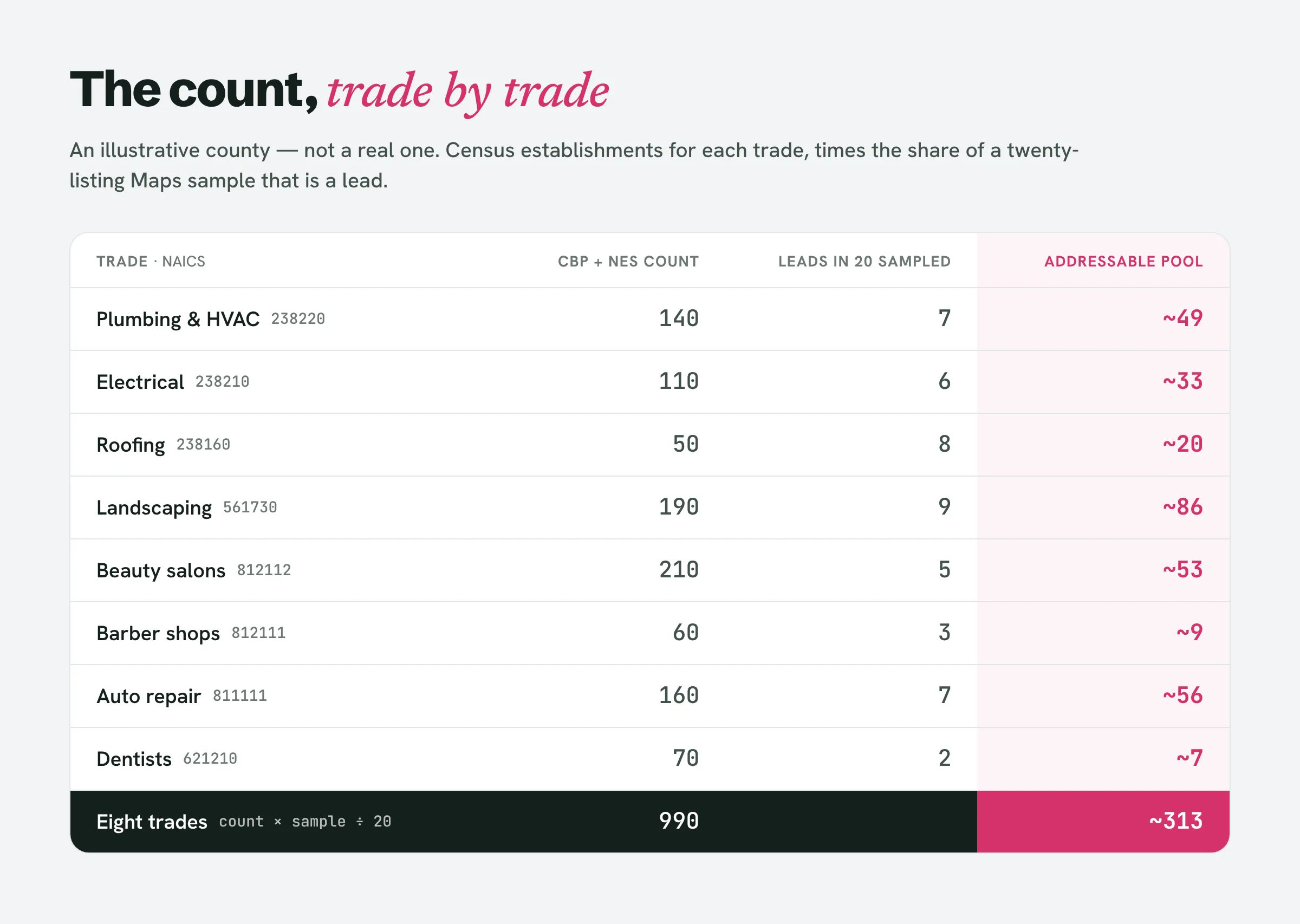
Two things fall out of the table that a national percentage would have hidden. The addressable pool is not 27% of anything; it is 32% here and it would be a different figure in the next county, because it is mostly landscaping, auto repair and salons rather than the trades the statistics pages lead with. And the dentists, who every “best niches for web design” listicle recommends, contribute seven leads, because they almost all have a site already and the ones that do not belong to a dental group.
Is web design in demand in a town this size? Convert the pool to months
The question “is my city big enough” is really “how long will this pool last me”, and that is arithmetic rather than opinion. From the cold-email piece on this site: one paid client takes about twelve replies, four of them interested, so the number of businesses you need to pitch per client is 12 divided by your reply rate. At a 3% reply rate that is 400 businesses per client; at 10%, 120.
Set that against the 313 in the example. At 3% the whole county buys you less than one client and you are done in a quarter. At 10% it buys you between two and three clients, and if you want one a month, you have run out of county by spring. Neither answer means the town is too small. It means the pool is set by two things you control, the number of trades on your list and your reply rate, and only one thing you do not, which is the Census count. Before deciding your city cannot support you, add four trades, which in the example roughly doubles the pool, or add the neighbouring county, or fix the reply rate, which moves the per-client figure by more than any city boundary can. A town of 20,000 with a 10% reply rate is a better market than a city of 200,000 at 1%.
The pool also refills: businesses open, change hands and let their sites rot every year, so the count you make this autumn is not the count next autumn. That is its own subject. For now, the number you were looking for is not a percentage. It is the row total in your own table, and it took an afternoon.
People also ask
How can I get a list of businesses in my area?
For the count, the Census: County Business Patterns for employer businesses and Nonemployer Statistics for the rest, both free, by county and industry. For a list with names and phone numbers, a Google Maps search per trade, which is incomplete but has what the Census does not, or a scraper or scanner that walks the map for you.
Which business does not have a website?
In the twenty-listing samples the empty bucket is largest in trades where the owner is also the workforce: landscaping, roofing, handyman and cleaning work, independent auto repair, barbers. It is nearly empty for dentists, lawyers and anything owned by a group or franchise, where the site exists but belongs to someone else.
Are web designers still in demand?
For local businesses, the demand is the addressable pool above, and it is non-zero in every county with a Census row. What has changed is the sale: the owner who has no site has usually decided not to have one, so the demand that converts is mostly the fourth bucket, the business whose site is quietly costing it calls.
How to find businesses that need new websites?
Count the trade from the Census, sample twenty listings on Maps, and keep the ones whose own site fails the phone check. Then pitch those, one trade at a time, so that your opening line can be specific.
Do small businesses need a website?
The ones whose customers search and compare before they call do, and the ones whose customers arrive through a booking app, a delivery platform or a franchise brand mostly do not. That is the same split as the sample buckets, which is why the sample is the right test.
Count once, then pitch
The number you wanted, how many businesses in your city need a website, is not on any statistics page, and the eight that rank for the question disagree with each other by a factor of forty because none of them counted a city. You can. The Census tells you how many plumbers, salons and garages your county has, including the ones Maps has never heard of; twenty listings per trade tell you what share of them are a lead; and the people-per-client arithmetic tells you how many months that is. If the answer is short, the fix is more trades or a better reply rate, not a bigger town.
LeadReef does the sweep part: it finds the local businesses whose site is losing them customers, builds a prototype redesign, deploys it and drafts the cold email. The first 10 leads are free, from 10 business types and 10 locations in any combination, so you can test one trade from your table before you commit an afternoon to the rest. Find your first client at leadreef.ai/find.