
Businesses That Need a Website vs. Businesses That Will Pay for One: Which Local Niches Actually Buy
This piece gives you a test instead of a list. Three questions you can answer about any local niche from your laptop, and a table of what the owners in the no-buy niches are already paying instead of a website, which is the thing that explains their “no”.
Search for businesses that need a website and you get lists. Fifty-seven of them, a hundred, a hundred and twenty: hair salons, barbers, nail technicians, restaurants, plumbers, churches, farms. The lists are not wrong. Almost every business would be better off with a decent site. But “would be better off” is not the question you are asking. You want to know which of those owners will pay you, this month, for a site you build. That is a much shorter list, and nothing on page 1 tells you how to draw it.
This piece gives you a test instead of a list. Three questions you can answer about any local niche from your laptop, and a table of what the owners in the no-buy niches are already paying instead of a website, which is the thing that explains their “no”.
Why the “need a website” lists don’t predict who buys
We read eleven of the pages Google ranks for this and the niche queries around it in October 2026: Truehost’s 100+ list, SiteSwan’s six, the dev.to and Progress Software niche posts, the Paige Brunton pricing survey, lead-tool blogs from LeadX, Webleadr, SiteSeeker, B2BLeadFinder and Origami, and Network Solutions’ statistics round-up. Nine are lists. Two, Webleadr and SiteSeeker, name niches to avoid, and SiteSeeker scores niches on market size, job value, search reliance and pitch fit, which is the most useful thing on the page. None of the eleven asks the question that decides the sale: does the customer’s path to this business run through a website at all?
Clutch’s August 2025 small business survey found 17% of small businesses still have no website, and that over a third of those say a website isn’t relevant to them; they rely on social media or marketplaces instead. That answer is usually read as denial. For a good share of these owners it is accurate. The customer finds them another way, and the owner knows it.
The same goes for the industry no-website rates that circulate on lead-tool blogs: cleaning 50 to 60%, trades 45 to 56%, salons 38 to 44%. None of them cite a source, so treat them as estimates. More to the point, a high no-website rate in a niche mixes two different groups: owners who are losing customers without a site, and owners who have never needed one. A list cannot separate them. The three questions below can.
The three-question test for whether a niche buys
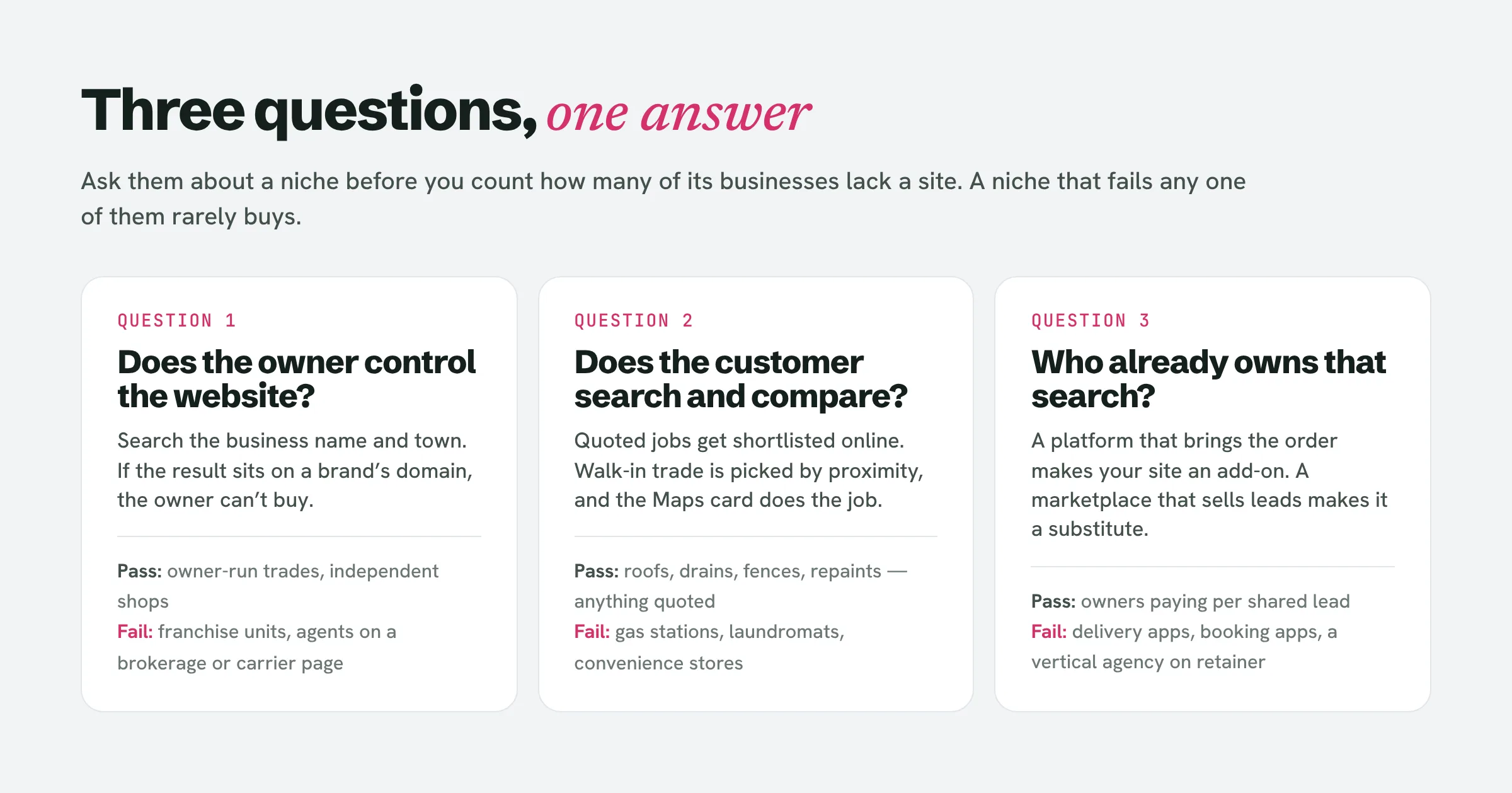
1. Does the owner control the website?
Standard franchise agreements say things like “Franchisee will not display the Proprietary Marks on or associate the System with any website without the express consent of Franchisor”, and forbid the franchisee from registering any domain that contains the brand’s marks. The person behind the counter at a franchised gym, cleaning brand or sandwich shop cannot buy a site from you, however bad the one they have is. The same is true of real estate agents on a brokerage-supplied page, insurance agents on the carrier’s site, and dealerships on the manufacturer’s template.
The check takes ten seconds: search the business name and town. If the result is brand.com/locations/your-town, the owner is not the decision-maker, and you move on.
2. Does the customer search, compare, and end up on a website?
Walk-in and location trade fails this question. A gas station, convenience store, laundromat, dry cleaner, car wash or neighbourhood bar is chosen by proximity. The Google Maps card does the whole job: hours, phone, directions. When one of these owners tells you a website isn’t relevant to their industry, they are right, and no volume of them lacking a site turns them into a market.
The opposite is anything quoted rather than priced. A roof, a drain, a fence, a tree, a kitchen, a repaint. The customer searches, shortlists three, and the website is where they decide who to call. These niches pass.
3. Does a platform already own the search, and does the owner love it or resent it?
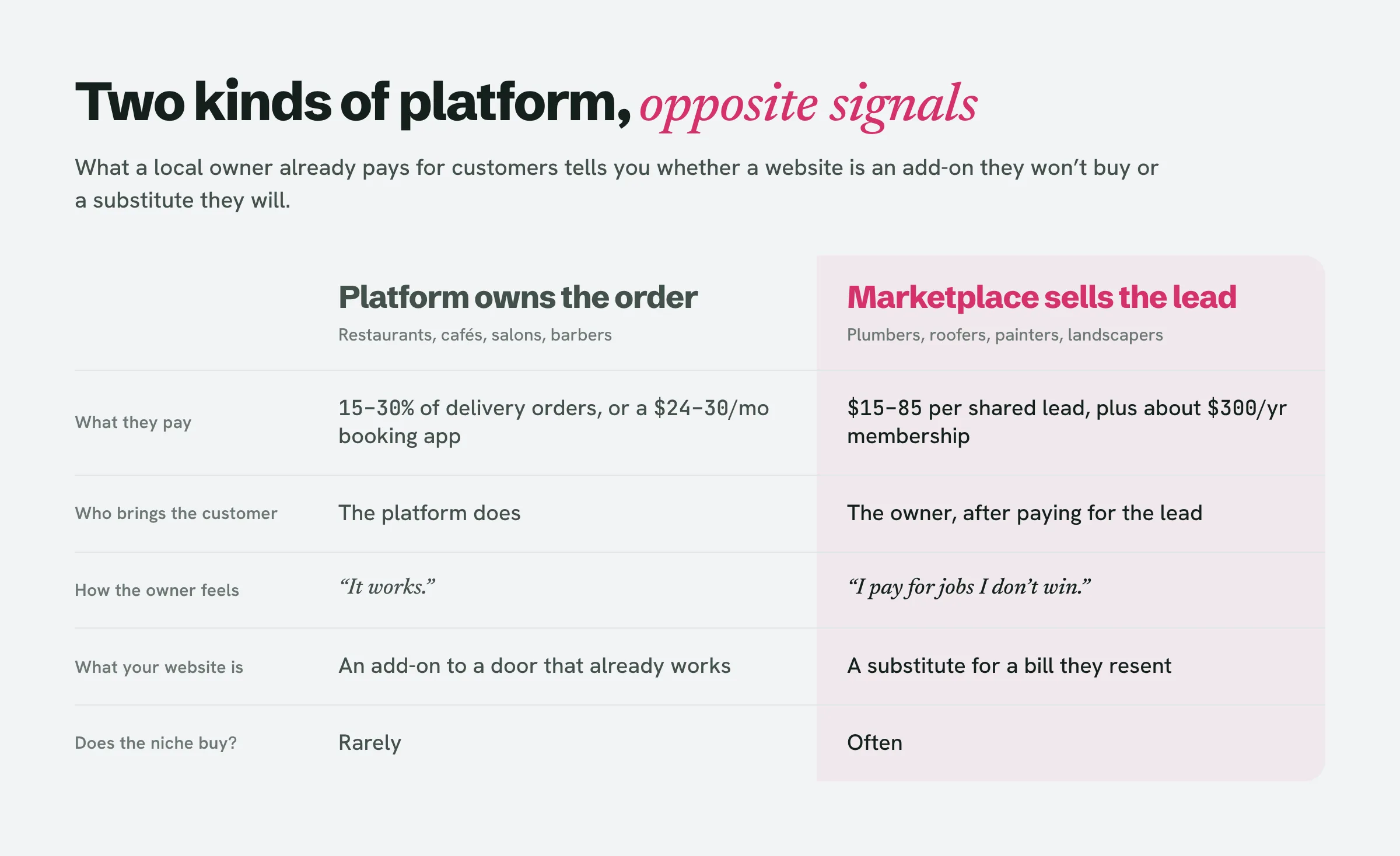
This is the question none of the eleven pages ask, and it splits the “need a website” list cleanly. There are two kinds of platform between a local business and its customers, and they send opposite signals.
Transaction platforms own the order. DoorDash’s merchant plans take 15%, 25% or 30% of each delivery order and 6% of pickup orders. Salons pay Booksy $29.99 a month plus $20 per extra staff member, or Vagaro from $23.99 a month on its introductory rate, and run the rest on Instagram. These are real costs, but the platform brings the demand, and a website does not replace it. The owner’s digital life is already working. A site is an add-on at best, and add-ons are hard to sell cold.
Lead marketplaces sell the owner their own customers. Angi charges contractors per lead, roughly $15 to $85 each according to Housecall Pro’s 2026 guide, on top of an annual membership of about $300, and the same lead is shared with several competitors, so the owner pays for jobs they don’t win. Nobody loves this bill. A website that brings the owner’s own calls is a direct substitute for a cost they already resent, and that is the strongest buying signal in local work.
There is a third case: niches that already bought. Dentists, lawyers, orthodontists and accountants mostly have sites, and the sites were built by agencies that do nothing but dental or legal marketing. Pitching here is a switching sale against an incumbent with a retainer, not a first-site sale, and a freelancer in their first year usually loses it.
Best web design niches, read through the test
Run the trades through the three questions and they pass all of them. Plumbers, roofers, electricians, HVAC contractors, landscapers, painters, cleaning companies, handymen and auto repair shops are owner-run, their jobs are quoted, their customers search and compare, and a large share of them are paying a lead marketplace per shared lead. This is the list SiteSeeker, Webleadr and LeadX converge on, and now you know why it keeps coming up, and what the first line of your pitch is: the number they are already paying for a lead they have to fight four other companies for.
The test also catches the exceptions inside a good niche. A roofer who is a franchise unit fails question one. A plumber whose Maps card links to a national brand’s booking page fails question three. Both will show up on any “no website” or “bad website” list, and both are dead leads.
Industries that need websites but rarely buy them
Here is the no-buy side of the usual lists, with the thing each owner is already paying for instead of a website. That cost is why the pitch doesn’t land, and it is checkable before you send anything.
| Business type | What the owner pays instead | Why your site doesn’t replace it |
|---|---|---|
| Restaurants and cafés | Delivery commission (DoorDash 15–30% of delivery orders), Google menu, review sites | The platform brings the orders; a site adds a menu they already have elsewhere |
| Salons, barbers, nail studios | Booking app subscription ($23.99–$29.99/mo plus per-staff fees), Instagram | Bookings already flow; the site would be a front door to a door that already works |
| Franchise units | A brand-controlled page on the franchisor's domain | The owner is contractually unable to buy |
| Agents under a brokerage or carrier | A supplied agent page on the brokerage or carrier site | Same: not theirs to replace |
| Walk-in and location trade (gas, laundromat, convenience, dry cleaner) | Nothing beyond the Maps card | The customer never searches past proximity |
| Dentists, lawyers, accountants | A vertical agency on retainer | It's a switching sale against an incumbent, not a first site |
Small businesses that need websites and will pay: the four-line version
A local niche buys a website when all four of these are true. The owner decides, with no brand or brokerage above them. The customer searches and compares before choosing. The job is quoted, not priced off a board. And the owner currently gets customers either from nowhere in particular or from a per-lead bill they would happily stop paying. Four of four and the niche buys. Three of four, and you will close some. Two or fewer, walk away, however long the “businesses that need a website” list says that niche is.
How to find businesses that need a website, and check the niche instead of the list
You can run the test on a niche in your own town in twenty minutes. Open Google Maps, search a trade and your town, and take the first twenty listings. For each one, press the website button and note which of four things happens. Nothing, because there is no site. A page on a brand’s domain, which is a franchise or a brokerage. A booking or ordering page, which is a platform that owns the demand. Or a real site that belongs to the business and is visibly poor. Only the fourth bucket, and the empty bucket in a quoted trade, is a lead. Compare niches by how many of their twenty land there, not by how many lack a site.
Doing that across a city and every trade is slow. LeadReef runs the sweep and flags the sites that are losing their owners customers; the ownership and platform checks above are still yours to make before you pitch. For a deeper look at sourcing, how to find local businesses without a website walks through the full approach, and tools to find local businesses to pitch compares the options side by side.
People also ask
Which type of business needs a website?
Any business whose customer searches and compares before buying: quoted trades, home services, owner-run clinics, independent professionals. Businesses chosen by proximity need a Maps listing more than a site.
How to find businesses that want a website?
Wanting is different from needing. The owners most likely to want one are paying a lead marketplace per shared lead, or have a site they bought once that is now failing them. Owners who have never had a site and run a walk-in trade are the hardest sell.
How to find clients who need a website?
Search a trade and your town on Google Maps, open the first twenty listings, and sort them by what the website button does: nothing, a brand page, a booking page, or a poor site of their own. The last group is your client list.
Is web design still worth it in 2026?
For local quoted trades, yes. The owner's alternative is paying $15 to $85 per shared lead indefinitely, and a site they own is cheaper within a year. For niches where a platform owns the order, the honest answer is often no.
The list is not the market
Every “businesses that need a website” list is a list of businesses that would benefit from one. The ones that will pay you are a subset, and the three questions — who controls the site, whether the customer searches, and who owns that search — draw the line more reliably than any no-website percentage. Pick a niche that passes all three, and the pitch writes itself around a bill the owner already resents.
Finding those businesses in your city, with sites bad enough to be worth replacing, is the slow part. LeadReef finds them, builds the prototype and drafts the pitch, and your first 10 leads are free, from 10 business types and 10 locations you choose. Find your first client at leadreef.ai/find.